
Analysis of the Largest Credit Unions: Strategic Insights for 2025
Brian's Banking Blog
The term 'largest credit unions' often evokes a simple ranking by asset size. For bank executives and directors, however, the real value lies in deconstructing how these institutions achieved scale and what their current strategies signal for the broader market. This analysis moves beyond surface-level metrics to dissect the operational models, member acquisition funnels, and digital footprints of the industry's leaders. We will examine the distinct competitive advantages that define each of the largest credit unions, from Navy Federal’s unparalleled niche dominance to Alliant’s digital-first approach.
The critical takeaway is not just who is biggest, but why they succeed and how your institution can leverage similar data-driven principles to inform its own growth, risk management, and talent strategies. Understanding their performance in key areas like loan growth, efficiency ratios, and member value provides a direct competitive benchmark. For example, analyzing a leader's loan origination mix against local market demographics can reveal untapped opportunities for your own institution.
This article provides a strategic roadmap for any financial institution aiming to compete effectively. We will detail the platforms and tools, including direct links and screenshots, that enable a deeper, data-backed analysis of these industry titans.
1. Navy Federal Credit Union: Dominating a Niche Through Unwavering Focus
Holding its position as the largest credit union in the United States, Navy Federal Credit Union (NFCU) is a testament to the power of precise market segmentation. With a colossal asset base reported at $191.8 billion and a membership of 14.9 million as of mid-2025, its scale is unmatched. NFCU’s success isn’t just about size; it’s a direct result of its unwavering commitment to a specific, well-defined community: the military, Department of Defense personnel, and their families. This exclusive focus allows NFCU to build a brand fortified by deep trust and highly specialized services.
Core Strategy and Member Experience
NFCU’s entire operational model is engineered around the unique financial lifecycle of its members. They understand the financial nuances of military life, from the initial enlistment bonus and the need for savings tools during deployment to securing VA loans and planning for post-service retirement. This deep member intelligence informs their entire product suite.
- Product Offerings: NFCU provides a comprehensive set of financial products, including checking, savings, CDs, and a range of credit cards. They also offer competitive auto, mortgage, and personal loans tailored to their members' circumstances.
- Accessibility: The credit union ensures accessibility through a robust digital platform, offering online account opening and 24/7 support. Physically, its 371 branches are strategically located near military installations worldwide, supplemented by a network of over 30,000 fee-free ATMs.
- Membership Requirements: Access is strictly limited to active duty or retired members of the armed forces, veterans, DoD employees, and their eligible family and household members. A low $5 deposit into a Membership Share Savings account is all that is required to establish membership.
Actionable Takeaway: Define and own a defensible niche. Use granular market and demographic data to build a product suite and service model that is precisely aligned with a target segment's financial journey. This creates a competitive moat that is difficult for generalized competitors to penetrate.
Data-Driven Niche Domination
For banking executives, NFCU’s model offers a powerful lesson. Its growth is a direct result of leveraging deep member intelligence to create unparalleled value. A community bank can replicate this strategy by identifying its own core customer segment. Using a platform like Visbanking's Prospect module, you can analyze your market to identify concentrations of specific professions or businesses, such as a high density of healthcare professionals or logistics companies. The next step is modeling product development and marketing around their specific needs, just as NFCU has for the military community. For more information, you can explore this detailed list of credit unions in the United States to see how others compare.
2. State Employees’ Credit Union (SECU): A Hyper-Local Community Banking Powerhouse
As the second-largest credit union in the United States, State Employees’ Credit Union (SECU) of North Carolina exemplifies the strength of a deeply entrenched, state-focused model. With a formidable asset base of $53.1 billion and serving 2.8 million members as of mid-2025, SECU demonstrates that regional concentration can build an institution with national-level scale. Its success is rooted in an unwavering commitment to a single philosophy: "Do the Right Thing" for its specific member base of North Carolina state employees and their families.
Core Strategy and Member Experience
SECU's entire business model is a masterclass in serving a defined geographic and professional community. By limiting its field of membership to those with a direct connection to North Carolina, it cultivates a powerful sense of local ownership and trust. This hyper-local focus enables the credit union to develop products and services that directly address the financial realities of its members, from Raleigh to the Outer Banks.
- Product Offerings: SECU provides a full suite of essential financial services, including its popular CashPoints Global (CPG) checking accounts, savings, CDs, and a straightforward credit card program. It is particularly well-regarded for its mortgage, auto, and personal loan offerings, which often feature member-friendly terms.
- Accessibility: The credit union boasts an impressive physical presence with 275 branches across all 100 North Carolina counties, ensuring no member is far from in-person service. This is complemented by a vast network of over 1,100 proprietary CashPoints ATMs, creating one of the largest fee-free ATM networks in the state.
- Membership Requirements: Eligibility is strictly limited to employees of the State of North Carolina, public boards of education, associations of state employees, and certain family members. A nominal $25 deposit into a Membership Share Savings account is required to join.
Actionable Takeaway: Dominate a specific geography by building an operational footprint and product suite that is inextricably linked to the local economy and community. A deep local presence creates a significant competitive advantage over national banks and digital-only competitors who lack tangible community ties.
Data-Driven Geographic Saturation
For banking executives, SECU’s model provides a compelling case for the power of geographic saturation. Its growth isn't from national expansion but from deepening its penetration within a single state. Financial institutions can replicate this by using data to identify and super-serve a core geographic market. A platform like Visbanking's Market Analyzer can reveal demographic and economic trends within your institution's footprint, highlighting opportunities to tailor loan products to local industries or launch marketing campaigns that resonate with community values. The goal is to become the default financial institution for a specific region, just as SECU has in North Carolina. To see how other institutions compare, you can review this comprehensive list of credit unions in the United States for further benchmarking.
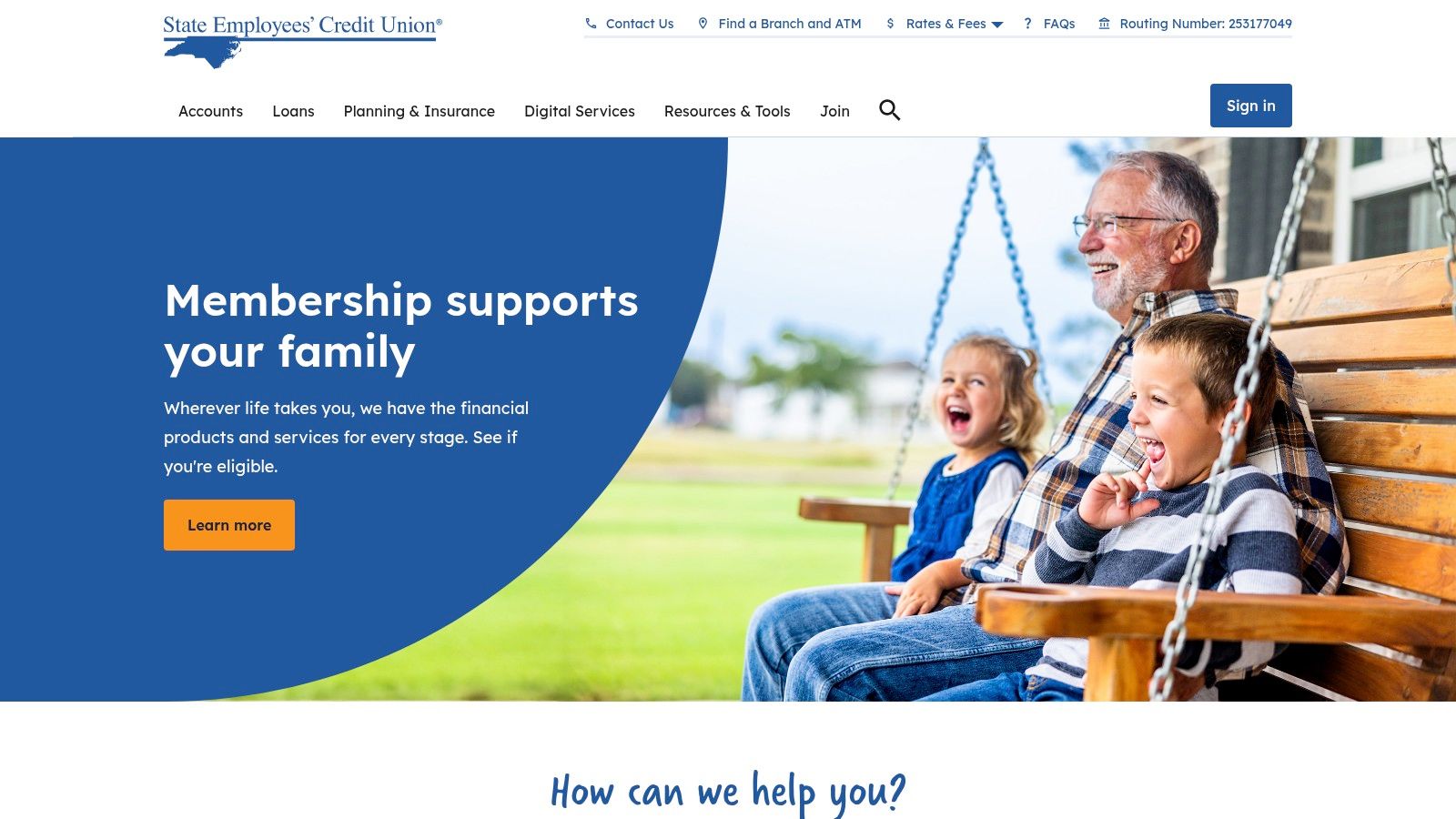
3. State Employees' Credit Union (SECU - NC): A State-Focused Model of Member Value
State Employees' Credit Union (SECU) of North Carolina showcases a powerful, geographically-concentrated membership model, making it one of the largest credit unions in the nation. With an asset base of $53.3 billion and serving 2.8 million members as of mid-2025, its scale is built on a hyper-focused mission: serving North Carolina's public sector employees and their families. This deep-rooted community bond allows SECU to operate with a unique member-first philosophy, prioritizing low fees and financial education over profit maximization.
Core Strategy and Member Experience
SECU's strategy is centered on providing tangible financial value back to its defined member base. By limiting its field of membership to those connected with North Carolina's public service, it fosters a strong sense of shared purpose and trust. This approach directly influences its product design and fee structure, which are notably simpler and more member-friendly than those of many large financial institutions.
- Product Offerings: The credit union provides a full suite of essential financial products, including checking and savings accounts, CDs, and various loan types like mortgages, auto, and personal loans. Its offerings are straightforward and designed for accessibility.
- Accessibility: SECU maintains a significant physical presence with 275 branches across North Carolina, complemented by a large network of "CashPoints" ATMs. While its digital services are robust, the emphasis remains on a strong, community-based branch network.
- Membership Requirements: Eligibility is exclusive to employees of the State of North Carolina, public boards of education, and certain associations, along with their immediate family and household members. Membership is established with a minimum $25 deposit into a Share Account.
Actionable Takeaway: Cultivate deep loyalty through a transparent, low-fee operating model within a defined geographic or professional community. A "give-back" philosophy, where value is returned to members through minimal fees and competitive rates, can create a powerful competitive advantage and insulate an institution from price-based competition.
Data-Driven Community Focus
For financial leaders, SECU’s success demonstrates that regional dominance is a viable alternative to national expansion. Instead of diversifying geographically, SECU has doubled down on its core market. A community bank can use this playbook by analyzing its own local market data to identify underserved, high-affinity groups. By leveraging a tool like Visbanking to map concentrations of municipal employees, educators, or healthcare workers within its footprint, an institution can create a highly tailored value proposition. This might include specialized loan programs for public servants or financial wellness workshops for local educators, mirroring SECU's strategy of building a loyal member base by serving its community first.
4. PenFed Credit Union (Pentagon Federal): Achieving Scale Through Broad Accessibility
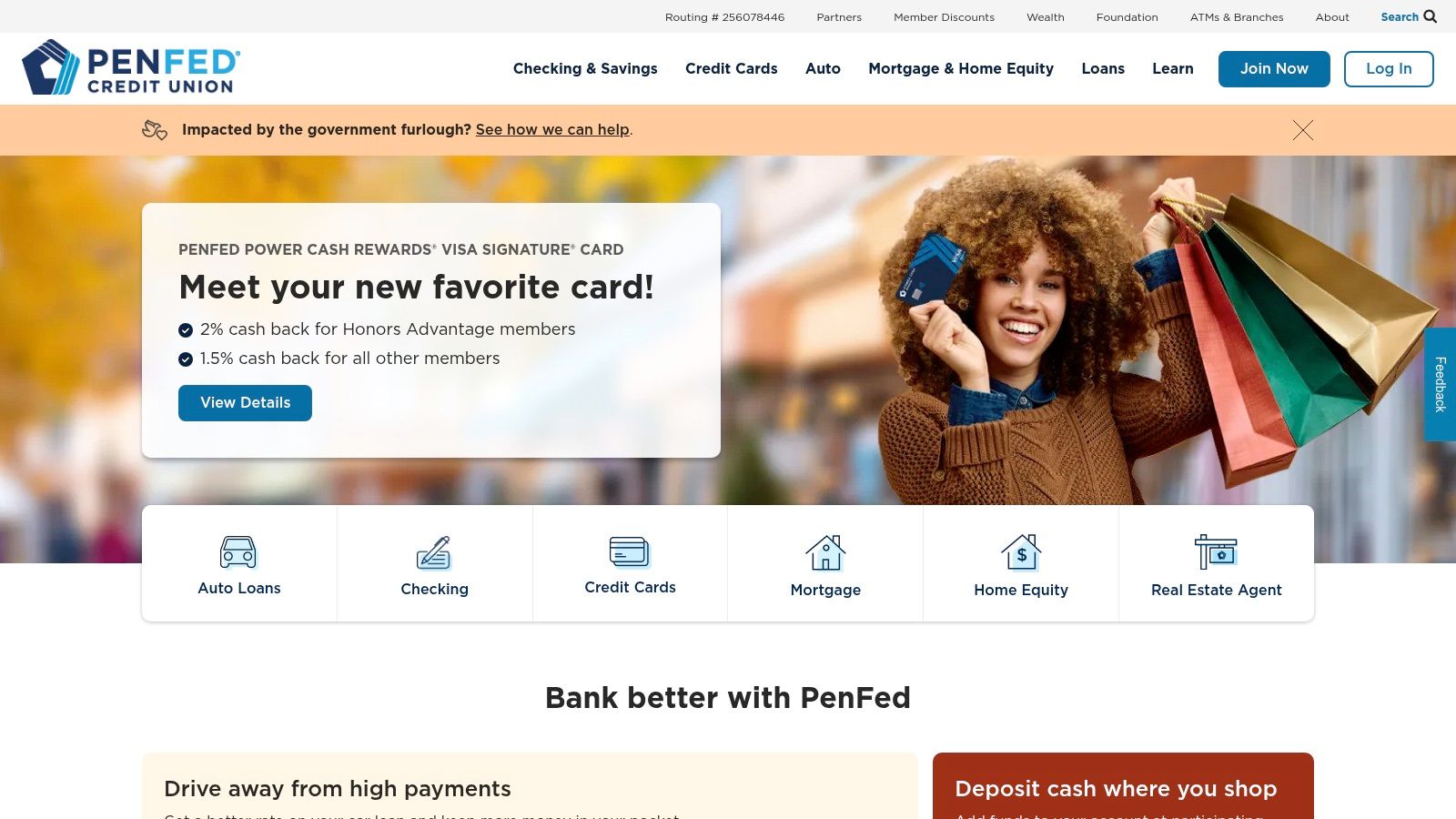
PenFed Credit Union, one of the largest credit unions in the nation, demonstrates how a federal charter can evolve from a narrow focus to achieve national scale. Initially serving the Pentagon, PenFed has masterfully expanded its field of membership, effectively opening its doors to the general public. With assets of $35.3 billion and over 2.9 million members, its growth strategy is a case study in balancing a legacy identity with a modern, inclusive market approach.
Core Strategy and Member Experience
PenFed’s model pivots from niche exclusivity to mainstream appeal by making membership acquisition as frictionless as possible. It leverages strong national product offerings, particularly in consumer lending, to attract a broad audience and integrates the membership process directly into its digital application funnels. This strategy successfully competes with national banks by offering credit union value with near-universal access.
- Product Offerings: The credit union is a major player in the consumer lending space, offering highly competitive auto loans, personal loans, mortgages, and a suite of popular credit cards. Its deposit products, including high-yield savings and CDs, are also designed to attract funds nationally.
- Accessibility: PenFed is a digitally-focused institution. Its website facilitates seamless online applications where prospective members can join and apply for a product in a single, streamlined workflow. While its physical branch network is limited compared to commercial giants, its digital platform ensures nationwide reach.
- Membership Requirements: While its roots are military and governmental, PenFed’s field of membership is now exceptionally broad. Most individuals can join by making a simple $5 deposit into a share savings account, effectively removing barriers to entry and enabling a growth-oriented, national marketing strategy.
Actionable Takeaway: Broaden your market by minimizing friction in the onboarding process. A streamlined digital application that combines membership establishment with product origination can convert prospects at a higher rate, transforming a potential barrier into a seamless part of the customer journey.
Data-Driven Market Expansion
For bank executives, PenFed’s trajectory provides a blueprint for expanding a charter's reach. The key is identifying and marketing high-demand products to a national audience while ensuring the digital experience can support that scale. By using a platform like Visbanking, a bank can analyze national lending trends and benchmark its product rates against competitors like PenFed to identify opportunities. For instance, if data shows your institution’s auto loan rates are in the top quartile nationally, a targeted digital campaign combined with a simplified online application could be modeled after PenFed's successful expansion strategy.
5. Alliant Credit Union: Scaling Nationwide with a Digital-First Model
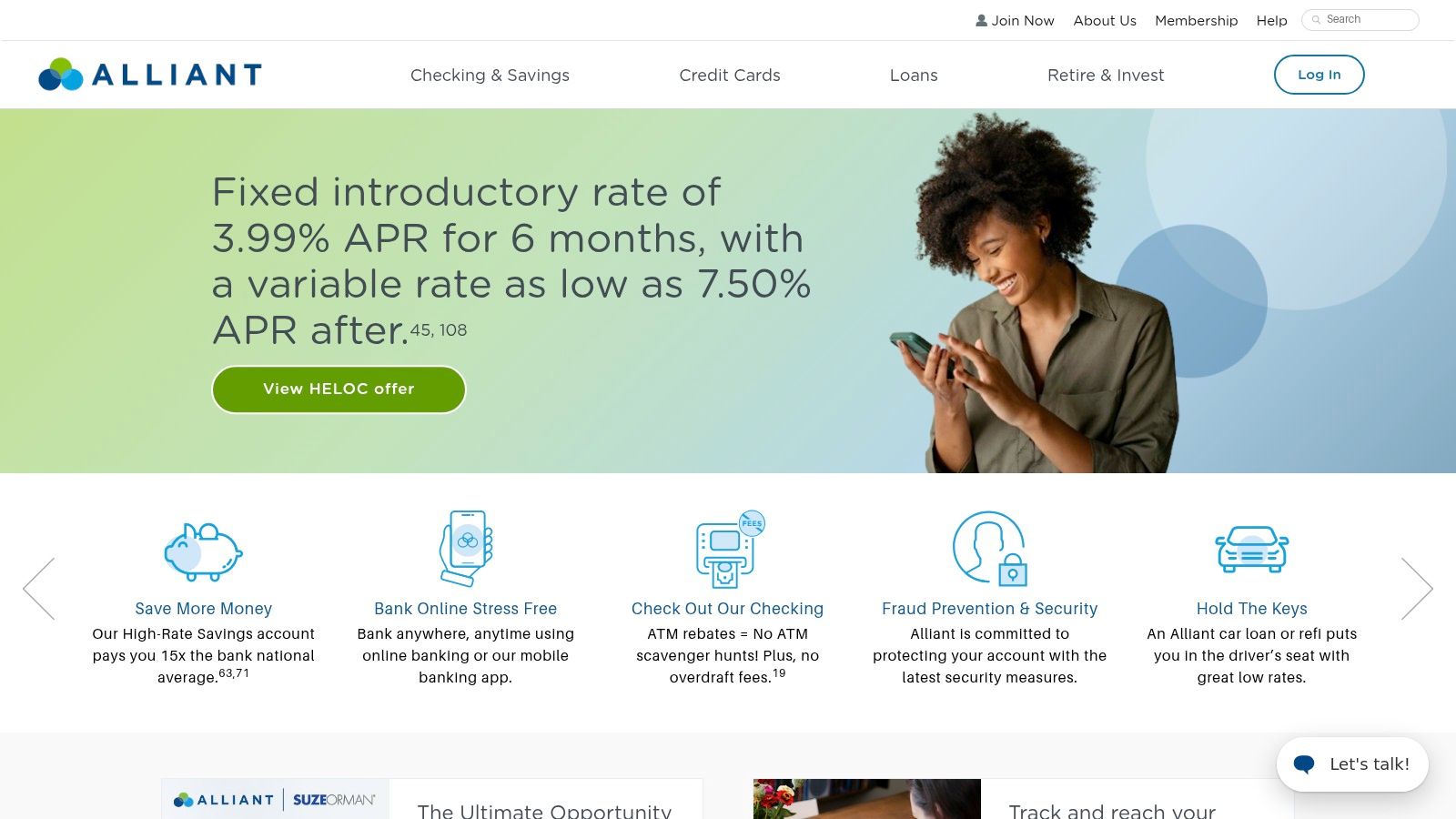
Alliant Credit Union demonstrates the power of a digital-native strategy to achieve scale and nationwide reach. As one of the largest credit unions, with assets reported at $19.4 billion and serving over 937,000 members as of mid-2025, its growth is fueled by a branchless model that prioritizes competitive rates and low fees. By removing the overhead of physical locations, Alliant channels its resources into a superior digital experience and passes the savings to its members, a strategy that resonates with a modern, self-service-oriented consumer base.
Core Strategy and Member Experience
Alliant’s model is built on accessibility and digital excellence. Its primary interface is a highly-rated mobile app and online banking platform, designed for seamless self-service from account opening to daily management. This digital-first approach allows it to compete on price and convenience, attracting members far beyond a traditional geographic footprint.
- Product Offerings: Alliant provides a full suite of products including high-yield checking and savings accounts, CDs, credit cards, and loans for mortgages and vehicles. Its rate structure is consistently among the most competitive in the market, a key value proposition in its marketing.
- Accessibility: The credit union has mastered national reach through an innovative membership model. While it serves employees of partner companies, it also allows anyone to join by supporting its partner charity, the Alliant Credit Union Foundation, making a one-time $5 donation on the new member's behalf.
- Membership Requirements: Besides specific employer or community affiliations, U.S. residents can join through the foundation pathway. A minimum $5 deposit into a savings account establishes and maintains membership.
Actionable Takeaway: A lean, digital-first operational model can be a powerful growth engine. By minimizing physical infrastructure costs, institutions can reinvest in technology and offer more competitive pricing, effectively turning a lower operating expense ratio into a direct competitive advantage for member acquisition.
Data-Driven Digital Expansion
For banking executives, Alliant’s success is a case study in leveraging a branchless strategy to capture a national market. This model’s viability hinges on understanding the digital consumer. A community bank or credit union can emulate this by first identifying digitally inclined segments within its own market using demographic and behavioral data. Analyzing which of the best credit unions to bank with operate with a similar model can provide valuable competitive benchmarks. The key is to ensure the digital platform is not just a channel but the core of the member experience, delivering value that outweighs the lack of in-person service.
https://www.alliantcreditunion.org
6. BECU (Boeing Employees Credit Union): Expanding from a Corporate Core to Regional Dominance
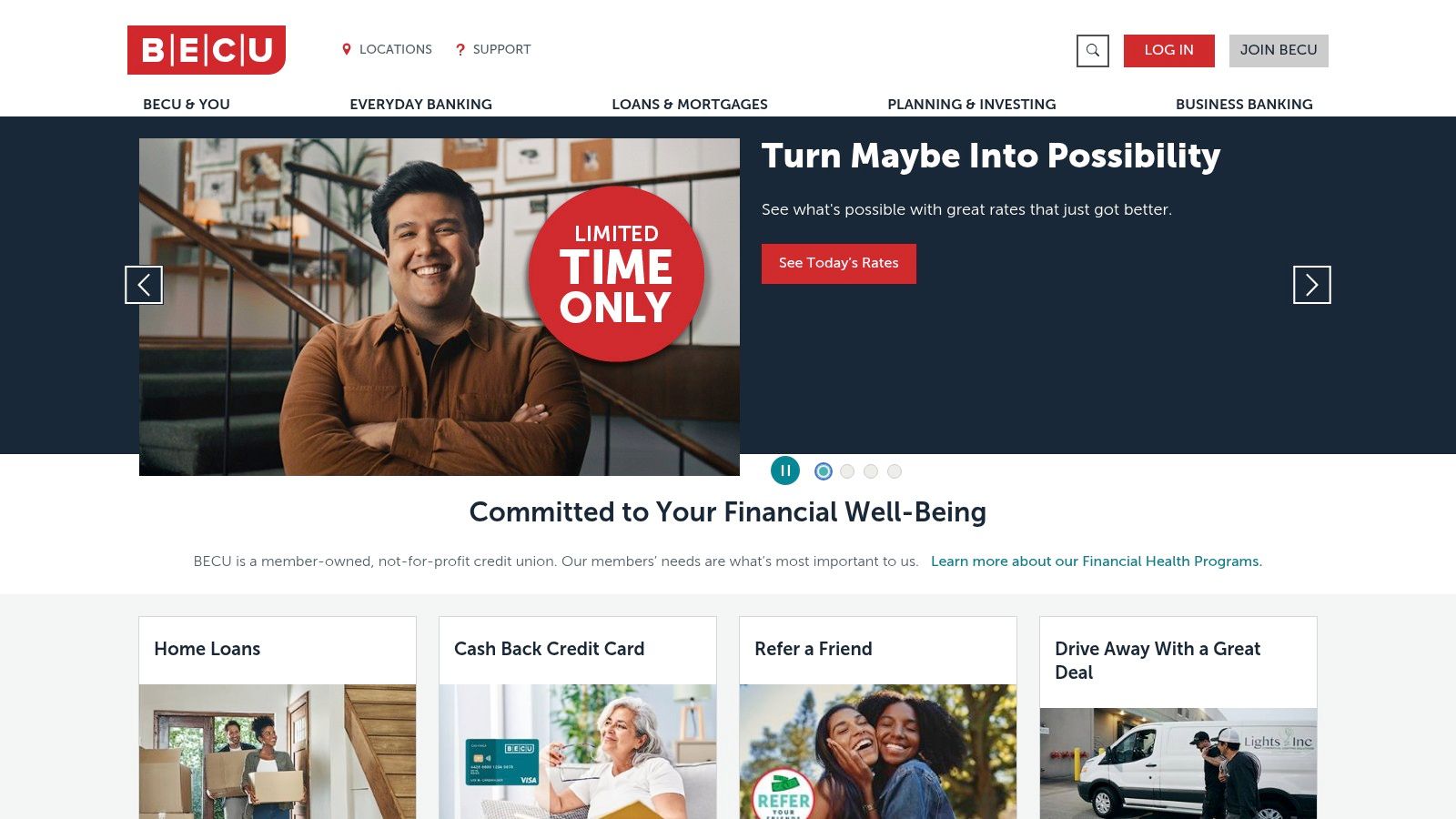
Originally founded to serve Boeing employees, BECU has successfully transitioned from a single-employer credit union into a regional powerhouse, demonstrating a scalable model for community expansion. As one of the largest credit unions, its growth to over $28.8 billion in assets and 1.4 million members is a masterclass in leveraging a strong initial niche to build a broader, geographically-defined member base. BECU’s strategy pivots from a corporate identity to a community-focused institution, offering low-fee services that attract a wide demographic within its operating region.
Core Strategy and Member Experience
BECU’s model is built on accessibility and value, effectively removing common barriers to banking. The credit union has largely eliminated standard monthly maintenance fees and minimum balance requirements, a strategy that resonates powerfully with a broad consumer base and drives significant member acquisition within its geographic footprint. This low-cost structure is supported by strong digital channels and a collaborative network.
- Product Offerings: BECU offers a streamlined suite of core products, including its popular no-minimum, no-monthly-fee checking and savings accounts. It also provides competitive rates on mortgages, auto loans, and credit cards, with premium benefits like higher savings yields available through its 'Member Advantage' tiered program.
- Accessibility: While its physical branch footprint is concentrated in Washington State, BECU extends its reach nationwide through a network of over 30,000 surcharge-free ATMs and thousands of shared branching locations. Its digital platform allows for seamless online account opening and management.
- Membership Requirements: Eligibility has expanded significantly from its origins. Membership is now open to all residents of Washington State and select counties in Oregon and Idaho. Employees of Boeing and its subsidiaries, as well as members of select associations, are also eligible regardless of location.
Actionable Takeaway: A strong niche can be a launchpad for broader market expansion. Start with a defined community, build a reputation for value, and then strategically relax membership criteria to capture adjacent geographic or demographic markets without losing your core value proposition.
Data-Driven Geographic Expansion
BECU’s success provides a compelling case study for financial institutions considering geographic expansion. The key is to anchor growth in data that identifies receptive markets. A community bank looking to replicate this can use a tool like Visbanking’s Market Expansion module to analyze demographic and economic data in adjacent counties. By identifying regions with a high concentration of consumers underserved by low-fee banking options, a bank can strategically place a new branch or launch a targeted digital campaign, mirroring BECU's move from a corporate to a community-centric model.
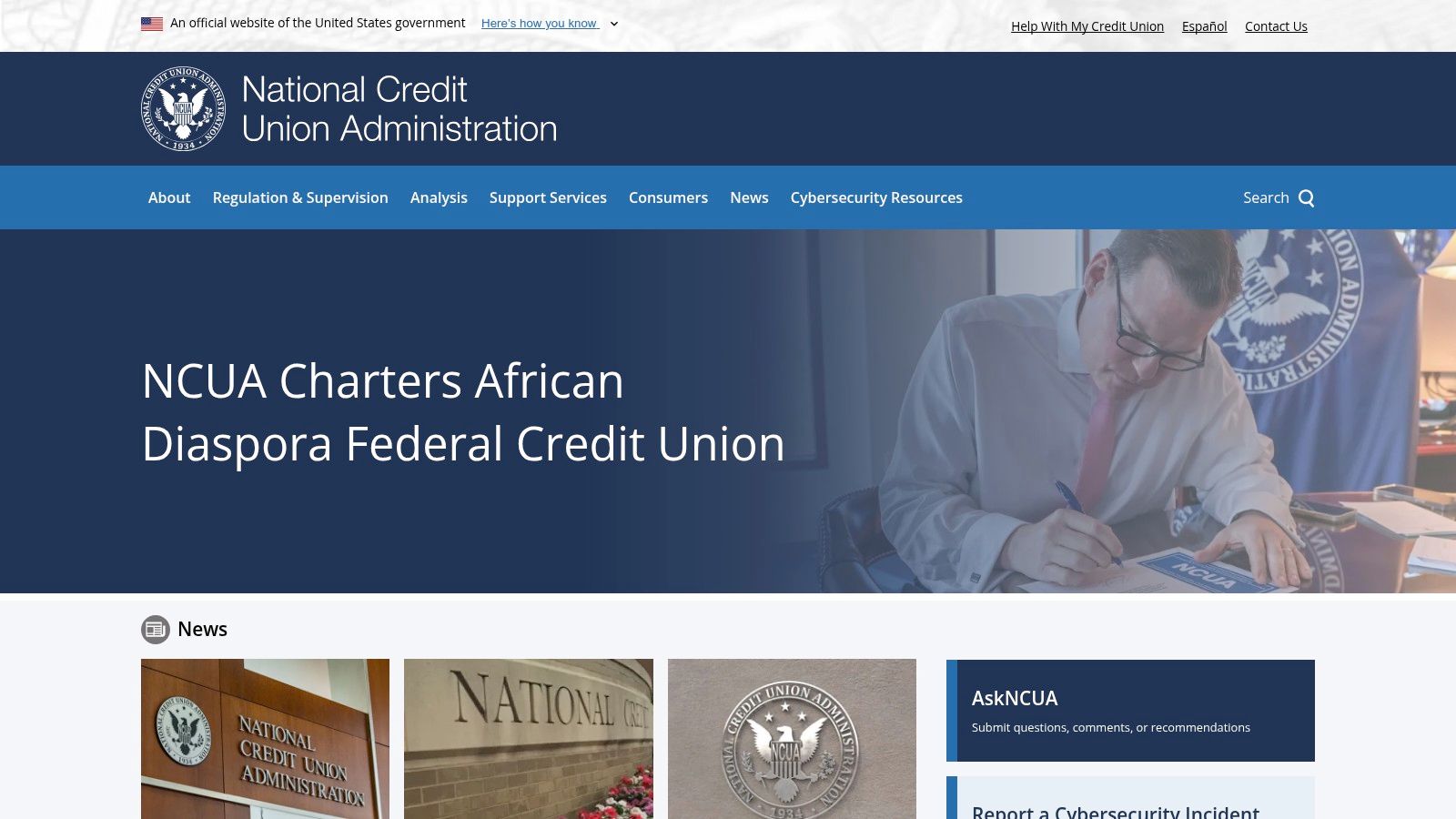
7. NCUA Credit Union Locator: The Authoritative Source for Verification
While not a ranking platform itself, the National Credit Union Administration's (NCUA) Credit Union Locator is an indispensable tool for any executive researching the landscape of the largest credit unions. It serves as the official, federally mandated source for verifying the operational and insurance status of every federally insured credit union in the United States. For any institution conducting competitive analysis or due diligence, this is the ground-truth resource.
Core Strategy and Member Experience
The NCUA's tool is not designed for a retail user experience but for providing authoritative, accurate data. Its core function is to deliver transparency and safety to the financial system. Users can quickly search for any credit union by name, charter number, or location to confirm its existence, find contact information, and, most importantly, verify its insurance status with the National Credit Union Share Insurance Fund (NCUSIF).
- Product Offerings: The platform provides data, not financial products. Key information includes a credit union's official website, phone number, branch locations, and basic field-of-membership details.
- Accessibility: As a free public service website from the U.S. government, it is universally accessible. Its "Research a Credit Union" companion tool offers deeper financial performance data, although it requires more navigation than specialized analytics platforms.
- Membership Requirements: Access is public and free of charge. No account or login is required to use the primary locator and research functions.
Actionable Takeaway: Use official regulatory tools as the foundational layer of your competitive intelligence. Before dedicating resources to analyze a competitor’s strategy, first use the NCUA locator to verify their charter, insurance status, and operational footprint. This step validates all subsequent data.
Data-Driven Niche Domination
For banking leaders, the NCUA site is the starting point for market validation. When identifying potential competitors among the largest credit unions in a specific state or region, this tool provides the official charter and branch data needed for an accurate geographic analysis. While it doesn't offer the deep asset and growth trend analysis found in platforms like Visbanking, it provides the raw, reliable data that underpins such insights. Understanding the official data sources is a critical first step; for a deeper dive into their structure, you can get a better understanding of credit unions in the United States.
Top 7 Credit Unions Comparison
| Item | 🔄 Implementation complexity | ⚡ Resource requirements | ⭐ Expected outcomes | 💡 Ideal use cases | 📊 Key advantages |
|---|---|---|---|---|---|
| Visbanking | High 🔄 — enterprise integrations, MLOps | High ⚡ — data engineering, secure infra, enterprise budget | Very strong ⭐⭐⭐⭐ — explainable signals & workflow-ready actions | Banking analytics, risk monitoring, sales prospecting, HR/recruiting | Broad bank data coverage, auditable pipelines, people graph, modular apps |
| Navy Federal Credit Union | Low 🔄 — consumer-facing operations | Low ⚡ — standard onboarding & branch/ATM ops | Strong ⭐⭐⭐ — full retail product set, competitive member offers | Military members, veterans, DoD employees & families seeking full-service banking | Large membership & asset base, wide ATM/branch network, competitive rates |
| SECU (NC) | Low–Medium 🔄 — branch-centric join process | Low ⚡ — in-person/mail documentation for membership | Solid ⭐⭐⭐ — low fees, transparent rates for members | NC public‑sector employees and families needing local services | Transparent rates, low minimums, extensive state branch/ATM coverage |
| PenFed Credit Union | Low 🔄 — digital-first onboarding | Low ⚡ — online application + membership creation | Strong ⭐⭐⭐ — competitive loans/cards, national offers | Consumers seeking competitive lending and simple nationwide access | Broad eligibility, easy digital onboarding, strong credit/auto products |
| Alliant Credit Union | Low 🔄 — fully digital account opening | Low ⚡ — online-only servicing, minimal paperwork | Strong ⭐⭐⭐ — competitive rates and mobile-first UX | Nationwide online customers wanting low-fee, app-centric banking | 100% digital onboarding, multiple eligibility paths, good rates |
| BECU | Low–Medium 🔄 — regional eligibility, shared-branching | Low ⚡ — online + regional branch operations | Solid ⭐⭐⭐ — no‑fee/no‑min accounts and local benefits | Washington State residents (and eligible OR/ID counties) | Low fees, large surcharge-free ATM network, shared-branch access |
| NCUA Credit Union Locator | Very low 🔄 — public search tool | Minimal ⚡ — web access only | Reliable ⭐⭐⭐ — authoritative verification & contact data | Verifying CU legitimacy, finding branches/insurance status | Official government source, supervisory data, insurance info |
From Benchmarking to Action: Implementing Your Data-Driven Strategy
The strategies employed by the largest credit unions, from Navy Federal’s member-centric scale to BECU’s community-focused growth, offer a clear lesson: market leadership is not a function of size alone. It is the result of a relentless focus on a defined strategy, executed with data-driven precision. Whether dominating a niche, mastering a geographic area, or leading with digital efficiency, each of these institutions leverages intelligence to understand its market, optimize performance, and create a sustainable competitive advantage.
Your institution's path forward is not to simply imitate these giants, but to apply the same underlying principles. This requires a commitment to transforming raw data into actionable intelligence, moving from passive observation to strategic execution.
Establishing Your Strategic Baseline
The first step is to establish a clear, objective view of your own performance relative to a meaningful peer group. This goes beyond simple asset size comparisons. It means dissecting key performance indicators (KPIs) to understand the why behind the numbers. For instance, if your net interest margin (NIM) lags behind a key competitor, is it due to a higher cost of funds or a less profitable loan mix?
A proper benchmark analysis would reveal this. For example, if a peer credit union with a similar asset size ($5 billion) has a 25 basis point advantage in NIM, a granular tool like Visbanking can isolate the cause, showing they achieve a 15 basis point lower cost of deposits while maintaining a loan-to-share ratio 5% higher than yours. This insight transforms a generic goal like "improve NIM" into a specific, measurable objective: "reduce cost of deposits by 10 basis points and increase loan-to-share ratio to 85%."
Identifying and Activating Strategic Levers
With a clear baseline, the next step is to identify the specific strategic levers that will drive your desired outcomes. This is where insights from the largest credit unions become a practical playbook.
- Market Segmentation: PenFed and Navy Federal demonstrate the power of a defined field of membership. Your institution can apply this principle by identifying underserved micro-segments within your own geographic footprint.
- Operational Efficiency: Alliant Credit Union’s digital-first model offers a blueprint for reducing overhead. Analyzing your non-interest expense per member against lean, digitally-focused peers provides a tangible target for operational improvements.
- Product Innovation: Analyzing the loan portfolio composition of institutions like SECU can reveal opportunities in your own market. Perhaps there is untapped demand for specific types of consumer or real estate loans that top performers are successfully originating. For comprehensive financial strategies that look towards the future, large credit unions often integrate insights from broader capital markets, including specific insights from CMBS deals for 2025, to inform their data-driven decisions.
Equipping Your Teams for Execution
The final, most critical step is to equip your teams with the tools to execute. Data is only valuable when it is accessible, understandable, and integrated into daily decision-making processes, from the C-suite to the front lines. Leaders at the largest credit unions do not just consume reports; they foster a culture where data intelligence powers every strategic conversation. This requires a platform that delivers not just charts, but a clear narrative of performance and opportunity.
Ultimately, the success of the nation’s largest credit unions provides a powerful roadmap. By embracing a disciplined, data-first approach to benchmarking, strategy, and execution, your institution can build its own sustainable advantage and drive meaningful, long-term growth.
Ready to move from analysis to action? Visbanking provides the Bank Intelligence and Action System that empowers executive teams to benchmark performance, uncover strategic opportunities, and execute with confidence. Schedule your personalized demo to see how you can transform your data into a competitive advantage.
Related Articles

Visbanking Blog
Credit Union vs Bank: The $2 Trillion Member Advantage

Visbanking Blog
Fastest Growing Banks: Who's Winning the Asset Race?

Visbanking Blog
Largest U.S. Credit Unions by Asset Size in 2025

Visbanking Blog
Credit Unions Banks Pursuing Growth & Opportunity

Visbanking Blog
6 Biggest U.S. Banks Enjoy First $1 Trillion Decade

Visbanking Blog