
How to Conduct Competitor Analysis for Strategic Advantage in Banking
Brian's Banking Blog
Effective competitor analysis is a systematic discipline for gathering and evaluating data on rival institutions. It is the practice of examining their financial performance, product strategies, and market positioning to inform superior decisions for your own bank. This process is no longer a retrospective review of quarterly reports. It is now a critical, real-time intelligence function that requires benchmarking key metrics—from loan growth to efficiency ratios—and leveraging modern data platforms to convert market information into decisive strategic action.
Why Traditional Bank Competitor Analysis Is Obsolete
Relying on quarterly call reports for competitor analysis is akin to driving a car by only looking in the rearview mirror. It provides a historical record, but offers no foresight into the road ahead.
In today's dynamic financial landscape, this reactive approach is dangerously slow. It exposes banks to significant risks, from missing critical M&A opportunities and mispricing loan portfolios to conceding market share before the threat is even recognized. The market simply moves faster than the legacy reporting cycle.

This outdated method relegates a critical strategic function to a historical accounting exercise, failing to deliver the forward-looking intelligence that leadership requires to make definitive, high-stakes decisions.
The Shift to Continuous Intelligence
Modern competitor analysis is not a periodic task; it is a continuous, integrated component of corporate strategy. The market demands a shift from static reviews to a dynamic intelligence capability that feeds critical, near-real-time information directly to the C-suite. This evolution is powered by sophisticated data aggregation and analytics tools.
This is a global priority. The Competitor Analysis Evaluation market was valued at $4.32 billion in 2021 and is projected to reach $6.60 billion by 2025. This growth underscores the imperative for institutions to invest in sophisticated intelligence. You can read more on these market projections for a global perspective.
The objective is no longer to simply collect competitor data. It is to arm the executive team with the intelligence to anticipate market shifts, identify strategic vulnerabilities, and capitalize on opportunities before they become widely recognized.
This strategic paradigm requires platforms that do more than present raw data. To be effective, leaders need tools like Visbanking that synthesize disparate data points into a coherent, strategic narrative. Such platforms empower executives to:
- Benchmark performance against meticulously defined peer groups, not arbitrary local competitors.
- Identify emerging threats from non-traditional players, including fintechs and aggressive credit unions.
- Validate strategic initiatives—from capital allocation to product innovation—with empirical data.
The critical question must evolve from, "What did our competitors do last quarter?" to, "What does the data indicate about our competitors' next move?" This is how data-driven banks will not merely survive, but lead the market.
Defining Your Competitive Landscape for Meaningful Insights
A robust competitor analysis begins with a rigorously defined framework, not an unstructured list of local banks. A common failure is to define the competitive set too broadly or too narrowly, which dilutes the resulting insights. The objective is to avoid data overload and concentrate analytical resources where they will yield the most valuable intelligence.
This requires tiering competitors to create a strategic map of your operating environment. Neglecting this step leads to benchmarking against irrelevant institutions and failing to detect signals from ascendant threats.
This initial phase of intelligence gathering is foundational, setting the stage for all subsequent analysis.
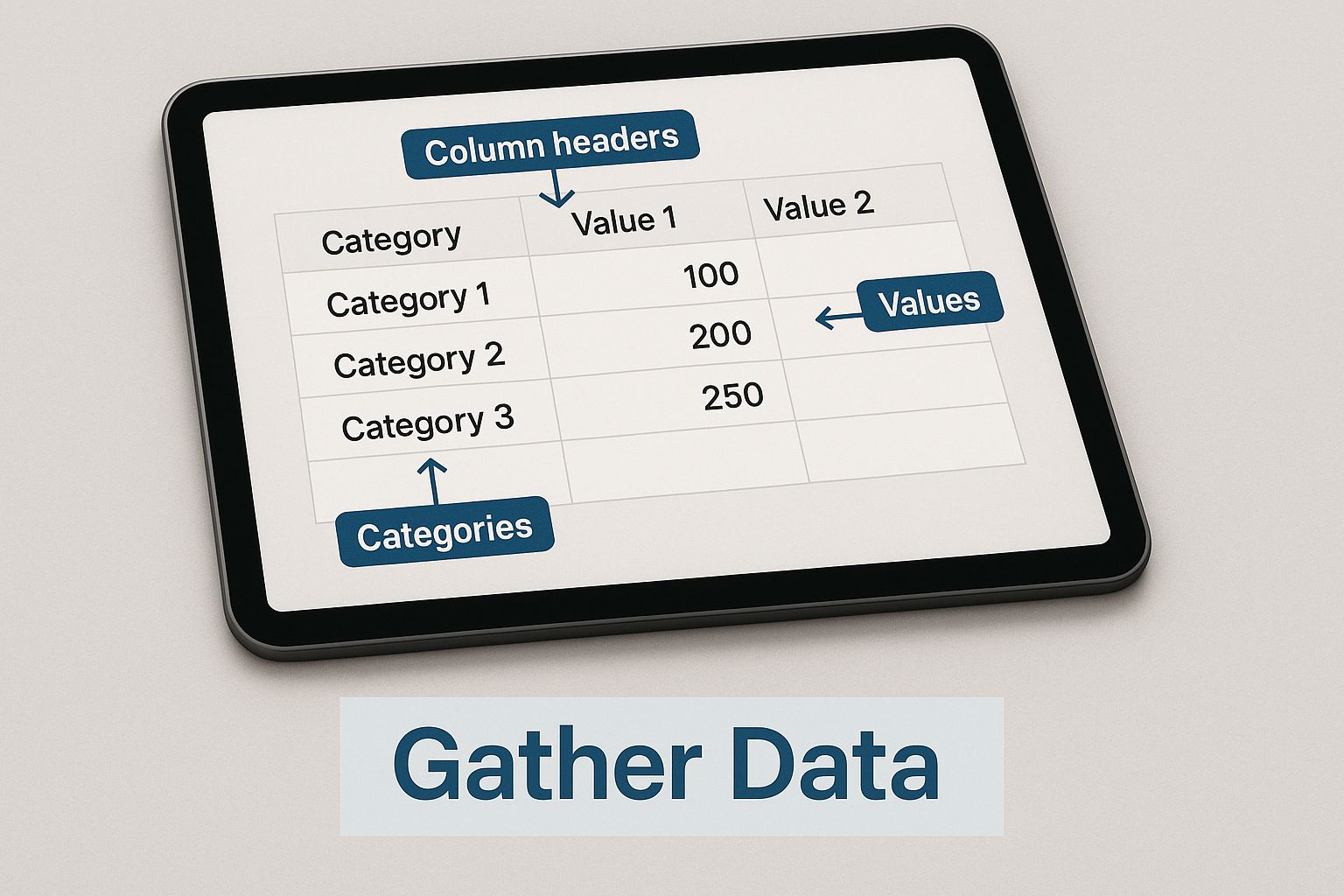
As illustrated, raw data acquisition is merely the first step. The strategic value is unlocked when that data is applied to a structured competitive framework.
Structuring Your Competitive Tiers
A disciplined tiering system is non-negotiable for any bank seeking a competitive edge. It sharpens focus and ensures performance is measured against the appropriate yardsticks. A best-practice approach is to segment the competitive landscape into three distinct categories.
Direct Competitors: These are institutions vying for the same customers in your primary markets. For example, a $2 billion community bank in suburban Dallas should monitor other local banks of similar asset size, particularly those with a significant presence in commercial and industrial (C&I) lending.
Aspirational Peers: These are high-performing institutions, often in different markets, that represent a strategic benchmark for excellence. The same Dallas bank might analyze a top-quartile $5 billion bank in North Carolina renowned for operational efficiency, benchmarking its own efficiency ratio (e.g., 61%) against the peer's superior performance.
Emerging Threats: This category includes non-traditional players gaining traction with your target demographic. This could be a credit union launching an aggressive small business services division or a fintech capturing local deposits with high-yield accounts.
Categorizing competitors in this manner concentrates analytical resources where they will deliver maximum impact, providing a clear roadmap for what to monitor and why.
| Competitor Tier | Definition | Example Institution | Key Metrics to Track |
|---|---|---|---|
| Direct Competitors | Institutions with similar size, market, and product offerings. | A local community bank of comparable asset size. | Loan growth, deposit rates, market share. |
| Aspirational Peers | High-performing banks you aim to emulate, often in different markets. | A top-quartile bank known for its efficiency or profitability. | Efficiency ratio, ROA, ROE, NIM. |
| Emerging Threats | Non-traditional players or new entrants gaining market traction. | A regional credit union or a national fintech platform. | Customer acquisition rates, digital product adoption. |
This tiered framework elevates competitor analysis from a retrospective reporting exercise into a proactive, strategic instrument. It compels clarity on who you are truly competing against and where your greatest opportunities and threats reside.
Applying the Framework for Actionable Intelligence
Once these tiers are established, your analysis becomes targeted and potent. You can compare specific performance metrics—such as Net Interest Margin or loan portfolio composition—against each group to uncover distinct strategic insights.
For example, your bank’s 3.25% NIM may appear strong relative to direct local competitors. However, it could significantly trail the 3.60% average of your aspirational peers.
This segmented view immediately isolates performance gaps and provokes critical strategic questions. Following the definition of your competitive landscape, it is essential to conduct detailed comparisons of features, pricing, and ROI, analogous to a comparison of competing software features in the technology sector.
This is where a data intelligence platform like Visbanking becomes indispensable. It enables you to construct and monitor these custom peer groups effortlessly, allowing leadership to focus on strategic decision-making rather than spreadsheet manipulation.
Sourcing Intelligence Beyond Standard Financials
An analysis limited to a competitor's quarterly income statement and balance sheet reveals only a fraction of the story. True competitive intelligence is derived from integrating a mosaic of data points that expose the narrative behind their strategy.
Focusing solely on top-line financials is a critical error. It overlooks how growth is funded, where risk is being concentrated, and what their customers are experiencing. To gain a strategic edge, you must assemble a multi-layered view that extends far beyond standard regulatory filings from the FDIC and NCUA.
Deconstructing the Balance Sheet
A rigorous analysis begins by dissecting the core components of a competitor's financial structure. This requires asking sharper, more strategic questions.
- Loan Portfolio Composition: Is a competitor aggressively expanding its Commercial & Industrial (C&I) lending while your institution remains heavily weighted in Commercial Real Estate (CRE)? Identifying a peer bank with 15% year-over-year growth in C&I loans at an average yield of 7.5% is a significant strategic signal that demands immediate investigation.
- Funding Sources: How reliant are they on non-core funding? A high concentration of brokered deposits can indicate a challenge in sourcing stable, low-cost funding—a potential vulnerability to exploit or an opportunity to acquire their customers.
- Asset Quality Trends: What is the trajectory of their nonperforming loans (NPLs)? A rising NPL ratio, particularly if concentrated in a specific asset class, can be a leading indicator of future credit losses and a weakness in their underwriting strategy.
High-level industry data, such as the FDIC's Quarterly Banking Profile, provides the necessary macro context for these deep dives.

Examining macro trends in net income and ROAA, as shown above, helps contextualize individual performance. It clarifies whether a competitor's success is driven by a superior strategy or simply by favorable industry tailwinds.
Integrating Qualitative Intelligence
Quantitative data tells you what is happening. Qualitative intelligence reveals why.
To achieve a complete, 360-degree perspective, you must incorporate unstructured data sources that expose strategic intent and market perception.
A competitor’s earnings call transcript is more than a financial report; it’s a strategic roadmap. Executive commentary on market expansion, technology investments, and risk appetite provides direct insight into future priorities.
This qualitative layer also includes monitoring local news for branch network changes and tracking online customer sentiment. To synthesize this information effectively requires modern data solutions. It is worth exploring how 360 Analytics and Customer Data Platforms can integrate these varied data streams.
The primary challenge is not a scarcity of data, but its fragmentation. Attempting to manually consolidate information from dozens of disparate sources is inefficient and prone to error.
This is precisely the problem that platforms like Visbanking are engineered to solve. We aggregate this diverse data into a single, reliable source of truth. Understanding how financial data integration works is the first step toward building an efficient and actionable intelligence system.
By combining granular financial metrics with qualitative strategic signals, your analysis transforms from a backward-looking report into a predictive tool. You can finally benchmark your institution against a competitor’s complete operational reality, not just their polished earnings release.
Turning Raw Numbers into Your Strategic Roadmap
Data in isolation is noise. Voluminous financial statements and regulatory filings do not, by themselves, drive decisions. The strategic value is realized when raw information is converted into sharp, actionable benchmarks that clarify your competitive position.
The process begins by focusing on the metrics that are the vital signs of a bank's health: Net Interest Margin (NIM), Efficiency Ratio, and Return on Average Assets (ROAA). Juxtaposing these metrics against your defined competitor tiers—direct, aspirational, and emerging—provides the essential context for strategic assessment.
This analytical discipline shifts the boardroom conversation from what the numbers are to why they are what they are and what must be done.
Going Deeper Than Just a Side-by-Side Look
A proper benchmark is a diagnostic tool, not a simple comparison. For example, discovering your bank's efficiency ratio is 62% while direct competitors average 55% is not merely an interesting data point; it is a clear indicator of a competitive disadvantage.
That 700-basis-point gap directly impacts profitability and signals an urgent need to examine noninterest expenses and optimize operations.
Modern business intelligence platforms illuminate these gaps instantaneously. An executive can visualize performance discrepancies on a dashboard in real-time, bypassing tedious data compilation to focus directly on strategic problem-solving. It is no surprise that such intelligence is becoming a cornerstone of corporate strategy; as noted by GroupBWT, BI technologies are delivering fresh, actionable insights that are now indispensable.
The goal is not to blindly replicate a competitor's metric. It is to understand the strategy driving their performance and determine whether a similar initiative—or a calculated counter-move—aligns with your bank's objectives.
The Metrics That Tell the Real Story
To make this process effective, it must be targeted. Concentrate on the key performance indicators that reveal the core strengths and weaknesses across the competitive landscape.
The primary metrics to monitor include:
- Profitability Ratios (ROAA & ROAE): How effectively do competitors convert assets and equity into profit? A peer bank that consistently posts a higher ROAA may possess a superior loan pricing strategy or more stringent overhead control.
- Operational Efficiency (Efficiency Ratio): This classic metric quantifies the cost to generate one dollar of revenue. A lower ratio is superior. Benchmarking this reveals whether your cost structure is lean or bloated relative to the competition.
- Net Interest Margin (NIM): NIM assesses the core profitability of a bank's lending and funding operations. Comparing this metric reveals which institution holds greater pricing power and is managing the interest rate environment and its regulatory compliance for banks more effectively.
By systematically benchmarking these key metrics against your defined competitor groups, you construct a clear, data-driven narrative of your bank's market position. This process illuminates precisely where to focus strategic resources, transforming a sea of data into a catalyst for action.
Turning Competitive Insights into Boardroom Strategy
Raw data and benchmarking reports are merely inputs. The ultimate purpose of competitor analysis is to shape strategy and drive decisions in the boardroom.
The analysis is incomplete until its insights are debated and translated into actions that impact market position, risk appetite, and growth initiatives.
This is where the return on investment in a modern data intelligence system is fully realized. It elevates the strategic conversation beyond operational minutiae, providing leadership with the empirical evidence needed to act with conviction.
From Analysis to Actionable Scenarios
Consider a mid-sized bank that, through continuous analysis, observes a direct competitor achieving superior results in its Commercial & Industrial (C&I) loan portfolio. A deeper dive reveals this competitor's average yield on new C&I loans is 75 basis points higher than its own, while maintaining a comparable risk profile.
This single insight, identified using a tool like Visbanking, becomes a strategic catalyst. It moves directly from an analyst's dashboard to the boardroom agenda, compelling a rigorous review of the bank's entire commercial lending strategy.
The discussion shifts from a vague objective of "growing C&I lending" to specific, data-backed questions:
- Is our current C&I product suite competitive on pricing and features?
- Are our loan officers properly incentivized and equipped to pursue higher-yield opportunities?
- What is our true risk tolerance in this segment compared to this high-performing peer?
Following this review, the bank might execute a complete overhaul of its C&I products, resulting in a 10% increase in qualified loan originations within two quarters. This is the tangible outcome of converting competitive data into strategy.
The most effective competitor analysis does not conclude with a report. It concludes with a decision. It compels leadership to confront market realities and answer the question: "What are we going to do about it?"
Uncovering Hidden Revenue Opportunities
In another real-world scenario, a bank uses a data platform to benchmark its non-interest income. The analysis reveals an aspirational peer of similar asset size is generating 20% more in fee income, driven primarily by treasury management services for small businesses.
This discovery immediately identifies a revenue gap and a clear market opportunity. The board can then authorize a targeted initiative to enhance its treasury services, acting not on speculation but on data that confirms a profitable model is already succeeding for a competitor.
Mastering banking data analytics is about turning information into profit, and this exemplifies that principle in action.
The transition to real-time, data-driven strategy is not a future trend; it is the current standard for high-performing banks. Research indicates that 70% of companies globally now use real-time analytics to inform their strategic actions. This shift from static reporting to continuous intelligence is what separates market leaders from the rest of the pack.
Ultimately, your competitive analysis serves one function: to produce insights that fuel decisive action.
Common Questions from Bank Executives on Competitor Analysis
When leadership teams commit to rigorous competitor analysis, several practical questions invariably arise. Addressing these concerns upfront ensures that the initiative yields strategic value, not just another report.
Here are the most common questions we receive from bank executives, with direct, substantive answers.
How Often Should We Be Doing This?
Quarterly deep-dives are insufficient, as the market does not operate on a quarterly schedule.
Key competitor metrics must be monitored continuously. A robust data intelligence platform provides a live pulse on critical indicators like loan growth, deposit rates, and noninterest income. This enables your institution to respond to market shifts as they occur, not months after the fact.
What's the Biggest Mistake You See Banks Making?
The most common and costly mistake is focusing exclusively on the bank across the street.
This narrow view creates a false sense of security. True strategic insight comes from a broader perspective. A proper framework must include different tiers of competitors, such as a high-performing regional bank in another state or an emerging digital-first institution. This provides a richer context for your own performance and, crucially, uncovers opportunities that would otherwise be missed.
The objective is not merely to measure performance against a local rival. It is to understand the strategies of top performers and innovators to inform your own path to top-quartile results.
How Can We Be Sure Our Benchmarking Data is Accurate?
The integrity of your analysis depends entirely on the quality of your data. The most reliable foundation is standardized regulatory data from sources like the FDIC and NCUA, which ensures an apples-to-apples comparison.
However, manually sourcing and cleaning this data is fraught with inefficiency and error. Platforms that automatically aggregate and normalize regulatory data serve as the single source of truth. They eliminate inconsistencies and free your team to focus on analysis, not data wrangling.
Where's the Best Place to Start Improving Our Process?
Begin by formalizing your competitive framework.
Clearly define your direct competitors. Next, identify aspirational peers—the institutions whose performance you seek to emulate. Finally, list any emerging threats on your radar. This single step brings immediate focus to your analysis and ensures you are tracking the metrics essential to achieving your strategic goals, such as improving your efficiency ratio from 61% to a peer average of 55%.
Ready to move beyond static reports? With Visbanking, you can implement a dynamic, continuous competitor analysis program that delivers actionable intelligence directly to your leadership team. Benchmark your bank's performance against any peer group you define.
Latest Articles
Brian's Banking Blog
Automated Alerts and Notifications for Banks
Brian's Banking Blog
Customer Feedback Loop for Banks: A Practical Playbook
Brian's Banking Blog
Commercial Lending Trends: What Bank Executives Must Know
Brian's Banking Blog
Bank Marketing Dataset Analysis Strategy

Brian's Banking Blog
ESG Peer Benchmarking for Bank Leaders
Brian's Banking Blog