
How to Calculate Efficiency Ratio: A Guide for Bank Executives
Brian's Banking Blog
To calculate a bank's efficiency ratio, divide its non-interest expenses by its operating revenue. The formula is that simple.
The result reveals how many cents it costs the bank to generate one dollar of revenue. It is a direct and powerful measure of operational discipline and core profitability.
Why the Efficiency Ratio Is a Critical Banking KPI

For a bank executive or director, the efficiency ratio is more than a line item on a financial report. It is a foundational key performance indicator (KPI) that assesses how effectively the institution manages its resources.
A lower ratio is superior, indicating the bank is adept at controlling costs relative to the income it generates.
This single metric cuts through the complexity of financial statements to deliver a clear verdict on operational performance. This is not a theoretical exercise; it is a critical tool for governance and strategic leadership.
The Core Components of the Ratio
To leverage the efficiency ratio, a leader must understand its two components. Grasping each element is essential to interpreting what the metric reveals about an institution's financial health.
Key Components of the Banking Efficiency Ratio
| Component | Definition & Strategic Importance |
|---|---|
| Non-Interest Expense | This is the bank's operational overhead. It encompasses all costs not directly tied to interest payments, including salaries and benefits, technology spend, premises, and marketing. It is a direct reflection of the bank's cost structure and investment strategy. |
| Operating Revenue | This is the total revenue a bank generates from its core business before accounting for credit losses. It is the sum of Net Interest Income and Non-Interest Income. This figure represents the bank's fundamental earning power. |
A clear understanding of these two inputs provides a complete picture. The value lies not just in the final ratio but in the operational drivers that produce it.
In banking, the industry benchmark for a high-performing U.S. bank has long been an efficiency ratio below 60%. A ratio climbing above 70% can be a red flag, signaling potential operational inefficiencies or a period of significant, and costly, strategic investment.
A high efficiency ratio is not merely an accounting issue; it is a strategic one. It indicates that the bank's cost structure may be misaligned with its revenue-generating capacity—a problem that demands board-level attention.
From Calculation to Actionable Intelligence
Knowing the formula is rudimentary. The real value is realized when leadership uses this data to drive superior decisions.
A single ratio is a snapshot. Its true utility emerges from tracking it over time and benchmarking it against relevant peers, transforming it into a powerful diagnostic tool. Instead of manually compiling data, a platform like Visbanking automates data aggregation and provides the necessary peer context to translate the number into actionable insight.
An upward trend can highlight bloated cost centers. Conversely, a best-in-class ratio can validate strategic investments in technology or talent. For a deeper analysis, learn what the efficiency ratio tells you about a bank in our guide.
Ultimately, the metric's power is not in the number itself, but in the strategic narrative it reveals and the actions it compels.
Let's Get Practical: Calculating Your Bank's Ratio
Calculating your bank's efficiency ratio is straightforward, but its strategic value comes from understanding what drives the numbers. This is not a mere spreadsheet exercise; it is about interpreting the story your operations are telling.
The formula is clear: Non-Interest Expense / Operating Revenue = Efficiency Ratio. Let's deconstruct where to source these figures and what they mean for your institution.
Finding Your Key Data Points
The primary source for this data is your bank’s quarterly Call Report.
- Non-Interest Expense: This represents your total overhead—all costs not directly tied to lending, such as salaries, technology investments, rent, and marketing. A critical note: exclude one-time charges, like goodwill impairments, as they can distort the true picture of ongoing operational efficiency.
- Operating Revenue: This is the total income generated from your core business. It is the sum of Net Interest Income (from lending activities) and Non-Interest Income (from fees, service charges, and other revenue streams).
This image illustrates the calculation.
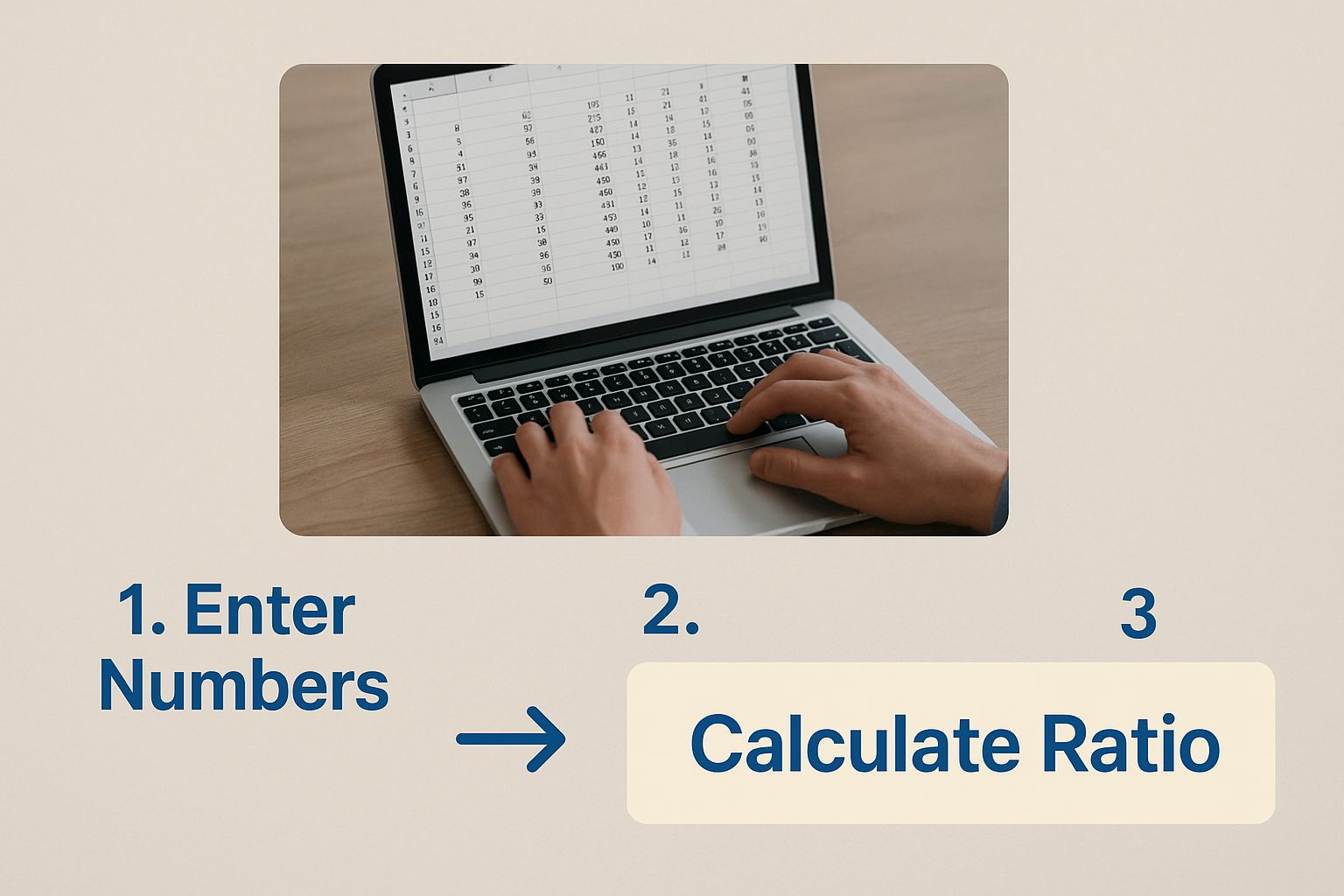
The formula condenses vast financial data into one clear, powerful metric.
Putting It All Together
Let's apply this to a practical example. Assume Bank A reports the following quarterly figures:
- Total Non-Interest Expense: $58 million
- Operating Revenue (Net Interest Income + Non-Interest Income): $100 million
The calculation is direct: $58,000,000 / $100,000,000 = 0.58
Bank A has an efficiency ratio of 58%. In practical terms, for every dollar of revenue generated, the bank spent 58 cents on overhead.
Obtaining the number is just the first step. The essential work for an executive team is to analyze why the ratio is what it is and determine which strategic levers to pull. Consider it the beginning of a strategic inquiry, not the final answer.
This fundamental principle of dividing expenses by revenue is a classic performance measure across industries. It is not unique to banking. For example, a business with $750,000 in expenses against $2,000,000 in revenue has an efficiency ratio of 37.5%. The concept is universal, as shown in these examples of efficiency ratios on netsuite.com.
The Power of a Single Decision
Now, let's observe what happens when strategy is informed by data.
Bank A's leadership team identifies an opportunity to streamline back-office operations. They approve a $2 million annual investment in automation technology to reduce manual processing.
One year later, the investment has delivered a $4 million annual reduction in salary and administrative costs. The net impact is a $2 million decrease in non-interest expense.
- New Non-Interest Expense: $56 million
- Operating Revenue: $100 million
- New Efficiency Ratio: $56,000,000 / $100,000,000 = 56%
A single, data-driven decision improved the efficiency ratio by 200 basis points. This is precisely where a data intelligence platform like Visbanking becomes indispensable. It allows you not only to track these metrics but also to model the potential impact of strategic decisions before committing capital.
A dynamic dashboard can transform static numbers into actionable intelligence.
Suddenly, you are no longer reacting to last quarter's report; you are proactively managing performance, tracking trends, and benchmarking against peers in real time. To truly understand your position, you must compare. Start by exploring our data and benchmark your bank today.
How Do You Stack Up? Benchmarking Your Ratio Against Peers

Calculating your efficiency ratio is the first step. The number is meaningless in a vacuum. Its strategic value is unlocked only through benchmarking against relevant peers.
Is your bank’s 62% ratio a sign of lean operations, or is it a warning that operational drag is eroding profitability? You cannot know without comparing your performance to other institutions navigating the same market conditions.
Finding Your Real Peer Group
This is a common point of failure. Comparing a $500 million community bank to a $50 billion regional institution is strategically useless. Their business models, cost structures, and regulatory environments are fundamentally different.
Meaningful comparison requires an apples-to-apples peer group, built using precise filters:
- Asset Size: This is the most critical filter for creating a level playing field.
- Business Model: A commercial-focused bank has a different expense profile than a retail or mortgage-centric institution.
- Geography: Local economic conditions, talent costs, and competitive intensity significantly impact a bank's performance.
This is why tools like Visbanking are so valuable. They allow you to instantly segment the entire banking landscape to build a custom peer group that is relevant to your institution, transforming a mountain of raw data into a clear, competitive yardstick.
To provide a general framework, here’s how the efficiency ratio often varies by asset size.
Efficiency Ratio Benchmarks by Bank Asset Size
This table shows illustrative median efficiency ratios, highlighting how performance expectations shift with scale.
| Asset Size | Median Efficiency Ratio | Top Quartile Performance |
|---|---|---|
| Under $500 Million | 65% | 58% |
| $500 Million - $1 Billion | 61% | 55% |
| $1 Billion - $10 Billion | 57% | 52% |
| Over $10 Billion | 54% | 49% |
These numbers provide a starting point, but the strategic narrative is always more nuanced than a single average.
Looking Beyond the Number
Once you have a benchmark, the analytical work begins. A ratio that is slightly higher or lower than your peers is not inherently good or bad. You must investigate the why.
A high efficiency ratio is not always a red flag. It may reflect a deliberate, board-approved strategy to invest in new technology or market expansion. Conversely, an unusually low ratio could signal a dangerous lack of investment in talent, compliance, or the core infrastructure required for sustainable growth.
This is where data becomes your most critical asset.
Suppose your bank's ratio is 58%, while your direct peers average 54%. This four-point gap is a clear signal to ask targeted questions. Are your personnel costs misaligned with the market? Are your vendor contracts uncompetitive? Or are your peers simply generating more revenue from a similar expense base? Each question opens a different strategic path, much like how analyzing a bank's loan-to-deposit ratio reveals insights about its lending activity.
The objective is not merely to know your number. It is to understand the strategic decisions and operational realities that produced it. This is what separates banks that merely report on performance from those that actively manage it.
From Insight to Action: What To Do With Your Efficiency Ratio
The efficiency ratio is a diagnostic tool. Its value lies not in the number itself, but in the strategic questions it prompts and the decisive actions it informs. For any bank leader, the essential question is always, "So what now?"
If your ratio is lagging behind your peers, it is a clear call to action. You have two primary levers to pull: reducing non-interest expenses or increasing operating revenue. The challenge is to eliminate inefficiency without compromising the capabilities that drive long-term growth.
The Expense Management Lever
Cost management requires a scalpel, not an axe. Across-the-board budget cuts can damage morale and cripple the very operations you aim to improve. A data-driven approach is superior, allowing you to identify specific areas of overspending relative to peers.
Common areas for optimization include:
- Branch Network Review: Analyze the profitability and traffic of each branch to inform decisions on consolidation or footprint transformation.
- Vendor Contract Scrutiny: Benchmark what you pay your core processor, legal counsel, and other key vendors against peer data. This often reveals opportunities to renegotiate more favorable terms.
- Smart Automation: Identify high-volume, repetitive back-office tasks and invest in technology to automate them. Implementing financial reporting automation can free up high-value employees for more strategic work.
This focus on efficiency is a universal principle of resource management. The energy sector, for instance, is defined by how effectively inputs are converted into profitable outputs. This reinforces the core concept that efficiency management is about maximizing the return on every dollar spent. You can explore this further with these insights on efficiency ratios from Deskera.com.
The Revenue Growth Lever
Expense control is only half of the equation. You can also improve your efficiency ratio by growing the denominator: operating revenue. This means making your existing assets and personnel more productive.
Practical applications include:
- Boosting Non-Interest Income: Maximize revenue from wealth management, treasury services, and other fee-generating business lines.
- Optimizing Your Loan Portfolio: Strategically shift the portfolio mix toward higher-yielding, risk-appropriate loans to expand your net interest margin.
A Real-World Example of Actionable Intelligence
Consider a $2 billion community bank with an efficiency ratio of 64%. While not alarming, it lagged the 60% average for similar-sized banks in its market, a fact quickly identified using Visbanking. That four-point gap catalyzed an internal review.
The data pointed to General and Administrative (G&A) expenses, specifically professional services costs, as the primary issue. Armed with this specific insight, the executive team launched a targeted review and renegotiation of all major third-party contracts.
Over the next 18 months, they reduced annual non-interest expenses by $1.5 million without impacting a single growth initiative. Their efficiency ratio dropped to 61%—a 300-basis-point improvement that flowed directly to the bottom line.
This is the power of moving from calculation to action. The next step is to turn this kind of intelligence into your institution's success story. Start by seeing how you measure up and benchmark your metrics with Visbanking today.
Make Data Work For You with Visbanking
Manually calculating your efficiency ratio and sourcing reliable peer data is a significant drain on executive time. Sifting through Call Reports to build a comparable peer group is the very definition of inefficiency—the exact problem the ratio is designed to solve.
Modern bank leadership requires immediate clarity, not spreadsheet gymnastics.
A dedicated bank intelligence tool fundamentally changes this dynamic. Visbanking was designed to eliminate this friction, providing instant, accurate calculations for your bank and any peer group imaginable.
From Raw Data to Strategic Insight in Seconds
With a platform like Visbanking, you can move from a single data point to a strategic analysis in minutes. You can instantly visualize your bank's efficiency ratio trended over multiple quarters.
Benchmarking against a custom-filtered peer group is a matter of clicks. Identifying the top performers within that group is just as simple.
The objective is to stop working for your data and start making the data work for you. An automated system transforms the efficiency ratio from a static, historical metric into a dynamic tool for managing the future.
This is not just about convenience; it is about maintaining a competitive edge.
When a board member asks how your personnel expenses compare to peers of the same asset size and business model, you should not have to say, "I'll get back to you." You should have the answer on screen.
Visbanking provides that capability. You can drill down into the specific line items driving your ratio—personnel, occupancy, or technology spend—to pinpoint exactly where you outperform or lag. This is how you move from analysis to action with confidence.
Stop reacting to yesterday’s numbers. It is time to equip your leadership team with the tools to proactively manage performance. Explore Visbanking's data platform and see how you can transform your strategic decision-making process today.
Let's Clear Up Some Common Questions About the Efficiency Ratio
Even for seasoned executives, the efficiency ratio presents nuances. It is a powerful metric, but its interpretation requires clarity. Here are answers to common questions that help drive smarter strategic decisions.
So, What’s a “Good” Efficiency Ratio for a Bank?
While the industry often cites a ratio below 60% as a benchmark for strength, a single number is insufficient. Top-quartile institutions often operate with ratios below 50%, demonstrating exceptional control over costs and revenue.
However, context is paramount. A bank making a strategic, board-sanctioned investment in technology or market expansion may see its ratio rise temporarily. This is acceptable if it is part of a deliberate plan. The best practice is not to chase a generic industry target but to benchmark against a curated peer group that reflects your bank’s specific strategy and market.
How Often Should We Be Looking at This Number?
Quarterly review is the absolute minimum, aligning with financial reporting cycles and board oversight. This serves as a standard operational check-up.
However, proactive management demands a monthly review. High-performing executive teams monitor their key metrics monthly. This cadence allows you to identify trends early, assess the real-time impact of strategic decisions, and address minor issues before they escalate.
A common mistake is treating the efficiency ratio as a report card viewed only four times a year. It must be a living metric—an operational pulse that guides your next decision, not just a record of where you have been.
Can a Low Efficiency Ratio Ever Be a Bad Thing?
Absolutely. An unusually low ratio may appear positive on the surface but can be a significant red flag. It often indicates that a bank is underinvesting in areas critical for long-term health and growth.
A ratio that seems "too good to be true" could signal dangerous underinvestment in:
- Technology: Legacy core systems, weak cybersecurity, or an outdated digital customer experience.
- Compliance: Insufficient personnel or systems to manage risk, creating exposure to significant future penalties.
- Talent: Suppressed salaries and training budgets, leading to high turnover and the loss of top performers to competitors.
If your ratio is exceptionally low, investigate the cause to ensure you are not sacrificing future stability for a short-term gain.
What Are the Biggest Mistakes People Make With This Ratio?
The most common error is analyzing the ratio in isolation. A 58% ratio may seem strong, but it is a sign of underperformance if your direct competitors are operating at 55%. Without peer benchmarks, the number lacks strategic context.
Another major pitfall is failing to deconstruct the ratio. A healthy overall figure can mask poor expense control if it is being propped up by a one-time surge in non-interest income. Finally, many leaders forget to adjust for non-recurring items—one-off gains or expenses that can distort the true picture of ongoing operational health.
Knowing your efficiency ratio is just the starting point. The real value is created when you convert that knowledge into action. This is what separates market leaders from the rest of the pack. With a tool like Visbanking, you can move from guessing to knowing. Benchmark your bank against any peer group, drill down into the drivers of your performance, and arm your team with the clear, actionable intelligence needed to win.
Explore Visbanking's data platform and benchmark your bank today.
Latest Articles

Brian's Banking Blog
Automated Alerts and Notifications for Banks
Brian's Banking Blog
Customer Feedback Loop for Banks: A Practical Playbook
Brian's Banking Blog
Commercial Lending Trends: What Bank Executives Must Know
Brian's Banking Blog
Bank Marketing Dataset Analysis Strategy

Brian's Banking Blog
ESG Peer Benchmarking for Bank Leaders
Brian's Banking Blog