
Financial Services Business Intelligence: A Guide for Bank Executives
Brian's Banking Blog
For bank executives, relying on static spreadsheets to make strategic decisions is no longer just inefficient—it’s a competitive liability. True financial services business intelligence is not an IT function; it is a core capability of the C-suite. It is the only way to convert a deluge of raw data into sharp, boardroom-level strategy that directly addresses margin compression, regulatory pressure, and digital competition.
Moving Beyond Spreadsheets in Bank Leadership

The financial markets move too quickly for traditional reporting. Monthly board packets filled with rearview-mirror data are insufficient for navigating today's competitive landscape. What directors and executives require is the ability to ask critical questions on the fly and receive immediate, data-backed answers.
This is precisely what modern business intelligence platforms deliver. They transform convoluted data from call reports, loan ledgers, and customer files into clear, actionable intelligence. This pivot provides leadership with the confidence to make smarter, faster decisions that directly impact the bottom line.
From Reactive Reporting to Proactive Strategy
The fundamental shift is from treating data as a historical record to deploying it as a forward-looking strategic asset. Instead of merely reviewing last quarter's results, executives can model future scenarios and stress-test assumptions in real time.
Consider a practical example. A bank director observes a slight dip in the Net Interest Margin (NIM) over two consecutive quarters. With a BI platform, they can instantly benchmark their NIM against a curated peer group of similarly-sized institutions in their primary market. Within seconds, the analysis reveals that their loan yields on new originations are lagging the peer average by 25 basis points—a critical insight that would remain buried for weeks in standard spreadsheet-based reports.
This is the core function of financial services business intelligence. It elevates the conversation from "What happened?" to "What is our next move and why?" It provides the necessary context to act with conviction.
Armed with this single piece of data, the board can engage in a focused discussion on pricing strategy, risk appetite, and competitive positioning. This level of agility is unattainable through manual data analysis.
The market has already signaled its direction. The global business intelligence (BI) market, valued at USD 31.98 billion in 2024, is projected to reach USD 63.20 billion by 2032. The segment driving this growth is financial performance and strategy management, a clear indicator that the industry is heavily investing in BI for superior decision-making. You can read the full research about BI market growth.
Adopting advanced data intelligence is not optional; it is essential for survival and growth. Platforms like Visbanking provide the tools not just to keep pace, but to lead the market.
The Four Pillars of a Data-Driven Banking Strategy
To gain a decisive competitive advantage, bank leaders must move from a reactive to a strategic posture. This requires a firm grasp of financial services business intelligence not as a vague concept, but as a concrete framework built on four pillars. Each pillar directly impacts performance, profitability, and competitive standing.
Mastering these pillars is the difference between possessing raw data and using it to command the market.
The dashboard below visualizes the critical metrics that provide leadership with immediate strategic clarity.
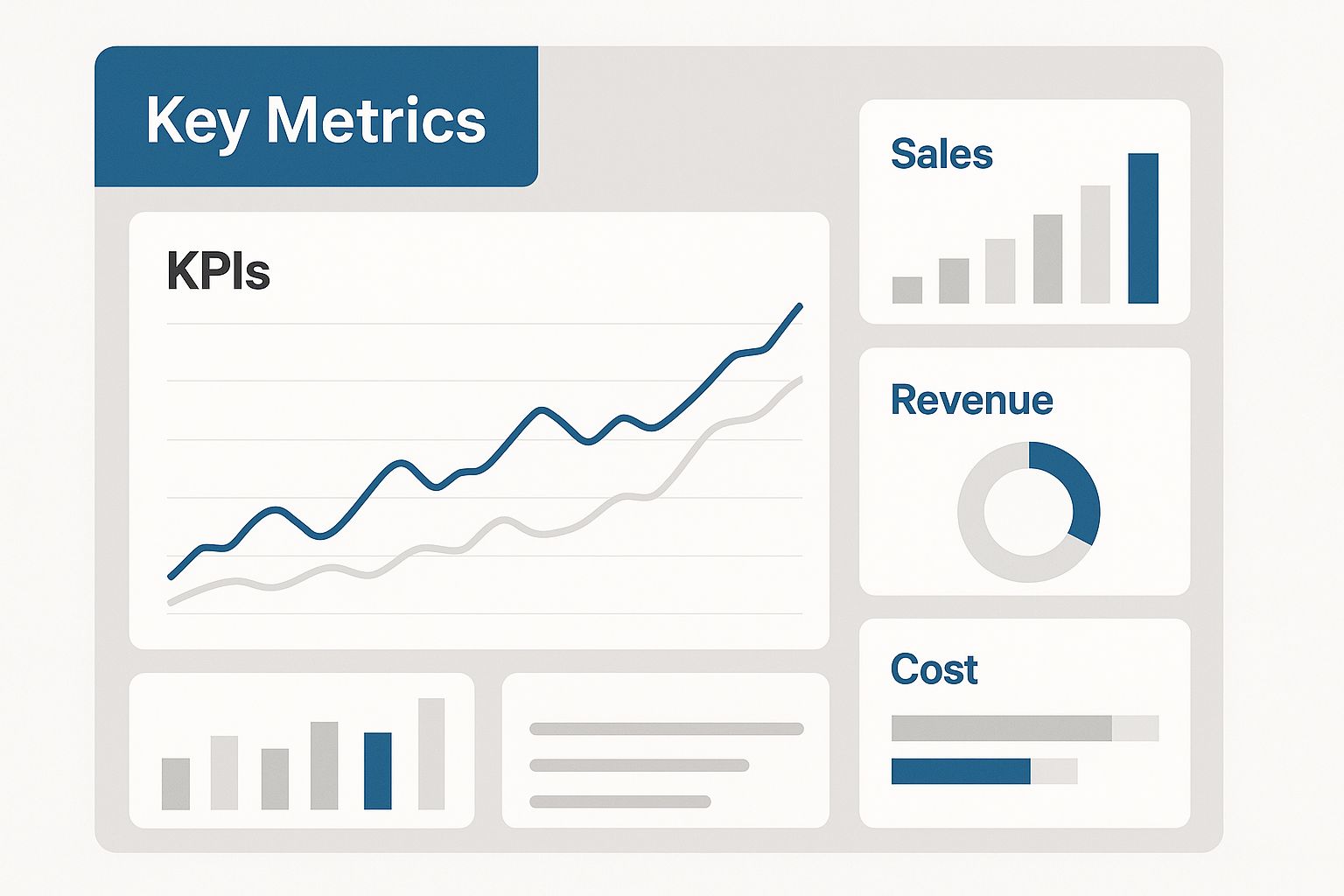
This single view offers a high-level summary of performance, enabling directors to spot trends and identify issues without waiting for manual reports.
1. Performance Benchmarking
A bank does not operate in a vacuum. True performance is relative, making accurate peer benchmarking the foundation of any sound banking strategy. Analyzing only internal trends means operating with incomplete information. It is imperative to know precisely how key metrics stack up against direct competitors.
Consider your efficiency ratio. Let's say it stands at 65%. An internal review might show marginal improvement. However, what if a BI platform like Visbanking instantly reveals that your direct peer group—banks of a similar asset size in your market—averages 58%?
That 7-point gap is no longer just a number. It represents millions in potential pre-tax profit being left on the table. This insight transforms a boardroom discussion from self-congratulation to a focused examination of the bank's cost structure.
2. Proactive Risk Management
The second pillar shifts focus from performance to preservation. Modern risk management is not about reviewing historical losses; it is about anticipating threats and acting before they materialize. The right data intelligence provides the tools for this foresight.
A robust business intelligence system transforms risk management from a defensive, compliance-driven exercise into a proactive, strategic advantage. It allows you to price risk more accurately and allocate capital more intelligently.
For instance, a BI platform can map a commercial real estate (CRE) loan portfolio against geographic and industry data. This might reveal an oversized concentration in hospitality loans within a single three-county area, representing 15% of the total loan book—a significant risk invisible on a standard balance sheet review. This knowledge empowers leadership to adjust underwriting standards or manage that exposure before a downturn in the local tourism sector impacts the portfolio.
3. Customer and Product Profitability
Not all customers and products contribute equally to the bottom line. The third pillar is about surgical precision—identifying the exact sources of profitability. Granular analysis moves beyond high-level metrics to a deep understanding of what drives revenue.
A bank might find that its top 10% of commercial clients generate 60% of its non-interest income. A deeper BI analysis could further reveal that these same clients are heavy users of treasury management services but have minimal engagement with the wealth management division.
This is not merely a data point; it is a directive for relationship managers. It provides a clear roadmap for a targeted cross-selling campaign with a quantifiable upside.
4. Operational Efficiency
The final pillar turns the focus inward. With margins under constant pressure, eliminating inefficiency is one of the most direct paths to improved profitability. Business intelligence allows for a detailed examination of operational workflows, staffing models, and channel usage.
By analyzing transaction data, a bank might discover that a specific branch experiences a 40% decline in foot traffic after 2:00 PM on weekdays, while digital channel usage for deposits surges during the same period. This data provides an undeniable foundation for re-evaluating branch hours, reassigning staff to enhance digital customer support, and ultimately reducing overhead without degrading the customer experience.
Each of these pillars demonstrates how a platform like Visbanking provides the critical intelligence needed for decisive, confident action.
Traditional Reporting vs. Modern Business Intelligence
For years, banks have relied on static reports offering a glimpse into the past. In today's market, looking backward is a recipe for falling behind. Modern business intelligence provides a dynamic, forward-looking view that is essential for strategic leadership. The table below highlights the fundamental differences.
| Attribute | Traditional Reporting | Financial Services Business Intelligence |
|---|---|---|
| Focus | Historical ("What happened?") | Predictive & Prescriptive ("What will happen & what should we do?") |
| Data | Static, siloed, and often outdated | Real-time, integrated, and interactive |
| Output | Fixed spreadsheets and PDFs | Customizable dashboards and visual analytics |
| User | IT-dependent, a few power users | Self-service, accessible to business leaders |
| Goal | Scorekeeping and compliance | Strategic decision-making and competitive advantage |
| Speed | Slow, manual report generation (days/weeks) | Instant insights, on-demand analysis |
The shift from traditional reporting to true business intelligence is not just a technical upgrade; it's a cultural one. It empowers your entire leadership team to move from being reactive observers to proactive strategists, shaping the future of your institution with data-backed confidence.
How BI Applications Drive Real-World Bank Profitability
Strategic frameworks are important, but for bank executives and directors, the ultimate question is how this impacts the bottom line. Financial services business intelligence is not an academic exercise. It is a tool for identifying—and capturing—profit opportunities hidden within your own data.
The power of BI lies in its ability to translate vast, complex data sets into clear, numbers-driven directives. It moves your team from theoretical discussions to concrete actions with measurable financial outcomes. A crucial first step is ensuring your foundational data is clean and efficiently managed through accounting process automation. With a solid data foundation, BI tools can deliver their full potential.
Let's examine two practical scenarios where BI makes a tangible difference.
Scenario 1: Optimizing the Loan Portfolio
A community bank with $750 million in assets is experiencing pressure on its Net Interest Margin (NIM). Using a BI platform, the leadership team analyzes its loan portfolio by type, officer, geography, and origination date.
The initial review shows no red flags. However, when they benchmark their commercial real estate (CRE) loan yields against a curated peer group in their specific market, they uncover a critical issue. New CRE loans originated over the last 18 months are consistently priced 15 basis points lower than what peers are achieving for similar risk profiles. This was a slow, silent erosion of margin invisible in their standard reports.
The platform didn't just report what was happening; it showed precisely where the margin was eroding. This level of detail is the difference between data and actionable intelligence.
Armed with this specific insight, the executive team acts decisively. They adjust the rate floor for new CRE loans, bringing pricing in line with the market. The projected impact of this single, data-backed decision is a $500,000 annual increase in net interest income. This is the power of turning data into dollars.
Scenario 2: Unlocking Non-Interest Income
Consider a regional bank with $3 billion in assets seeking to boost its non-interest income. The board wants a surgical, ROI-driven plan rather than a broad marketing campaign for wealth management services.
The bank leverages its financial services BI platform to analyze its deposit base with one objective: identify high-value customers who are underserved. The system quickly pinpoints a segment of 2,500 depositors with a powerful profile:
- Consistently hold deposit balances over $100,000.
- Have zero existing wealth management products with the bank.
- Show transaction patterns suggesting high disposable income.
Instead of a generic marketing blast, the bank launches a highly targeted outreach campaign exclusively for this group. The messaging is personalized, acknowledging their valued relationship and introducing the specific benefits of the bank’s wealth advisory services. The result is a 12% uptake from this small group, generating $1.2 million in new, recurring non-interest income.
This success was not a fortunate guess. It was the direct result of using data to identify a prime opportunity and executing with precision. This is exactly how a strong BI system transforms customer data into a strategic asset for growth, a concept we explore further in our guide to business intelligence for banks.
These examples underscore a simple truth for modern banking leaders: the greatest opportunities to improve profitability are already locked inside your data. The right BI platform is the key to unlocking them.
Integrating AI and Predictive Analytics into Your Strategy
For years, traditional business intelligence excelled at answering a vital question for bank leaders: "What happened?" While historical performance analysis is crucial, a true competitive edge in today's dynamic market comes from answering a more valuable question: "What will happen next?"
This is the new frontier of financial services business intelligence. Artificial intelligence (AI) and predictive analytics are no longer theoretical concepts for the tech department; they are practical, powerful tools for the C-suite. The objective is to move beyond dashboards that merely report past results and toward building a forward-looking strategy based on data-driven forecasts.
From Hindsight to Foresight
Predictive analytics examines historical data to identify patterns and forecast future trends. This is not speculation; it is the application of sophisticated statistical models and machine learning to solve real-world banking challenges. Modern BI platforms now provide these tools, enabling leadership to anticipate market shifts and mitigate risks before they materialize.
Consider loan portfolio management. Standard BI might report that the loan delinquency rate was 1.2% last month. This is useful but reactive. Predictive BI, however, can analyze thousands of data points—transaction histories, credit behaviors, economic signals—to identify specific loans that have a 75% probability of becoming delinquent in the next 90 days.
This shift from reactive monitoring to proactive intervention is a fundamental game-changer. It empowers leadership to allocate resources precisely where they are needed, addressing problems before they impact the balance sheet.
You are no longer just reporting on credit losses after the fact; you are actively preventing them. This transforms risk management from a defensive function into a strategic advantage.
Practical Applications of Predictive Intelligence
AI-driven insights have applications across the entire bank, offering clear, actionable intelligence that directly impacts the bottom line. The goal is to integrate this foresight into every major decision.
Here are a few high-impact examples:
- Predicting Customer Churn: AI models can analyze everything from account balances to transaction frequency to identify clients at risk of attrition. Imagine a model flagging a high-value commercial client whose average deposits have dropped 30% and who has ceased using digital services. This is a clear signal for a relationship manager to make a proactive call, converting a potential loss into a retained relationship.
- Real-Time Fraud Detection: Legacy fraud systems are often slow and easily circumvented. AI-powered systems learn from new fraud patterns in real time, detecting sophisticated schemes that rule-based engines miss. This can mean stopping a fraudulent wire transfer in its tracks versus weeks of damage control.
- Optimizing Capital Allocation: Predictive models can forecast demand for different loan products across various markets. If data predicts a surge in HELOC demand in a specific county, you can reallocate marketing and staffing resources to capture that opportunity before competitors even recognize it.
This advanced level of analysis is why the global business intelligence software market, valued at USD 41.74 billion in 2024, is projected to exceed USD 151.26 billion by 2034. You can discover more insights about this market expansion. This growth is driven by the integration of AI and machine learning.
Integrating these tools is a strategic necessity. At Visbanking, our platform is designed to make these advanced capabilities accessible, turning complex data into clear, forward-looking forecasts. Explore our guide on predictive analytics in banking to learn how to build a more resilient, forward-thinking institution.
A Strategic Roadmap for BI Implementation
Implementing a powerful financial services business intelligence platform is a fundamental strategic shift, not merely an IT project. For bank directors, driving this change requires a clear roadmap that prioritizes business outcomes over technical specifications. This is your blueprint for embedding data intelligence into the core of your bank’s decision-making process.
The primary objective is to move your leadership team away from static, outdated reports and toward self-service analytics where they can get answers to their most significant strategic questions in minutes, not weeks. Achieving this requires a deliberate, four-step approach.
1. Define Strategic Objectives First
A common mistake is to begin with technology. A successful BI implementation always starts with the business questions that need answers. Before evaluating any platform, your leadership team must clarify its strategic priorities.
Are you primarily concerned with margin compression? Is identifying new sources of non-interest income the top priority? Or is proactive risk management the most urgent need?
By starting with the "why," you establish non-negotiable criteria for what a BI solution must deliver. This focus ensures you invest in a tool that solves your specific business problems, not just a complex piece of software.
For example, a board might set a goal to improve the efficiency ratio by 500 basis points over the next two years. This single objective immediately frames the entire BI initiative, directing focus toward analyzing operational costs, branch performance, and staffing models.
2. Secure True Executive Buy-In
Securing buy-in extends beyond a signature on a budget approval. It requires building a solid business case that resonates with every executive and board member. This case must be built on three pillars: ROI, competitive advantage, and risk mitigation.
Present concrete numbers. Demonstrate how benchmarking loan yields against peers could uncover a 10-basis-point pricing gap, translating to a $400,000 increase in annual net interest income. Show how identifying at-risk customer segments could prevent millions in deposits from leaving the bank. This reframes the conversation from "How much does it cost?" to "How much more will we make?"
3. Choose the Right BI Partner
With your objectives defined, the next step is to select a partner, not just a product. For bank executives, the focus should be on usability and strategic value, not a long list of technical features. The key is to find a platform designed for business leaders, not data scientists.
Key criteria include:
- Ease of Use: Can a non-technical director log in and immediately begin asking questions and comparing performance against peers? If not, the platform will not be adopted.
- Data Quality and Integration: The platform must operate on clean, reliable, and integrated data. Effective financial data integration is critical to ensure insights are derived from a complete and accurate view of the bank.
- Security and Compliance: The partner must demonstrate enterprise-grade security protocols, including SOC 2 compliance. For banking, this is a baseline requirement.
4. Foster a Data-Driven Culture
Finally, a BI platform is not a one-time project; it is the catalyst for a cultural shift. Building a data-driven culture means integrating data into every high-level discussion. Board meetings should transition from reviewing static reports to interacting with live dashboards, stress-testing ideas, and modeling scenarios on the fly.
Globally, while only 26% of employees frequently use BI tools, cloud adoption for these tools is extremely high, led by North America at 87%. As you can learn more about these BI market trends, the industry is clearly moving toward greater agility. At Visbanking, our platform is designed to accelerate this cultural change by empowering leaders to turn insight into action.
Turning Data Intelligence Into Decisive Action
In banking, the speed of decision-making is a primary determinant of success. The time between gaining an insight and acting upon it is where market share is won or lost. Your competitors are not idle; they are using financial services business intelligence to optimize pricing, acquire customers, and manage risk with a precision that was previously unattainable.
The era of managing a bank on intuition and historical reports is over. Superior data intelligence now directly equates to superior performance. Period.
This is not about adopting the latest technology trend; it is a strategic imperative. When dealing with thin margins and intense competition, the ability to see precisely how you measure up against your peers provides the ultimate advantage. It transforms conversations from "I think" to "the data shows."
The purpose of a modern BI platform is to close the gap between knowing what to do and acting on that knowledge. It converts a sea of data into a clear signal for action, providing the confidence to make bold, decisive moves.
The Final Step From Theory to Practice
The question for every bank director is not if you should adopt these tools, but how quickly you can integrate them into your strategic planning process. The concepts discussed here are not theoretical; they represent the daily practices of top-performing banks.
Consider the two paths forward:
- Path A: Business as Usual. Continue making decisions based on static, rearview-mirror reports. You will perpetually react to market shifts rather than anticipating them.
- Path B: The Strategic Edge. Employ a system that delivers live, comparative intelligence. Every choice—from setting loan rates to allocating marketing budgets—is informed by a real-time understanding of your competitive position.
The choice is stark. One path leads to gradual irrelevance. The other leads to sustainable, profitable growth. The only way to fully grasp this is to see it with your own bank's data.
The journey begins with a single, concrete step. It is time to move from theory to reality and see exactly how your bank compares. This is not just another demonstration; it is the first move toward instilling a data-first discipline within your leadership team.
Explore your competitive position with Visbanking today, and discover what decisive action truly looks like.
Got Questions? We've Got Answers.
When bank leaders begin to seriously consider business intelligence, a few key questions consistently arise. Here are straightforward answers to the most common inquiries.
How Big of a Headache Is Implementation?
Modern BI implementation bears little resemblance to legacy IT projects. The days of year-long rollouts that consume internal resources are over.
Cloud-based BI platforms like Visbanking are engineered for rapid deployment. We securely connect to your existing data sources—from call reports to core systems—and deliver executive-level dashboards within weeks, not years. We handle the heavy lifting, allowing your team to focus on using the insights.
What’s the Real ROI Here?
The return on investment for a BI platform is not a fuzzy, theoretical benefit. It is a direct and measurable impact on the income statement.
The misconception that BI's ROI is difficult to quantify is incorrect. It is one of the most direct and measurable technology investments a bank can make. A straight line can be drawn from the insight to the financial result.
Consider these tangible examples:
- Boost Net Interest Margin (NIM): Benchmarking your loan pricing against peers can reveal significant opportunities. A 10-basis-point adjustment on a $200 million loan portfolio adds $200,000 directly to your bottom line.
- Find New Non-Interest Income: Identifying high-value depositors who are not using other bank services enables targeted cross-selling campaigns that drive new fee income.
- Cut Operational Fat: Analyzing branch traffic and staffing patterns allows for optimization of hours and resource allocation, leading to direct reductions in overhead.
Is Our Data Actually Secure on Someone Else's Platform?
Security is non-negotiable. Leading BI providers for the financial industry operate with security as a foundational principle, often exceeding the measures that many banks can maintain internally.
This includes SOC 2 compliance, end-to-end data encryption (in transit and at rest), and strict role-based access controls. These systems are architected from the ground up to meet the stringent requirements of financial regulators. Your data's security is not a feature; it is the entire foundation of the service.
In banking, the value of superior intelligence cannot be overstated. With Visbanking, you gain the clarity to benchmark your performance, identify opportunities, and execute your next strategic move with absolute confidence.
Latest Articles

Brian's Banking Blog
Tokenized Deposits Just Went Mainstream — And Your Bank Is Already Behind

Brian's Banking Blog
Winning the Talent War for Credit Management Jobs

Brian's Banking Blog
AI Vendor Risk Is Your Bank's Biggest Blind Spot

Brian's Banking Blog
Ad Hoc Reporting Means Decisive Action for Banking Leaders

Brian's Banking Blog
FDIC Just Opened Failed Bank Auctions to Private Equity — Is Your Bank Ready?

Brian's Banking Blog