
A Strategic Executive's Guide to Customer Segmentation in Banking
Brian's Banking Blog
Customer segmentation is not a marketing exercise. It is the core practice of grouping your bank's customers based on who they are, what they need, and what they will do next. This isn't about creating charts for a presentation; it's a fundamental strategy for identifying risk, driving profitability, and securing a competitive advantage. It means looking past basic demographics to understand the financial DNA of your clientele and acting on that intelligence with precision.
Why Traditional Banking Segments Are Failing

For decades, the banking playbook was simple. Customers were sorted into static boxes defined by age, income, and ZIP code. A "high-net-worth individual" was a number in an assets-under-management column. A "young professional" was an age bracket and a job title. That model was once sufficient. Today, it is a direct path to irrelevance.
The financial services landscape is no longer a protected local market. It is a hyper-competitive arena where fintechs and other nimble players are not just offering better rates—they are winning with superior, data-driven customer experiences.
They understand that a 35-year-old urban professional saving for a primary residence has fundamentally different needs than a 35-year-old entrepreneur financing their second business, even if they draw the exact same salary. Traditional segmentation misses this distinction entirely.
The Cost of Inaction
Adherence to outdated demographic buckets exposes an institution to significant strategic risk. When you cannot differentiate between customers who only appear similar on the surface, you fail to address their actual needs. This is not a minor oversight; it is a critical vulnerability.
- Losing Your Best Customers: A competitor using behavioral data can identify that your customer is preparing for a major capital outlay—a home purchase or business expansion. They will preemptively deliver a tailored loan product before your institution is even aware of the opportunity. For a community bank, losing a single high-value commercial relationship due to inaction can mean a $2-5 million loss in potential loan volume.
- Wasting Marketing Dollars: Broad campaigns aimed at "millennials" or "retirees" are inefficient and ineffective. A bank might spend $50,000 on a digital HELOC campaign that reaches thousands of homeowners, yet a data-driven competitor will spend $5,000 targeting the 200 households actively researching home renovation financing, achieving a far higher conversion rate.
- Failed Cross-Selling Attempts: Without a complete view of a customer's financial life, cross-selling is reduced to guesswork. Actionable segmentation uncovers opportunities based on behavior, not assumptions.
Here is the critical takeaway: traditional segmentation tells you who a customer is. Modern, data-driven segmentation tells you what they are about to do. The latter is where competitive battles are won.
Leading institutions understand that advanced customer segmentation is a strategic imperative. It is about deploying data to anticipate customer needs, personalize every interaction, and secure market share. It is precisely why we built the intelligence layer in Visbanking’s BIAS—to enable banks to move from reviewing static reports to executing decisive, profitable actions.
To compete, you must see your customers with the same clarity as your most aggressive rivals. This begins with recognizing that the old methods are no longer sufficient.
The Four Pillars of Modern Customer Segmentation
To be effective, customer segmentation must be built upon four distinct but interconnected pillars. This is not about applying generic labels; it's a systematic approach to understanding who your customers are, where they are located, why they make financial decisions, and how they interact with your institution.
Mastering these four dimensions is the foundational step toward a strategy that anticipates customer needs rather than merely reacting to them. The goal is to know what your clients require before they ask—and certainly before your competitors do.
This is not theoretical. The infographic below demonstrates how this multi-layered approach translates directly into a healthier bottom line.

As shown, the path to improved ROI and customer retention begins with personalization, and that personalization is powered by an intelligent segmentation strategy.
Demographic: The "Who"
This is the baseline: quantifiable, statistical data about an individual. It includes age, income, gender, and occupation. While it's a necessary starting point, it is insufficient on its own. Knowing a customer earns $150,000 annually reveals very little about their financial behaviors or future needs.
However, when combined with other data layers, demographics become powerful. A high-earning 32-year-old is a data point. A high-earning 32-year-old with two young children who just increased their direct deposit by 20% is a strategic opportunity for discussions about 529 college savings plans or a larger mortgage.
Geographic: The "Where"
This pillar segments customers by physical location—state, city, or even specific census tract. Historically, this data informed branch placement. Today, its application is far more sophisticated.
Modern data intelligence can draw a direct line between a geographic area and the financial products its residents are actively seeking. A bank may discover that a specific suburban ZIP code has a mortgage refinance rate 30% higher than the regional average, while a downtown district shows a surge in demand for high-yield savings accounts among renters. Tools like Visbanking’s BIAS platform identify these hyper-local trends, enabling you to deploy marketing capital with surgical precision.
A customer's location is more than an address; it's a proxy for their lifestyle, community, and potential financial needs. Ignoring this layer of data is equivalent to ignoring the local economy in which you operate.
Psychographic: The "Why"
This is where we move from observation to understanding. Psychographics delve into a customer's core values, attitudes towards money, lifestyle, and financial personality. Are they a risk-averse saver focused on long-term security, or an ambitious investor seeking growth opportunities?
Understanding these motivations is how you build genuine trust and product alignment. A customer who prioritizes environmental and social governance (ESG) is a prime candidate for your sustainable investment funds. Another who values ultimate convenience will be a power user of your most advanced digital banking tools. These are the critical insights that demographics miss but are essential for creating meaningful engagement.
To explore this dimension further, review our complete guide to bank customer segmentation.
Behavioral: The "How"
This is arguably the most powerful pillar. Behavioral segmentation analyzes what customers actually do. It is based on concrete, observable actions.
- Transaction Patterns: A customer making frequent international wire transfers signals a need for foreign exchange services or multi-currency accounts.
- Product Usage: A client consistently hitting their credit card limit but paying the balance in full each month is an ideal candidate for a premium rewards card with a higher credit line.
- Channel Engagement: The customer who uses the mobile app exclusively for deposits but always calls a relationship manager for investment advice has explicitly defined their preferred hybrid service model.
This is the data that provides predictive power. A series of large, sudden deposits is not just a balance change; it may be the accumulation of a down payment for a new home. Intelligent systems like Visbanking are designed to detect these signals, cutting through transactional noise to provide your team with a clear directive to act.
By integrating these four pillars, you stop seeing customers as entries in a database. You begin to see the whole person, and that changes everything.
Actionable Segmentation Models for Banking
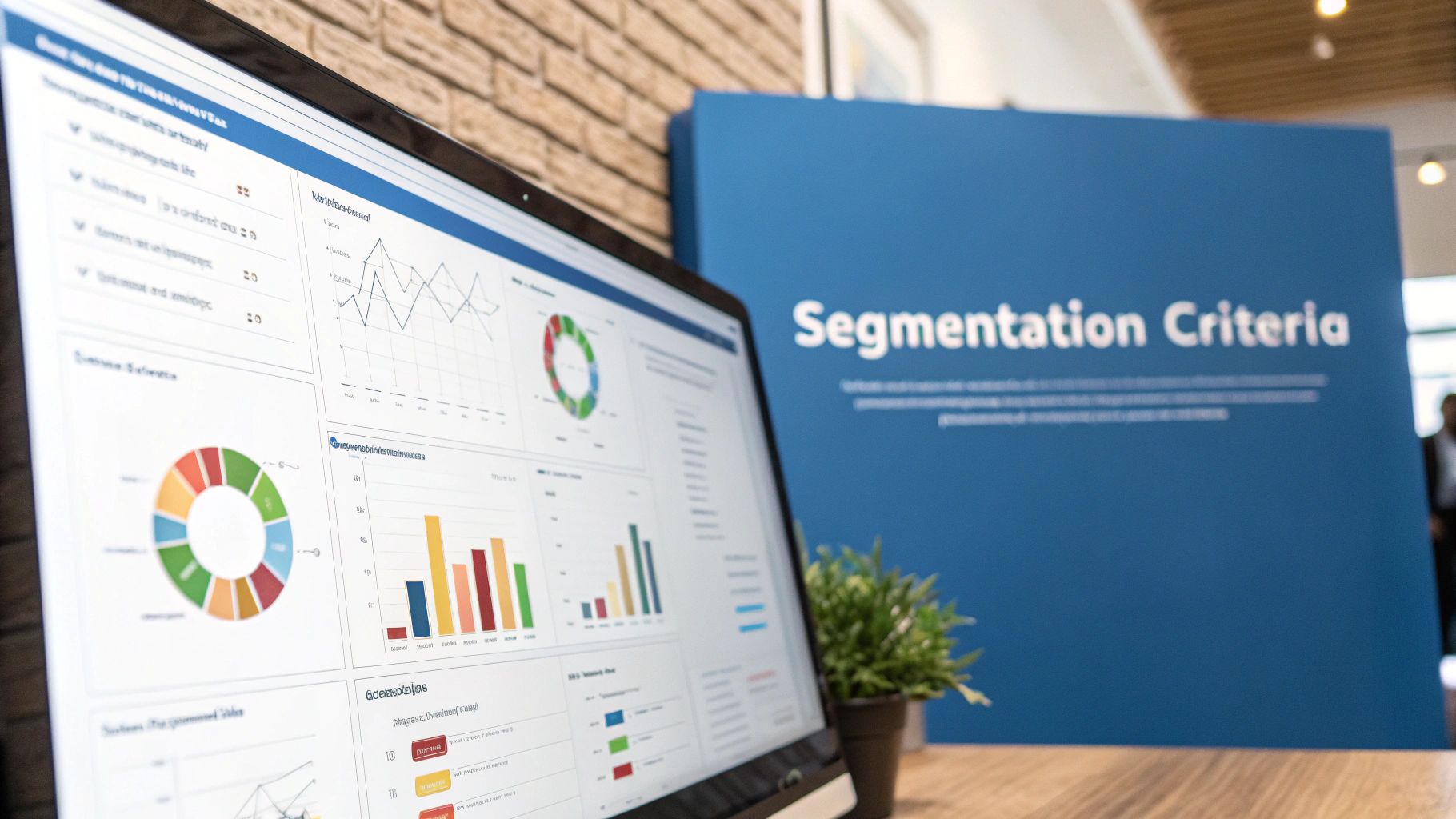
Understanding segmentation theory is one thing. Implementing it to drive revenue and deepen loyalty is another matter entirely.
Effective segmentation is not an academic exercise. It is a powerful tool for daily operations—a method to find, target, and serve specific customer groups with the precision they now expect. The most competitive banks are moving beyond broad-stroke categories to build dynamic models that reflect the complex financial lives of their customers.
Value-Based Segmentation
This model addresses the most critical question: who are your most profitable customers? It provides a clear, quantitative view of customer value by analyzing deposit balances, loan portfolios, investment holdings, and fee income.
This goes beyond simply identifying high-net-worth individuals. Consider the customer with a modest checking account who also holds a mortgage, an auto loan, and a small business line of credit with your bank. Their lifetime value could easily eclipse that of a client with a large but dormant savings account.
Example in Action: A community bank identifies a segment of 250 households with a total relationship value exceeding $750,000. Instead of generic marketing, each household is assigned a dedicated relationship manager who proactively offers annual financial reviews and priority access to wealth advisors. This targeted initiative protects $40 million in core deposits and generates a 15% lift in new investment product adoption from that segment alone within 12 months.
Needs-Based Segmentation
Value-based segmentation tells you who to talk to. Needs-based segmentation tells you what to talk about. This approach groups customers based on their specific financial goals and challenges, inferred from their behavior—transaction histories, credit inquiries, and digital footprints.
Are they aggressively saving for retirement? Funding a child's education? Managing cash flow for their business? Each need corresponds to a specific product or service you offer. A customer who repeatedly moves large sums to an external brokerage account is signaling a clear need for a conversation with your investment team.
Banks using AI-powered tools have seen customer engagement increase by as much as 30% by using this model. Analyzing real-time behaviors allows them to pinpoint micro-segments with specific needs, as detailed in recent global consumer banking reports.
Life-Stage Segmentation
An individual's financial priorities evolve predictably over their lifetime. This model anticipates these shifts, turning major life events into opportunities for your institution to provide timely, relevant solutions. It combines demographic data (age) with behavioral triggers (changes in spending or saving).
- Early Career (22-30): Focused on managing student debt, building credit, and initial savings. Prime candidates for high-yield savings, starter credit cards, and financial literacy tools.
- Family Formation (30-45): Key activities include home buying, saving for college, and increasing insurance coverage. Target with mortgages, 529 plans, and HELOCs.
- Peak Earning Years (45-60): Concentrated on maximizing retirement contributions and wealth transfer planning. Receptive to investment products and trust services.
- Pre-Retirement (60+): Primary goals are capital preservation and income generation. Need guidance on retirement fund management, annuities, and estate planning.
A platform like Visbanking’s BIAS system provides the intelligence to activate these models. It connects the dots between a new payroll deposit, a large payment to a wedding venue, and a visit to your online mortgage calculator, transforming disparate data points into a clear customer narrative. This enables your team to move from reactive service to proactive advising, placing the right offer in front of the right person at the right time.
The true power of customer segmentation in banking is realized when these models are dynamic, continuously updated with new data. That is how you win—not on rates, but on relevance.
Bridging the Digital and Physical Divide
The "digital versus branch" debate is a false dichotomy and a dangerous strategic trap.
Too many executives operate under the assumption that customers exist in one channel or the other. They do not. The real challenge—and the most significant opportunity—lies in creating a seamless, high-value experience regardless of how a customer chooses to engage. This is achievable only through sharp, actionable customer segmentation in banking.
Dismissing branches as relics is a profound error. So is assuming every customer desires a purely digital relationship. The future is not about choosing between channels; it is about intelligently integrating them, guided by a deep understanding of customer behavior and needs.
This is where your data must drive strategy. Forget clumsy generational buckets. The focus must be on precise behavioral groups that transcend age. Consider a "Digital-First, High-Complexity" customer. This segment could include a 28-year-old software engineer and a 55-year-old surgeon. Both may conduct 90% of their daily banking online, but both will demand a face-to-face meeting with an expert for significant financial planning.
Uncovering What Customers Really Want
Recent data confirms this hybrid reality. Despite the surge in digital banking adoption, entrenched assumptions are proving incorrect.
While 65% of Gen Z and Millennials state a preference for digital-first banking, a nearly identical percentage of Gen X and Boomers still rely on the trust and personal interaction of a physical branch. Even as the number of U.S. branches has declined by 24% over the last decade, a decisive 65% of all customers view them as essential for resolving complex financial matters, according to Accenture’s latest global banking research. You can review their full 2025 consumer report for detailed findings.
The strategic implication is clear: your institution must serve both the digital native and the branch-reliant client, because they are often the same person.
Leading banks are no longer managing separate channels; they are orchestrating unified customer journeys. They know a journey might begin on the mobile app, continue on the website, and culminate in a face-to-face meeting. Every touchpoint must feel connected and intelligent.
Using Segmentation to Optimize Both Worlds
A powerful bank digital strategy does not mean eliminating your branch network. It means redefining its purpose. Proper segmentation is the mechanism that enables you to make optimal investments in both your digital platforms and your physical footprint.
Here’s how data-driven segmentation drives success across both domains:
- For Your Digital Channels: Identify segments of heavy mobile users who are not engaging with your financial planning tools. This is a clear signal to deploy targeted in-app tutorials or push notifications directly to those users most likely to benefit, thereby increasing engagement and ROI on your technology investments.
- For Your Physical Branches: Pinpoint geographic areas with a high concentration of 'Relationship-Driven' customers, such as small business owners or pre-retirees. Instead of closing a branch in that area, transform it into an advisory hub staffed with specialists in commercial lending or wealth management, directly aligning services with the demonstrated needs of the local community.
A system like Visbanking’s BIAS delivers the clarity required to execute this dual strategy. By analyzing actual customer behavior, it can identify a segment of "Digitally-Assisted Investors"—clients who conduct research online but prefer to execute trades with an advisor.
This insight is invaluable. It dictates resource allocation, ensuring your digital platforms are optimized for self-service while your branch teams are prepared for high-value, consultative interactions.
It is time to stop guessing what customers want and start using data to build the precise banking experience each segment demands.
Turning Customer Segments Into Growth Engines

Let's be direct. Customer segmentation in banking too often concludes with categorizing clients into static boxes. The strategic imperative is to think beyond mere organization. True segmentation is about transforming your best customers into a powerful, self-sustaining growth engine for your bank.
The objective is to move beyond identifying high-value customers to systematically creating brand advocates. These are the clients who not only remain loyal but also actively drive new business to your institution.
This creates a flywheel effect: advocates deepen their own relationships, exhibit lower price sensitivity, and provide the highest-quality referrals possible. This organic growth dramatically reduces customer acquisition costs and builds a competitive moat that cannot be overcome by a rival's marketing budget. It represents a shift from passively serving customers to actively cultivating an army of proponents.
This is not about chasing high satisfaction scores. It is a deliberate strategy: identify customers with advocacy potential, deliver proactive and personalized service, and measure the direct impact on your bottom line.
Identifying and Cultivating Your Advocate Segment
The first step is to identify customers with the potential to become your most effective advocates. This requires looking beyond satisfaction metrics to find specific behaviors and attributes that signal deep-seated loyalty. An intelligence platform is essential here, integrating disparate data points to flag these individuals.
Key indicators include:
- High Product Penetration: A client using your checking, savings, mortgage, and investment services has already demonstrated immense trust.
- Positive Engagement Patterns: These customers provide unsolicited positive feedback, respond favorably to surveys, and demonstrate high engagement with your communications.
- Referral Behavior: Even without a formal program, some customers are natural referrers. This behavior must be tracked.
Example in Action: A mid-sized bank uses its data intelligence platform to identify a "Pre-Advocate" segment of 2,500 customers who hold three or more products and have a Net Promoter Score above 80. Instead of standard marketing, this group receives proactive outreach from a senior relationship specialist. This includes valuable insights, such as a notification about a maturing CD accompanied by a pre-approved, higher renewal rate.
This proactive, high-value engagement transforms a satisfied customer into a loyal advocate. The result? Within six months, this targeted group increases its product holdings by 10%. More importantly, new customer referrals directly attributable to this segment increase by 40%. A small, focused effort yields a measurable return in both share of wallet and organic growth.
Measuring the True ROI of Advocacy
The impact of advocacy initiatives must be tracked with the same rigor applied to loan performance or deposit growth. Many banks fail here, lacking the tools to connect these "soft" initiatives to hard financial results. The goal is to measure business outcomes, not sentiment.
This is not theoretical; it is how leading global banks are outperforming the market. A recent Accenture study revealed that while 73% of banking customers use multiple providers, banks in the top quintile for customer advocacy achieve 1.7x faster revenue growth. Their advocates also hold 17% more products, increasing share of wallet by 5–30%. You can explore how advocacy is powering banking growth here.
To achieve these results, leading banks use advanced analytics to predict advocacy potential by analyzing customer interactions and life events. It is a strategic shift from passively collecting survey data to actively driving growth with intelligence.
A robust platform like Visbanking’s BIAS provides the clarity to execute this strategy. It helps your bank move from simply viewing customer data to acting on it with surgical precision. It reveals the signals of a potential advocate, equips your team with the insights to cultivate that relationship, and allows you to benchmark the direct financial return of your efforts against your peers.
This is the future of sustainable growth in banking: turning your best customers into your most effective sales force.
Your Roadmap to Intelligent Segmentation
Let's be clear: truly advanced customer segmentation in banking is not another project. It is a fundamental shift in how your entire institution operates.
Transitioning from concept to capability requires a clear, executive-led roadmap. This is not a technical manual for your IT department; it is a strategic guide for leadership. Success depends on three pillars. Execute them well, and the results will follow. Falter on one, and even the most sophisticated analytics will fail to deliver value.
The goal is not a one-time analysis but the permanent installation of a powerful capability into your bank's operational DNA.
The Executive's Implementation Path
How do you convert data into decisive action and sustainable growth? The process must be championed from the top down, following a structured path that ensures your investment generates returns across the entire organization.
Step 1: Data Readiness Assessment. Before evaluating any technology, you must conduct a frank assessment of your data infrastructure. Can you create a single, unified view of the customer from disparate sources—core systems, CRM, digital channel interactions? The fundamental question for the board is: Do we trust our data to tell the complete and accurate story of our customers?
Step 2: Technology and Partner Evaluation. Once your data landscape is understood, you can select the right intelligence platform. The objective is not to find a tool that produces charts, but a system that delivers actionable insights. A partner like Visbanking provides this critical intelligence layer, connecting raw data to strategic objectives and identifying opportunities your competitors will miss.
Step 3: Organizational Alignment. This is the most critical and often overlooked stage. Your teams—from marketing and product development to front-line branch staff—must be trained and empowered to use these new segments. This requires embedding segmentation into performance metrics, compensation plans, and daily workflows. It must become a core component of your banking strategic planning.
The transition to intelligent segmentation is an enterprise-wide initiative. It demands leadership's unwavering commitment to dismantling internal silos and fostering a culture where data-driven decisions are the standard operating procedure.
This roadmap transforms customer segmentation from an abstract marketing concept into a core business discipline. It is about building the institutional capacity to anticipate customer needs, personalize every interaction, and create undeniable value that secures loyalty and fuels growth.
The path forward requires clarity and a trusted partner to navigate the complexity. The first step is to establish a baseline. Let's benchmark your current strategy against your peers and explore how Visbanking’s BIAS system can deliver the intelligence you need to lead.
Got Questions? We've Got Answers.
As a bank leader, your time is your most valuable asset. Here are direct answers to the most common executive questions regarding customer segmentation.
How Fast Will We Actually See a Return?
Faster than you might expect. The return on this investment is not measured in years.
Initial wins from more intelligent marketing campaigns and resource allocation typically materialize within the first 3-6 months. For example, identifying a segment of customers whose spending patterns indicate an imminent home renovation allows for a targeted HELOC offer, drastically improving conversion rates over broad-based advertising.
More substantial impacts, such as a significant lift in customer lifetime value and reduced attrition, build over the following 12-18 months. This is the timeframe in which your institution masters the art of proactive, needs-based communication at scale.
What's the Single Biggest Mistake Banks Make With This?
Treating it as a one-time project. The most common failure is creating a set of static segments, documenting them in a report, and then failing to integrate them into daily operations. This renders a powerful strategic tool inert.
Think of customer segmentation less like a printed map and more like a live GPS. It requires a constant stream of new data to remain accurate and must be woven into every decision, from the front line to the boardroom. If it is not operational, it is a failure. Period.
Does This Mean We Have to Rip Out Our Core System?
Absolutely not. This is a common and costly misconception. A multi-year IT overhaul is not a prerequisite for intelligent segmentation.
The strategic approach is to deploy an intelligence layer—such as Visbanking's BIAS system—that integrates with your existing infrastructure. It extracts and harmonizes data from your core, CRM, and digital platforms, transforming it into actionable, strategic insights.
This allows you to leverage the power of modern analytics without the massive disruption of a core conversion. The goal is to make your existing data work smarter for you today.
In banking, data isn't enough. You need clarity. At Visbanking, we turn that mountain of customer information into your next profitable decision. See how you stack up against your peers and find your next best customer.
Latest Articles
Brian's Banking Blog
Commercial Lending Trends: What Bank Executives Must Know
Brian's Banking Blog
Bank Marketing Dataset Analysis Strategy

Brian's Banking Blog
ESG Peer Benchmarking for Bank Leaders
Brian's Banking Blog
What Is Repricing Risk: A Bank Executive's Guide
Brian's Banking Blog
How to Manage Vendor Relationships in Banking
Brian's Banking Blog