
Customer Relationship Management for Banks: A Strategic Playbook for Executives
Brian's Banking Blog
Customer relationship management (CRM) in banking is not an IT initiative; it is a core business strategy. The central premise is simple: leveraging data to understand clients with precision, thereby building defensible, long-term value.
The era of transactional banking is over. Sustainable profitability is now achieved by cultivating relationships, anticipating customer needs, and providing advisory value. For bank leadership, mastering a data-driven CRM strategy is no longer optional—it is fundamental to competitive survival and growth.
Why Relational Banking Is the New Competitive Battlefield

In a commoditized market, the distinguishing factor is not product features; it is the intelligence and depth of customer relationships. This requires a strategic pivot from a product-centric model to a customer-centric one.
Operating without a modern, integrated Customer Relationship Management (CRM) system is equivalent to managing a loan portfolio without credit scores. Every decision is based on incomplete information, high-value opportunities are systematically missed, and risk is amplified. A bank may see a single large deposit but lacks the context to act. Is it proceeds from a business sale, an inheritance, or capital awaiting deployment elsewhere? Without a unified data view, the bank cannot know, and therefore, cannot advise.
This operational blindness prevents the identification of high-profitability clients, cross-sell opportunities, and early-warning signs of attrition. Front-line teams are relegated to a reactive posture, responding to requests rather than proactively guiding clients toward optimal financial outcomes.
The Strategic Shift from Transactional to Relational Banking
The distinction between legacy and modern banking models is stark. For executives, grasping this shift is critical to steering the institution toward sustainable growth and franchise value.
| Metric | Transactional Model (Legacy) | Relational Model (CRM-Driven) |
|---|---|---|
| Primary Goal | Maximize volume of individual sales | Maximize lifetime value of each relationship |
| Customer View | Fragmented by product (loan, deposit, etc.) | Holistic, 360-degree view of the entire client |
| Data Usage | Used for basic reporting and record-keeping | Used for predictive insights and proactive advice |
| Sales Approach | Reactive, product-focused selling | Proactive, needs-based advising |
| Success Metric | Number of accounts opened, loan volume | Customer profitability, retention, wallet share |
| Technology | Siloed systems, manual data entry | Integrated CRM as the central intelligence hub |
Clinging to the transactional model exposes a bank to competitive threats. The relational model, powered by a robust CRM, builds a competitive moat rooted in superior customer intelligence.
The Cost of Inaction
The financial consequences of a fragmented customer view are tangible and severe. Consider a commercial client with a $2 million operating account, a $5 million credit line, and treasury management services. Without a unified CRM, the loan officer sees only the credit line, the branch manager sees only the deposits, and the treasury specialist sees only their services. No single individual comprehends the full relationship.
When a competitor offers a slightly better rate on an equipment loan, the bank is blindsided. The entire relationship, worth over $150,000 in annual revenue, is now at risk. The cause is not an individual failure but a systemic one, stemming from a fragmented data strategy.
A robust CRM, powered by precise data intelligence, is the definitive tool for building long-term franchise value and navigating market uncertainties with confidence. It transforms customer data from a passive record into an active strategic asset.
The Market Is Moving—Fast
The industry’s pivot to the relational model is accelerating, creating a performance gap between institutions that adapt and those that do not. The global banking CRM market, valued at USD 20.06 billion, is projected to exceed USD 43.38 billion by 2032. This growth is driven by intense customer expectations and regulatory pressures. You can learn more about the banking CRM market trends and their strategic implications.
A well-executed CRM strategy becomes the central nervous system of the bank, turning raw data into actionable intelligence. This is where Visbanking’s BIAS provides a decisive advantage. By benchmarking internal performance against real-time peer and market data, executives can validate strategies and identify opportunities invisible to competitors.
The question is not if a bank requires a sophisticated CRM strategy, but how quickly it can be deployed to defend and grow market share. To own your market, you must first measure your position within it. Explore Visbanking’s data intelligence platform to see how benchmarking transforms insight into market power.
Building a High-Performance Banking CRM Framework
An effective CRM strategy is not a software purchase; it is a disciplined operational framework. For banking executives, the focus must be on three core components that directly impact the bottom line and competitive positioning. These are strategic imperatives that convert raw data into a competitive weapon.
This dashboard mockup illustrates how key CRM features converge to provide a high-level view, enabling faster, more informed executive decisions.
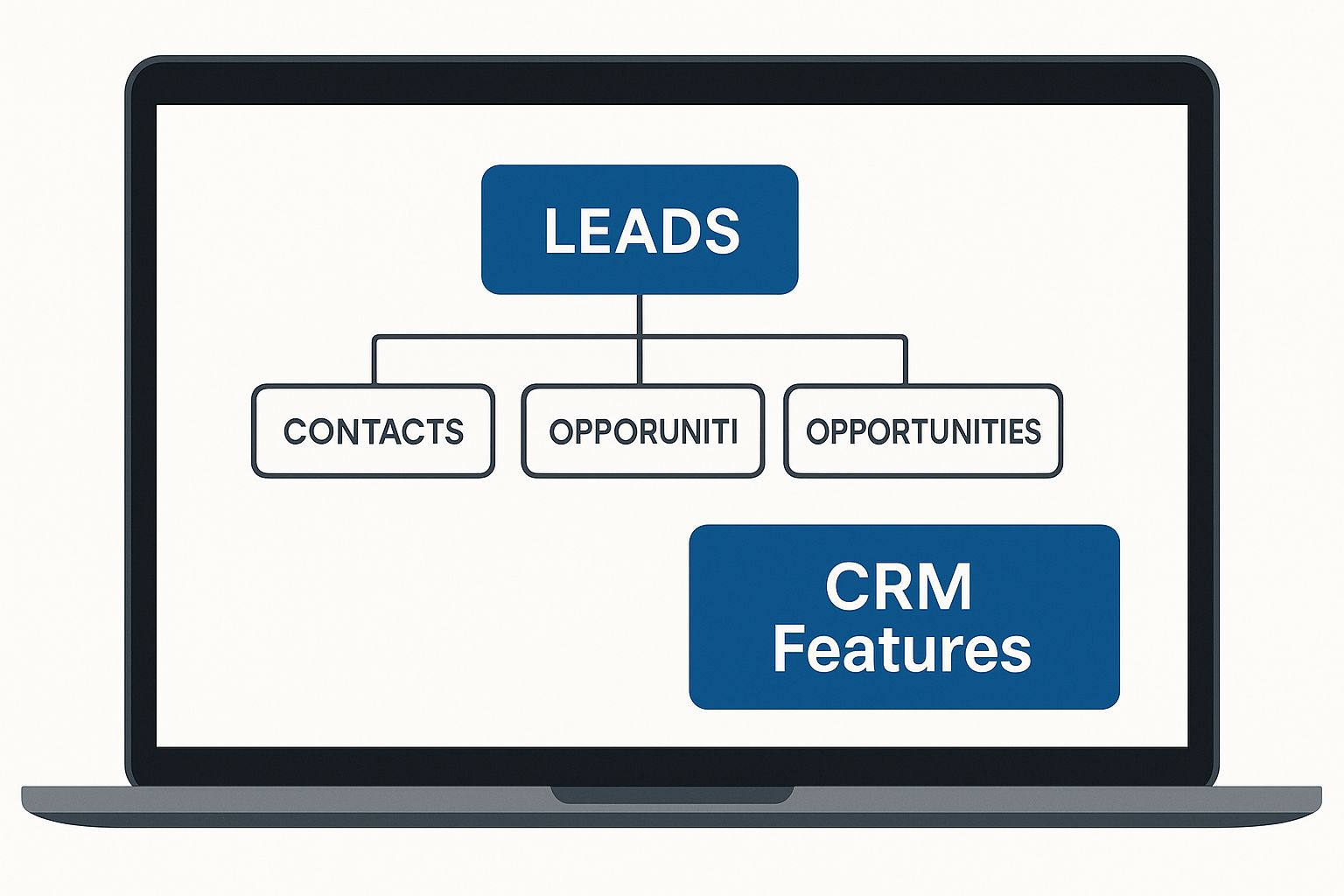
A powerful CRM consolidates critical data, providing the clarity required for decisive action.
Pillar 1: The Unified Customer View
The foundation of any high-performing banking CRM is a single source of truth for every client. Data currently siloed in loan systems, core deposit platforms, and wealth management software must be unified.
A unified view consolidates every interaction, transaction, and product holding into a complete profile. This is about establishing context. When a relationship manager can view a client’s $1.2 million commercial mortgage alongside their $400,000 operating account and personal investments, the conversation shifts from product sales to strategic financial partnership.
Pillar 2: Proactive Sales and Service Enablement
With a 360-degree view established, the next imperative is to equip front-line teams with predictive insights. A modern CRM moves beyond historical reporting to forecast future client needs, transforming data intelligence into a primary sales tool.
Imagine a relationship manager receives a CRM-generated alert: a commercial client exhibits cash flow patterns and industry trends indicating a 65% probability of requiring equipment financing within six months.
This single insight changes the dynamic. Instead of reacting to a competitor's offer, the team proactively initiates a consultative discussion about growth. A $500,000 loan is secured before the client even considers external options.
This is the tangible ROI of a properly implemented CRM. It provides the intelligence to anticipate client needs and capture business that would otherwise be lost.
Pillar 3: Automated Journey Orchestration
The final pillar involves scaling personalized engagement across the entire customer base. Automated journey orchestration uses CRM data to trigger timely, relevant communications, making personalization efficient.
For example, when a customer’s five-year mortgage renewal approaches, the CRM can automatically initiate a sequence:
- An email is sent 90 days prior with preliminary renewal options.
- At 60 days, a task is assigned to their personal banker for a follow-up call.
- If the customer browses refinancing rates on the bank's website, targeted digital ads for home equity lines of credit are displayed.
This automated, multi-channel approach maintains customer engagement in a relevant manner without overburdening staff. It is the mechanism for building loyalty at scale.
These three pillars—a unified view, proactive enablement, and automated orchestration—are the foundation of a CRM strategy that drives measurable results. Their power is amplified when internal data is contextualized with external market intelligence. Platforms like Visbanking’s BIAS provide this external lens, enabling you to benchmark performance and validate that CRM-driven initiatives are capturing market share.
To lead, you must understand both your customers and your competitive standing. Explore our data platform to see how benchmarking turns CRM insights into market dominance.
How Data-Driven Segmentation Unlocks Real Profitability

A banking CRM provides the framework for growth, but its power is unlocked through intelligent customer segmentation. The legacy approach of grouping customers by simple demographics like age or zip code is obsolete. True competitive advantage is derived from a more sophisticated methodology.
Modern segmentation analyzes behavioral and value-based metrics, such as Customer Lifetime Value (CLV), risk profiles, and product propensity. It is about understanding not just who customers are, but what they are likely to do next. The raw data residing in core systems is a strategic asset; with an analytical lens, it becomes a tool for targeted, revenue-generating action.
Moving Beyond Basic Demographics
Traditional segmentation fails because it relies on broad assumptions. Grouping all customers aged 45-55 in an affluent neighborhood into one cohort presumes homogenous needs, leading to generic marketing, poor conversion rates, and wasted resources.
Data-driven segmentation creates micro-segments based on actual financial behaviors:
- High-Value Depositors: Identify clients with significant cash reserves who lack a corresponding wealth management relationship.
- Prime Mortgage Refinancers: Flag customers with mortgage rates substantially above current market rates, creating an opportunity for proactive outreach.
- Small Business Growth Candidates: Pinpoint business clients with increasing deposits and transaction volumes who are likely candidates for a new credit line or treasury services.
This is not merely better marketing; it transforms a cost center into a direct driver of profitable growth.
A Practical Scenario: From Data to Dollars
Consider a community bank with $1.5 billion in assets. Using its CRM and external market intelligence, it identifies 400 households with average deposit balances over $300,000 but no existing wealth management relationship. Market analysis from a platform like Visbanking confirms this segment is underserved.
The bank executes a hyper-personalized campaign, delivering tailored content on capital preservation and retirement income strategies. Relationship managers are armed with detailed customer profiles, enabling meaningful dialogue.
The result: a 12% conversion rate, yielding 48 new wealth management clients and $45 million in new assets under management in a single quarter. This is the outcome when a CRM is leveraged as a strategic profitability engine.
The Accelerating Need for Intelligent Systems
This shift is a necessity. The banking CRM software market is projected to grow from USD 15.4 billion to USD 18.14 billion in a single year, a compound annual growth rate of 17.8%. This expansion is fueled by the demand for automated insights and the rising volume of digital transactions.
The takeaway for bank executives is clear: internal data is valuable only when contextualized. Platforms providing robust financial data integration are essential for converting raw numbers into strategic actions. Understanding your own data is the first step. Benchmarking it against competitors and the broader market is what empowers decisive, profitable decisions.
Fortifying Risk Management and Regulatory Compliance
For any bank director or executive, risk management is the foundation of institutional stability. While often viewed through a sales and marketing lens, a customer relationship management for banks system is one of the most powerful tools for constructing an ironclad compliance and risk management framework.
A centralized CRM provides a complete, auditable history of every customer interaction—every email, call, meeting, and inquiry is logged in a single, unified record. This "single source of truth" is invaluable for dispute resolution and, more critically, for demonstrating to regulators that the bank adheres to consistent, well-documented processes.
From Data Points to Defensive Actions
This unified record-keeping shifts risk management from a reactive to a proactive posture. By consolidating customer data from across the institution, a CRM enables compliance teams to identify anomalous behavior that siloed systems would miss, transforming static customer profiles into an active surveillance tool.
Consider a real-world example: A long-time commercial client, operating almost exclusively in the U.S., initiates a series of unusual international wire transfers to a high-risk jurisdiction. In a disconnected system, these transfers might go unnoticed. A well-configured CRM, however, flags this deviation from the client’s established behavioral baseline instantly, triggering an automated alert to the compliance team. This single alert can preempt a potential money laundering event, saving the bank from significant financial penalties and reputational damage.
Ensuring Policy Consistency and BSA/AML Adherence
The ability to monitor and flag such irregularities is central to a robust Bank Secrecy Act (BSA) and Anti-Money Laundering (AML) program. A CRM ensures that compliance policies are not merely documented but are consistently applied across all customer touchpoints. It provides the clear data trail required to navigate regulatory examinations successfully.
A CRM system turns compliance from a reactive, check-the-box exercise into a proactive, data-driven defense. It provides the evidence and early warnings needed to protect the bank's assets and charter.
Integrating CRM data with external benchmarks provides an additional layer of strategic insight. Before examining a platform that facilitates this, let's review how CRM data serves as a critical input across various bank departments.
CRM Integration Points for Key Banking Functions
A CRM is not an isolated tool. Its data provides critical inputs that strengthen the entire institution.
| Bank Department | Primary CRM Contribution | Key Performance Indicator (KPI) Impacted |
|---|---|---|
| Compliance & Risk | Centralized audit trail of all customer interactions. | Reduced regulatory fines; Lower BSA/AML risk exposure. |
| Retail Banking | 360-degree view of the customer for personalized service. | Increased customer retention; Higher cross-sell ratio. |
| Commercial Lending | Tracks relationship history and communication for loan officers. | Faster loan processing times; Improved client satisfaction. |
| Marketing | Customer segmentation for targeted campaigns. | Higher campaign ROI; Increased new customer acquisition. |
| Operations | Streamlined workflows for customer service requests. | Reduced average handling time; Improved first-call resolution. |
The data flowing through the CRM directly impacts the performance and efficiency of nearly every function within the bank. Platforms like Visbanking’s BIAS allow you to compare your bank’s risk profiles against peer institutions, an invaluable practice for confirming your risk controls align with industry standards. Learn more in our guide to regulatory compliance for banks.
Ultimately, investing in a robust CRM is a direct investment in the bank's safety and soundness, connecting front-line activities with back-office obligations to create a unified defense.
A Banker's Playbook for Nailing CRM Implementation
A Customer Relationship Management system rollout is not an IT project; it is a fundamental business transformation. For executives, the priority is providing strategic direction to ensure the initiative delivers a measurable return on investment and avoids common, costly pitfalls.
Success begins with a clear, unified vision. Many institutions err by evaluating vendors before defining success metrics—a backward approach that invites scope creep, budget overruns, and a system misaligned with strategic goals. The essential first step is executive consensus on the why before engaging in discussions of what or how.
Define What a "Win" Actually Looks Like
Before any vendor demonstration, the leadership team must agree on specific, quantifiable goals. Vague objectives like "improving the customer experience" are insufficient. Success must be defined in concrete terms that can be tracked on a dashboard and reported to the board.
For example:
- Increase cross-sell ratio from 2.1 products per household to 2.5 within 18 months.
- Reduce attrition among high-value clients by 15% year-over-year.
- Decrease administrative time for loan officers by 20% to reallocate efforts to business development.
These precise, data-backed goals provide clarity and serve as the yardstick for measuring project ROI, elevating the initiative beyond a mere technology upgrade.
A successful CRM is a business strategy enabled by technology, not the other way around. The focus must remain on business outcomes, with technology selected to achieve them.
Make Data Quality a Day-One Priority
A CRM's effectiveness is entirely dependent on the quality of its underlying data. Data integrity issues are the primary cause of CRM implementation failures. If front-line staff cannot trust the information presented—an outdated phone number, an incorrect account balance—they will cease to use the system, nullifying the investment.
A rigorous data governance plan must be established from the outset. This includes assigning clear ownership for data quality, establishing data entry standards, and implementing a process to cleanse and merge data from disparate systems—core, loan origination, and wealth management platforms. User adoption is contingent on a foundation of clean, trustworthy data.
Roll It Out Smart and Integrate Everything
Attempting a bank-wide, single-phase CRM launch is a recipe for disruption and resistance. A phased rollout is the prudent approach. Begin with a single business unit, such as commercial lending or private banking. This allows the team to secure early wins, gather user feedback, and resolve issues in a controlled environment before a broader implementation.
Furthermore, the full power of customer relationship management for banks is realized through comprehensive integration. This extends beyond internal core systems to include external market intelligence. Enriching customer data with external benchmarks from a source like Visbanking provides a complete strategic picture. You no longer see just your share of a customer's wallet; you see their total potential wallet share relative to competitors. The CRM evolves from an internal database into a powerful strategic tool.
By 2025, an estimated 91% of companies with over ten employees will use a CRM. Their top objectives are clear: improving customer satisfaction (71%), increasing sales revenue (67%), and gaining real-time insights (62%). As you can discover more about these CRM adoption statistics, the market has shifted decisively toward systems that deliver tangible results. To lead, a bank must know its customers and its competitive position with equal clarity.
The Future of CRM: Time to Integrate Intelligence for a Real Competitive Edge
Customer relationship management in banking has reached an inflection point. Legacy CRM systems—digital Rolodexes—are being supplanted by intelligent platforms powered by AI and predictive analytics. The future is not about reacting to customer behavior but about predicting it and acting before the market shifts.
However, this predictive power is incomplete if based solely on internal data. An inward-facing view provides only a partial narrative. True strategic advantage comes from enriching internal customer knowledge with a clear understanding of the competitive landscape.
From Internal Records to True Market Intelligence
Consider a common scenario: your CRM indicates your bank holds a 70% share of a key commercial client's wallet. On its face, this appears strong. But what is the total market opportunity with that client? And how does that 70% compare to the share held by your primary competitors?
External intelligence is the game-changer. Integrating real market benchmarks places internal metrics in their proper context.
Knowing your customer's share of wallet is valuable. Knowing how that compares to your top three competitors in a specific zip code is a decisive advantage that allows you to move from defense to offense.
Platforms like Visbanking’s BIAS deliver this critical external perspective, allowing you to overlay your CRM data with peer and market benchmarks. Suddenly, you can determine if your 70% share of wallet is truly market-leading or if you are ceding ground to an aggressive competitor. Your data transforms from a simple record into a strategic weapon.
The Actionable Takeaway for Bank Leadership
The synthesis of internal data and external intelligence is the final component of a data-driven bank. It empowers executives to answer high-stakes strategic questions with confidence: Are our relationship managers targeting the most profitable segments? Are our growth projections based on market reality or internal optimism? Where are the untapped opportunities that competitors are missing?
This proactive, data-informed posture is central to modern banking leadership and the broader digital transformation in finance. The objective is to build an institution that anticipates customer needs and outmaneuvers the competition with precision. Your CRM provides the internal map; market intelligence provides the coordinates for victory.
To master your market, you must first measure it accurately. Benchmarking performance is not an academic exercise; it is the essential first step toward building a sustainable competitive advantage. Explore Visbanking’s data intelligence solutions to arm your team with the insights required to win.
Got Questions? We’ve Got Answers.
How Can a CRM Really Speed Up Digital Progress?
A well-implemented CRM acts as the central hub for a bank's digital operations. It integrates every customer touchpoint—from branch interactions to mobile app usage and website visits—creating a seamless, unified customer dialogue.
In practice, this enables automation of key processes like loan application updates and the delivery of precisely timed, personalized marketing offers. It is the mechanism for delivering high-touch, personal service at scale, meeting the expectations of today’s clientele.
Why Is CRM Security Such a Big Deal for Banks?
Trust is the foundational asset of any financial institution. Banks are custodians of highly sensitive information and operate under intense regulatory scrutiny. A data breach represents a catastrophic failure of that trust, with reputational damage that is difficult, if not impossible, to repair.
Therefore, a banking CRM must be architected as a secure fortress, featuring end-to-end encryption, meticulous audit trails, and granular user permissions. This is not merely a compliance requirement; it is a prerequisite for protecting the bank's reputation.
When Should We Actually Start Using AI and Predictive Analytics?
Now. Relying solely on historical customer data is no longer a viable strategy in a fiercely competitive market. Predictive analytics embedded within a CRM allows a bank to anticipate a customer’s future needs—such as an impending mortgage refinance or a business’s readiness for an expanded line of credit.
When these internal predictive insights are combined with external market data from a platform like Visbanking, the strategic advantage is magnified. Your team transitions from a reactive to a proactive, advisory role, solidifying relationships and securing business before competitors are aware an opportunity exists.
What’s the Real Damage of Bad CRM Data?
The impact is absolute. Poor data quality negates the entire CRM investment. The principle of "garbage in, garbage out" applies directly.
Relationship managers will lose confidence in the system, leading to low user adoption. More critically, flawed data leads to flawed strategic decisions. Customer segmentation will be inaccurate, strategic planning will be based on erroneous assumptions, and growth initiatives will fail.
Clean, verified data is the non-negotiable foundation for achieving any meaningful ROI.
To truly lead your market, you have to know where you stand. Visbanking gives you the outside intelligence to benchmark your performance against everyone else, turning your own data into a powerful competitive weapon. See how you stack up.
Latest Articles
Brian's Banking Blog
Talent Intelligence Software for Banks: A 2026 Guide
Brian's Banking Blog
Exposure at Default: The Complete Guide for Bank Leaders
Brian's Banking Blog
What Are UCC Filings Used for in Banking

Brian's Banking Blog
FDIC Call Report Instructions How to File Accurately
Brian's Banking Blog
Predictive Analytics Risk Management for Banks That Works

Brian's Banking Blog