
Top Crisis Management Best Practices for Banks in 2025
Brian's Banking Blog
In today's volatile financial landscape, a generic crisis plan is a liability. The frequency and complexity of threats, from sudden liquidity crunches and cyber-attacks to reputational crises accelerated by social media, demand a more sophisticated, data-driven approach. For bank executives and directors, navigating these challenges is not merely about response; it's about building institutional resilience. Waiting for a crisis to stress-test your protocols is a strategy doomed to fail. A proactive stance, grounded in real-time intelligence and peer-benchmarked data, separates the institutions that thrive from those that merely survive.
This article outlines nine critical crisis management best practices, moving beyond theoretical advice to provide actionable, data-centric strategies. We will explore how to build a robust framework that anticipates risk, ensures clear communication, and protects stakeholder trust. Each practice is designed to be implemented with precision, demonstrating how leveraging a comprehensive Bank Intelligence and Action System (BIAS), such as Visbanking, empowers leadership to anticipate threats, make decisive moves, and safeguard the institution's future with confidence. This is not a checklist but a blueprint for embedding resilience into your bank’s operational DNA, ensuring you are prepared long before a threat materializes.
1. Establish a Data-Empowered Crisis Management Team (CMT)
The foundation of any robust crisis response is a dedicated, cross-functional Crisis Management Team (CMT). This is not a theoretical roster but a fully operational command unit with defined roles, clear authority, and, critically, access to real-time data. An effective CMT integrates leaders from legal, operations, finance, communications, and IT who can interpret and act on live intelligence to ensure decisions are swift, unified, and informed by facts, not fear.
A traditional CMT operates on reported information, which often lags reality. One of the most critical crisis management best practices is to elevate your team with live intelligence.
The Visbanking Edge: From Reactive to Proactive
A modern, data-empowered CMT uses a platform like Visbanking to monitor peer performance, market liquidity, and public sentiment in real time. This transforms a reactive posture into a strategic advantage. For instance, if a peer institution shows sudden, anomalous deposit outflows, your CMT is alerted instantly, not days later from a regulatory filing. This allows for preemptive action, such as shoring up liquidity or preparing stakeholder communications.
Key Insight: By benchmarking Key Risk Indicators (KRIs) against a curated peer group, a CMT can distinguish between an isolated issue and a systemic trend, enabling a precisely calibrated response.
Actionable Implementation
- Real-World Scenario: A regional bank’s CMT used Visbanking's peer deposit flow data to preemptively manage its own liquidity during a localized panic. By reassuring major clients with hard numbers showing their stable position relative to competitors, they prevented a run, and their deposit beta remained 15% lower than affected peers.
- Actionable Tips:
- Integrate: Make your BIAS platform a non-negotiable component of the CMT’s standard operating procedures.
- Staff Correctly: Ensure the team includes a data analyst or a designated "data lead" who can translate complex metrics into clear executive actions.
- Define Triggers: Establish clear thresholds for CMT activation based on data, such as a 5% drop in overnight liquidity or a 20% spike in negative news mentions compared to your peer group.
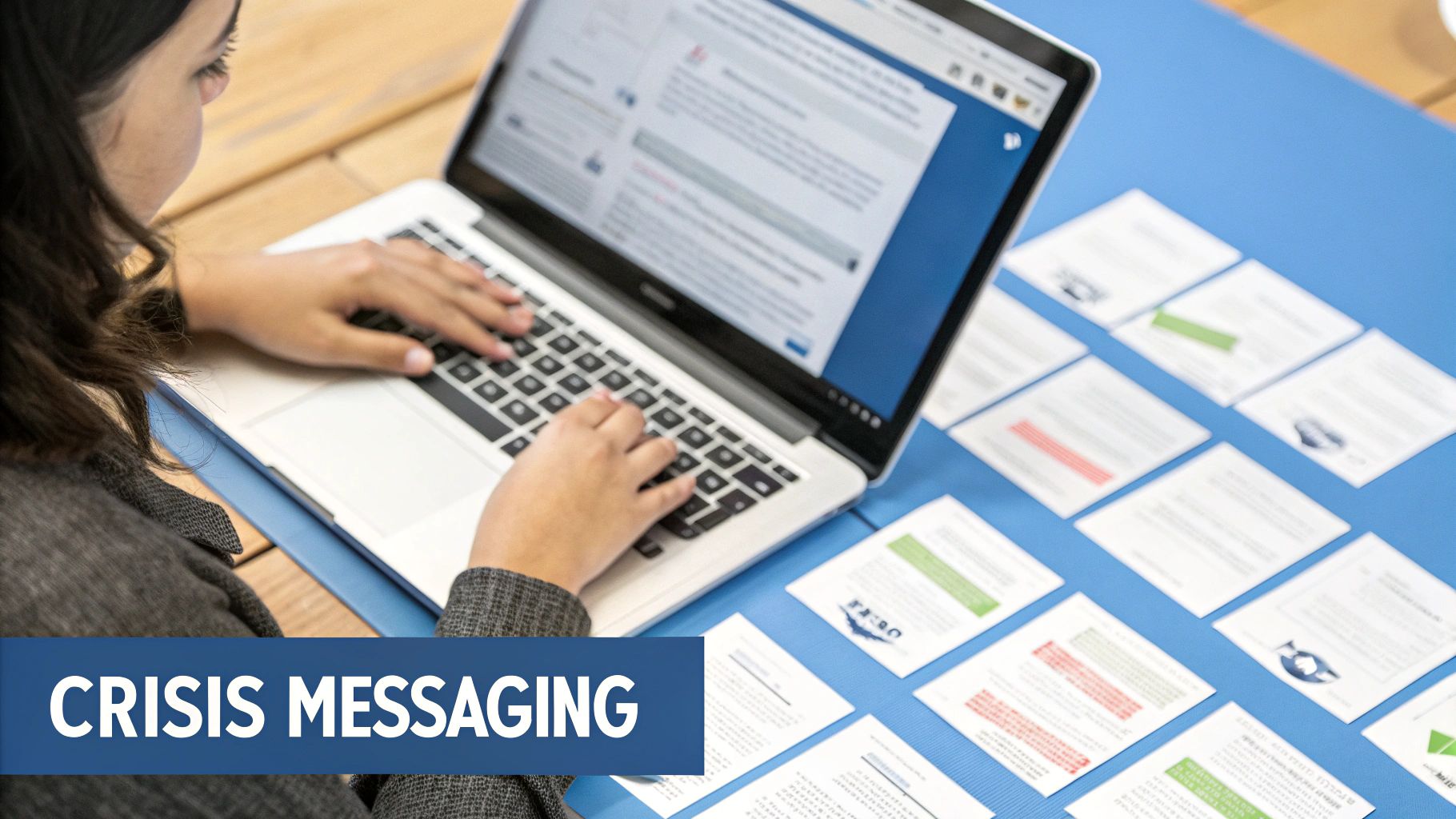
2. Develop a Comprehensive Crisis Communication Plan
In a crisis, the quality and speed of your communication can be as crucial as your operational response. A comprehensive crisis communication plan is a predetermined framework that dictates how, when, and what you communicate to key stakeholders, including clients, regulators, employees, and the public. It ensures messaging is consistent, transparent, and controlled, preserving stakeholder trust when it matters most.
Without a plan, communication becomes chaotic, leading to misinformation and reputational damage. A core tenet of modern crisis management best practices is to prepare your narrative before the crisis dictates it for you.
The Visbanking Edge: From Speculation to Fact-Based Statements
A data-driven communication plan moves beyond generic holding statements. By leveraging a platform like Visbanking, your communications team can craft messages grounded in verifiable market realities. Instead of vaguely assuring stakeholders of your "strong position," you can provide data-backed context, such as noting your loan-to-deposit ratio remains 10% stronger than the peer average or that your liquidity coverage is well above regulatory requirements and competitor benchmarks. This replaces fear with facts.
Key Insight: Communicating with data-driven transparency builds credibility faster than any apology. When you can prove your stability with hard numbers, you control the narrative and preempt damaging speculation.
Actionable Implementation
- Real-World Scenario: During a widespread tech outage affecting multiple banks, one institution’s communications team used Visbanking's real-time sentiment analysis. They identified that customer frustration was highest regarding a lack of updates. Their team immediately increased the frequency of its communications across all channels, providing specific, data-informed timelines, which resulted in a 30% lower volume of negative social media mentions compared to affected peers.
- Actionable Tips:
- Develop Templates: Create pre-approved message templates for various scenarios (e.g., liquidity concerns, data breach) with placeholders for specific data points from your BIAS platform.
- Train Spokespersons: Designate and train specific leaders, arming them not just with talking points but with an understanding of the key performance indicators that prove the bank’s stability.
- Prepare Channels: Have "dark site" versions of your website and client portals ready to activate, populated with clear, data-rich information that reassures stakeholders and directs them to facts.
3. Implement Early Warning Systems and Risk Monitoring
The best way to manage a crisis is to prevent it from ever happening. While not always possible, implementing sophisticated early warning systems moves an institution from a state of response to one of anticipation. These systems are not just about fraud detection; they involve the continuous monitoring of internal operations, external market signals, and stakeholder sentiment to detect anomalies and emerging threats before they escalate.

This proactive stance is a cornerstone of modern crisis management best practices, shifting the focus from damage control to strategic prevention by identifying and neutralizing risks at their source.
The Visbanking Edge: From Lagging Indicators to Predictive Alerts
Traditional risk monitoring often relies on lagging data, such as quarterly call reports or post-event analyses. A modern early warning system, powered by a platform like Visbanking, leverages high-frequency, near-real-time data. It can track subtle shifts in peer deposit pricing, sudden changes in a competitor's loan-to-deposit ratio, or spikes in regional commercial real estate vacancy rates, providing predictive alerts that signal future stress. For a deeper dive into the technological backbone of such systems, explore how AI-powered video surveillance analytics can transform security with predictive capabilities.
Key Insight: Early warning systems succeed when they connect disparate data points. A minor uptick in local business defaults, combined with a competitor’s aggressive new CD rate, isn't just noise; it’s a predictive signal for a potential liquidity squeeze in your market.
Actionable Implementation
- Real-World Scenario: A community bank’s BIAS platform flagged a 75-basis-point increase in Certificate of Deposit rates from three key competitors in a single week. This early warning allowed their ALCO to proactively adjust their own funding strategy, securing necessary liquidity before the broader market repricing, saving an estimated 20 basis points on their cost of funds over the next quarter.
- Actionable Tips:
- Set Clear Thresholds: Define specific data triggers for alerts, such as a 10% change in peer non-interest-bearing deposit outflows or a sudden spike in commercial loan delinquencies in your primary MSA.
- Integrate Data Sources: Combine internal operational data with external market intelligence from your BIAS platform for a holistic view of emerging risks.
- Test and Calibrate: Regularly run scenarios against your monitoring systems to ensure they are sensitive enough to catch genuine threats without generating excessive false positives.
4. Practice Rapid Response and Decision-Making Protocols
In a crisis, hesitation is a liability. The first hours are critical, and a team’s ability to assess, decide, and act swiftly can mean the difference between containment and catastrophe. Effective rapid response protocols are not improvised; they are pre-defined, drilled, and embedded in the organization's muscle memory. These frameworks, inspired by military command and emergency services, provide clear lines of authority, decision-making trees, and immediate action steps to eliminate ambiguity when pressure is at its peak.
This structured approach is a cornerstone of crisis management best practices, ensuring that your response is governed by strategy, not stress.

The Visbanking Edge: Accelerating Decisions with Data
Protocols provide the "how," but real-time data provides the "what" and "why." A platform like Visbanking supercharges decision-making protocols by feeding them with live, contextual intelligence. Instead of relying on anecdotal reports, your CMT can use a dashboard to see a liquidity stress event unfolding across a peer set, validate its severity with hard numbers, and immediately trigger the appropriate, pre-approved response protocol. This transforms a theoretical decision tree into a live, data-driven action plan.
Key Insight: Clear protocols combined with real-time data intelligence collapse decision-making timelines. When a crisis hits, your team isn't debating the facts; they are executing a practiced response based on verified information.
Actionable Implementation
- Real-World Scenario: During the 2023 U.S. debt ceiling negotiations, top financial institutions activated pre-planned “war rooms” to manage potential market chaos. As JPMorgan Chase's preparations show, these weren't just meetings but highly structured operations with clear protocols for every contingency. By having these frameworks ready, they could focus on strategic positioning rather than operational panic.
- Actionable Tips:
- Simulate: Run quarterly drills using Visbanking data to simulate scenarios like a sudden peer liquidity crunch or a deposit run. Test your team’s ability to follow protocols under pressure.
- Define Authority: Create a clear matrix that delegates decision-making authority for different crisis severities. A Tier 1 event (e.g., systemic crisis) might require CEO approval, while a Tier 3 event (e.g., negative social media trend) could be managed at the VP level.
- Automate Triggers: Use your BIAS platform to set automated alerts tied to specific action protocols. For example, if your bank's deposit beta exceeds the peer average by 10%, it could automatically trigger a communication plan to key stakeholders.
5. Maintain Transparent and Honest Communication
In a crisis, the currency of trust is transparency. A communication strategy built on truthfulness, accountability, and regular updates is not a soft skill; it is a core operational requirement. Stakeholders, from depositors to regulators, will fill an information vacuum with speculation and fear. Proactive, honest communication preempts this by controlling the narrative with facts and demonstrating integrity.
Effective crisis communication means acknowledging the problem, taking responsibility where appropriate, and providing a steady stream of updates. One of the most vital crisis management best practices is to communicate with empathy and clarity, even when you don't have all the answers.
The Visbanking Edge: Quantifying Sentiment and Calibrating Your Message
A modern approach to crisis communication is data-driven. A platform like Visbanking allows your team to monitor public and media sentiment in real time, tracking how your messaging is landing compared to peers. By analyzing news mentions, social media velocity, and sentiment scores, you can gauge whether your communications are reassuring stakeholders or inadvertently fueling panic, allowing for immediate course correction.
Key Insight: Objective sentiment analysis transforms communication from an art into a science. By tracking how your messaging impacts key metrics like deposit stability or stock performance against peers, you can prove the ROI of transparency.
Actionable Implementation
- Real-World Scenario: During a sector-wide liquidity scare, a mid-sized bank used Visbanking to monitor media sentiment. Noticing that peer communications were being criticized as vague, their CEO issued a direct statement acknowledging the market anxiety but providing specific, verified data on their own strong capital ratios. This transparent approach was positively received, and their sentiment score improved by 30% while peers saw continued declines.
- Actionable Tips:
- Lead with Empathy: Acknowledge the impact on customers and stakeholders first before presenting data.
- Stick to Facts: Use your BIAS platform to ground every public statement in verified data. Avoid speculation at all costs.
- Establish a Cadence: Commit to regular updates (e.g., daily briefings) to create a reliable information flow, even if the update is simply "we are still assessing the situation."
- Balance Transparency and Compliance: Work with legal and compliance teams to define what can be shared, ensuring transparency does not violate regulatory or privacy boundaries.
6. Conduct Regular Crisis Simulations and Training
A crisis management plan is only as strong as its execution. Systematic, rigorous simulations are essential for transforming a static document into a dynamic, battle-tested capability. These exercises move beyond theoretical planning by immersing your Crisis Management Team (CMT) in realistic scenarios, testing everything from communication protocols to decision-making under pressure. For financial institutions, this means practicing responses to bank runs, cybersecurity breaches, or sudden market shocks in a controlled environment.
This proactive training is one of the most vital crisis management best practices, as it builds muscle memory and reveals vulnerabilities before they can be exploited in a real event.
The Visbanking Edge: From Tabletop to Data-Driven Drills
Traditional simulations often rely on scripted, predictable inputs. A modern approach uses a platform like Visbanking to inject real-world data volatility into your training drills. Instead of just discussing a hypothetical bank run, your CMT can be presented with live-simulated data showing a peer institution’s deposit base eroding by 10% in a single day, forcing them to model the impact on their own balance sheet and formulate a data-backed response.
Key Insight: Data-driven simulations force your team to move beyond rehearsed scripts and make difficult decisions based on dynamic, evolving intelligence, mirroring the chaos of an actual crisis.
Actionable Implementation
- Real-World Scenario: A mid-sized commercial bank ran a cyber-attack simulation where Visbanking was used to model the reputational fallout. By tracking simulated social media sentiment and comparing it to real-world peer data from past breaches, the CMT could realistically project the impact on deposit stability and investor confidence, leading them to refine their public communications plan.
- Actionable Tips:
- Vary Scenarios: Run drills for different crisis types, such as a liquidity crunch, a sudden credit rating downgrade, or a major operational failure. Use peer data to make the scenarios more plausible.
- Involve Stakeholders: Include board members, key operational staff, and even external PR advisors in select simulations to test the entire response chain.
- Document and Adapt: After each simulation, conduct a thorough debrief. Document what worked, identify gaps, and immediately update your crisis management plan and data triggers.
7. Implement Stakeholder Engagement and Relationship Management
Crisis impact is not limited to balance sheets; it extends to the web of relationships your institution depends on. Proactive stakeholder management involves systematically identifying, engaging, and maintaining trust with key groups like customers, employees, regulators, and investors before a crisis hits. This ensures that during turbulent times, you are communicating with established partners, not skeptical strangers.
A core tenet of modern crisis management best practices is shifting stakeholder engagement from a public relations function to a data-driven strategic imperative. Neglecting this groundwork means you will be trying to build trust when it is already under threat.
The Visbanking Edge: Quantifying Stakeholder Risk and Opportunity
Effective stakeholder management requires understanding their behavior and sentiment. A platform like Visbanking provides critical data points, such as benchmarking your deposit stability against peers to gauge customer loyalty or tracking compensation trends to maintain employee trust. This data transforms relationship management from an art into a science, allowing you to anticipate needs and mitigate risks with precision. You can connect with your teams, customers, and vendors more effectively by understanding the financial context they operate within.
Key Insight: By analyzing peer data on customer deposit trends and employee compensation, your CMT can quantify stakeholder loyalty and proactively address vulnerabilities before they escalate during a crisis.
Actionable Implementation
- Real-World Scenario: During a period of industry-wide layoffs, a mid-sized bank used Visbanking’s compensation and benefits data to show its employees that their packages remained in the top quartile among peers. This data-backed communication significantly boosted morale and reduced attrition by 40% compared to competitors, securing a key internal stakeholder group.
- Actionable Tips:
- Map Stakeholders: Categorize stakeholders by influence and impact. Use deposit concentration data for major clients and compensation benchmarks for key employee groups.
- Establish Baselines: Use peer data to set performance baselines for customer loyalty (deposit beta) and employee satisfaction (compensation ratios) to monitor deviations.
- Tailor Communications: Prepare data-driven messaging for each stakeholder group. For investors, use peer performance metrics; for large depositors, use liquidity and stability comparisons.
8. Establish Business Continuity and Recovery Planning
A crisis doesn't just damage reputation; it cripples operations. Robust Business Continuity Planning (BCP) and recovery protocols are essential to ensure critical functions can withstand disruption and be restored swiftly. This isn't just about disaster recovery for IT systems; it’s a holistic strategy for maintaining operational integrity, from branch services to payment processing, minimizing financial loss and preserving customer trust.
For financial institutions, operational downtime is not an option. Integrating BCP into your overall strategy is one of the most fundamental crisis management best practices, ensuring the bank remains a pillar of stability even when facing internal or external shocks.
The Visbanking Edge: Quantifying Operational Resilience
Traditional BCP often relies on static, qualitative assessments. A data-driven approach uses real-time operational metrics to model the financial impact of disruptions and test the viability of recovery plans. With a platform like Visbanking, you can benchmark operational costs, efficiency ratios, and even staffing levels against peers to identify potential single points of failure before they are exposed during a crisis.
This allows you to move from a theoretical "what if" exercise to a quantified risk assessment. For example, by analyzing peer branch network performance, you can model the financial impact of temporarily closing specific locations and determine the exact capacity your digital channels must handle to absorb the displaced activity.
Key Insight: True business continuity isn't about having a plan on a shelf; it's about continuously validating that plan against real-world performance data to ensure your recovery time objectives (RTOs) are both realistic and financially sound.
Actionable Implementation
- Real-World Scenario: A mid-sized bank used Visbanking’s operational efficiency data to justify investment in a fully redundant payment processing system. Their analysis showed that even a six-hour outage during peak processing times would result in direct losses and regulatory penalties exceeding the cost of the backup system, a finding that secured immediate board approval. Learn more about how resilience is the cornerstone of modern banking.
- Actionable Tips:
- Prioritize with Data: Use performance and revenue metrics to rank business functions by financial impact, not just perceived importance.
- Test and Validate: Conduct regular, realistic stress tests of your BCP, using peer data to set performance benchmarks for your backup systems.
- Plan for Vendors: Extend your BCP to include critical third-party vendors, with clear contingency plans for supply chain disruptions.
9. Focus on Post-Crisis Learning and Improvement
The most resilient organizations do not just survive a crisis; they emerge stronger by systematically learning from it. A structured post-crisis review is not about assigning blame but about identifying systemic weaknesses and operational gaps. This process transforms a painful event into a catalyst for institutional improvement, reinforcing one of the most vital crisis management best practices: continuous adaptation.
A crisis is a real-world stress test of your people, processes, and technology. Failing to analyze the results is a squandered opportunity that leaves you vulnerable to a repeat failure, often with magnified consequences.
The Visbanking Edge: Quantifying the Aftermath for Deeper Insights
A truly effective after-action review moves beyond qualitative feedback to data-driven analysis. Using a platform like Visbanking, you can objectively measure the crisis's impact on key metrics like deposit beta, funding costs, and market share relative to your peers. This quantitative lens provides undeniable evidence of what worked and what didn't. Did your communications strategy stabilize deposit outflows faster than competitors? Did your liquidity plan hold up under pressure, keeping funding costs below the peer average?
Key Insight: Benchmarking your post-crisis recovery metrics against an unaffected peer group provides a clear, objective scorecard of your response effectiveness and pinpoints specific areas for strategic enhancement.
Actionable Implementation
- Real-World Scenario: After a regional market disruption, a bank's internal review concluded its response was successful. However, Visbanking data revealed their deposit costs spiked 25 basis points higher than the peer average during recovery, indicating an over-reliance on costly wholesale funding. This insight drove a complete overhaul of their contingency funding plan, saving an estimated $2 million in potential costs in future scenarios.
- Actionable Tips:
- Conduct Prompt Reviews: Hold after-action reviews while the events and decisions are fresh in everyone's minds, ideally within two weeks of the crisis de-escalating.
- Focus on Systems: Analyze the process, not the people. Use data to identify systemic friction points in your communication, decision-making, or operational execution.
- Document and Disseminate: Create a formal post-mortem report that integrates quantitative benchmarks with qualitative lessons. Ensure these findings are shared and integrated into future CMT training and playbooks.
9 Key Crisis Management Practices Comparison
| Approach | Implementation Complexity 🔄 | Resource Requirements ⚡ | Expected Outcomes 📊 | Ideal Use Cases 💡 | Key Advantages ⭐ |
|---|---|---|---|---|---|
| Establish a Crisis Management Team (CMT) | Medium to High – requires cross-functional coordination | High – ongoing training, availability, and maintenance | Faster, coordinated responses with clear decision-making | Organizations needing unified crisis command | Improved coordination, faster response, consistent decisions |
| Develop a Comprehensive Crisis Communication Plan | Medium – involves detailed protocols and stakeholder mapping | Medium – creation and updating of templates and training | Consistent, transparent messaging preserving reputation | Managing public and stakeholder communications | Maintains trust, reduces misinformation, speeds messaging |
| Implement Early Warning Systems and Risk Monitoring | High – requires technology integration and data analysis | High – investment in monitoring tools and personnel | Early detection of risks, enabling preventive actions | Organizations in dynamic or high-risk environments | Prevents crises, reduces impact, supports data-driven decisions |
| Practice Rapid Response and Decision-Making Protocols | Medium – clear frameworks and drills needed | Medium – training and communication systems | Minimized delays and decision paralysis during crises | Critical first hours of crisis response | Efficient responses, reduced delays, consistent approach |
| Maintain Transparent and Honest Communication | Low to Medium – mindset and communication planning | Low to Medium – ongoing communication efforts | Builds trust, reduces speculation, supports integrity | All organizations valuing stakeholder trust | Enhanced trust, fewer rumors, demonstrated accountability |
| Conduct Regular Crisis Simulations and Training | Medium to High – requires scenario development and coordination | Medium to High – time and resources for exercises | Identifies gaps, strengthens team competency | Preparing teams and plans for real crisis events | Validates plans, builds confidence, improves coordination |
| Implement Stakeholder Engagement and Relationship Management | Medium – ongoing relationship building | Medium – continuous communication and feedback systems | Builds goodwill, reduces backlash, creates advocacy | Long-term stakeholder trust and crisis mitigation | Strong relationships, better crisis support |
| Establish Business Continuity and Recovery Planning | High – comprehensive planning and backup systems required | High – investment in backups, testing, and maintenance | Minimizes disruption, faster recovery | Ensuring operational resilience during disruptions | Operational continuity, financial protection, resilience |
| Focus on Post-Crisis Learning and Improvement | Medium – requires structured review and documentation | Medium – time for analysis and implementing changes | Improved future responses and organizational learning | Post-crisis evaluation and continuous improvement | Converts crises into learning, prevents recurrence |
From Reactive Defense to Proactive Dominance
Crisis management in modern banking is no longer a matter of having a dusty playbook on a shelf. It has evolved into a dynamic, intelligence-driven capability that must be woven into the fabric of executive decision-making. The best practices detailed in this article are not standalone checklist items; they are deeply interconnected components of a resilient operational system. From a dedicated Crisis Management Team to rigorous post-crisis analysis, each pillar is fortified by the strategic application of comprehensive banking intelligence.
The journey through these crisis management best practices reveals a clear theme: proactive preparation beats reactive repair, every time. A well-structured CMT (#1) is only as effective as the data it receives. A Crisis Communication Plan (#2) loses its power without real-time information to ground its messaging. And Early Warning Systems (#3) are rendered useless if they only track lagging indicators instead of predictive market shifts. The true differentiator is not just having a plan, but powering it with live, contextual data.
The New Standard of Fiduciary Leadership
Mastering these concepts
Latest Articles

Brian's Banking Blog
Commercial Lending Trends: What Bank Executives Must Know
Brian's Banking Blog
Bank Marketing Dataset Analysis Strategy

Brian's Banking Blog
ESG Peer Benchmarking for Bank Leaders
Brian's Banking Blog
What Is Repricing Risk: A Bank Executive's Guide

Brian's Banking Blog
How to Manage Vendor Relationships in Banking
Brian's Banking Blog