
A Bank Executive's Guide to Mastering Credit Ratings
Brian's Banking Blog
A bank's credit rating is not a passive score; it is a critical strategic asset that directly dictates its competitive position. A strong credit rating for banks translates directly to a lower cost of funds, superior market access, and heightened counterparty confidence. For the executive team, actively managing this rating is a fundamental component of sound governance and strategic leadership.
Why a Bank's Credit Rating Defines Its Competitive Edge

Treating a credit rating as a compliance checkbox is a strategic error. It is a dynamic indicator of financial health and market perception with direct, bottom-line consequences. The delta between rating tiers is measured in basis points, market access, and ultimately, shareholder value.
Consider a practical example: a bank with an 'AA' rating can secure wholesale funding at approximately 40 basis points lower than a competitor rated 'A-'. On a $500 million issuance, this differential represents $2 million in annual savings. That capital can be redeployed into technology, talent, or lending, creating a significant competitive advantage.
The Rating as a Strategic Tool
A superior credit rating provides more than funding cost advantages. It signals institutional strength to depositors, investors, and counterparties, unlocking several key benefits:
- Enhanced Counterparty Confidence: A higher rating signifies lower risk, positioning your bank as a preferred partner for derivatives and interbank lending.
- Superior Access to Capital Markets: During periods of market stress, highly-rated institutions retain access to funding while lower-rated peers are sidelined. This ensures liquidity when it is most critical.
- Greater Operational Flexibility: A strong rating provides the financial latitude to execute strategic initiatives—such as acquisitions or market expansion—without incurring prohibitive capital costs.
For an executive team, the objective is to transform the rating process from an external audit into an internal strategic tool. This requires taking control of the narrative presented to rating agencies, investors, and regulators.
The Growing Importance of Credit Assessment
The global financial system operates on these assessments. The credit rating market, valued at USD 58 billion in 2023, continues to expand, underscoring the centrality of these scores to risk management and investment decisions. You can review the credit rating market size and growth trends here.
This reality demands a proactive, data-driven strategy. A passive approach—waiting for an agency to identify weaknesses—cedes control and puts the institution at a disadvantage.
The superior strategy involves continuous monitoring of key metrics against a curated peer group, allowing leadership to anticipate and address agency concerns before they are formally raised. Data intelligence platforms like Visbanking provide the precise comparative analytics required to identify vulnerabilities and opportunities, enabling a methodical strengthening of the bank's financial profile. Explore our data to benchmark your institution's standing.
Decoding the Rating Agency Playbook
To effectively manage a bank’s credit rating, leadership must view the institution through the lens of a rating agency analyst. While the final judgment contains qualitative elements, it is built upon a foundation of rigorous, data-driven analysis. Understanding this methodology is the first step toward controlling the narrative.
The process is not a black box; it is a methodical evaluation of core pillars that collectively depict a bank’s resilience and stability. While terminology may vary slightly among agencies, the fundamental principles are consistent.
These key factors provide a clear roadmap for how an analyst deconstructs a bank's balance sheet, strategy, and risk posture. This is where their scrutiny is most intense.
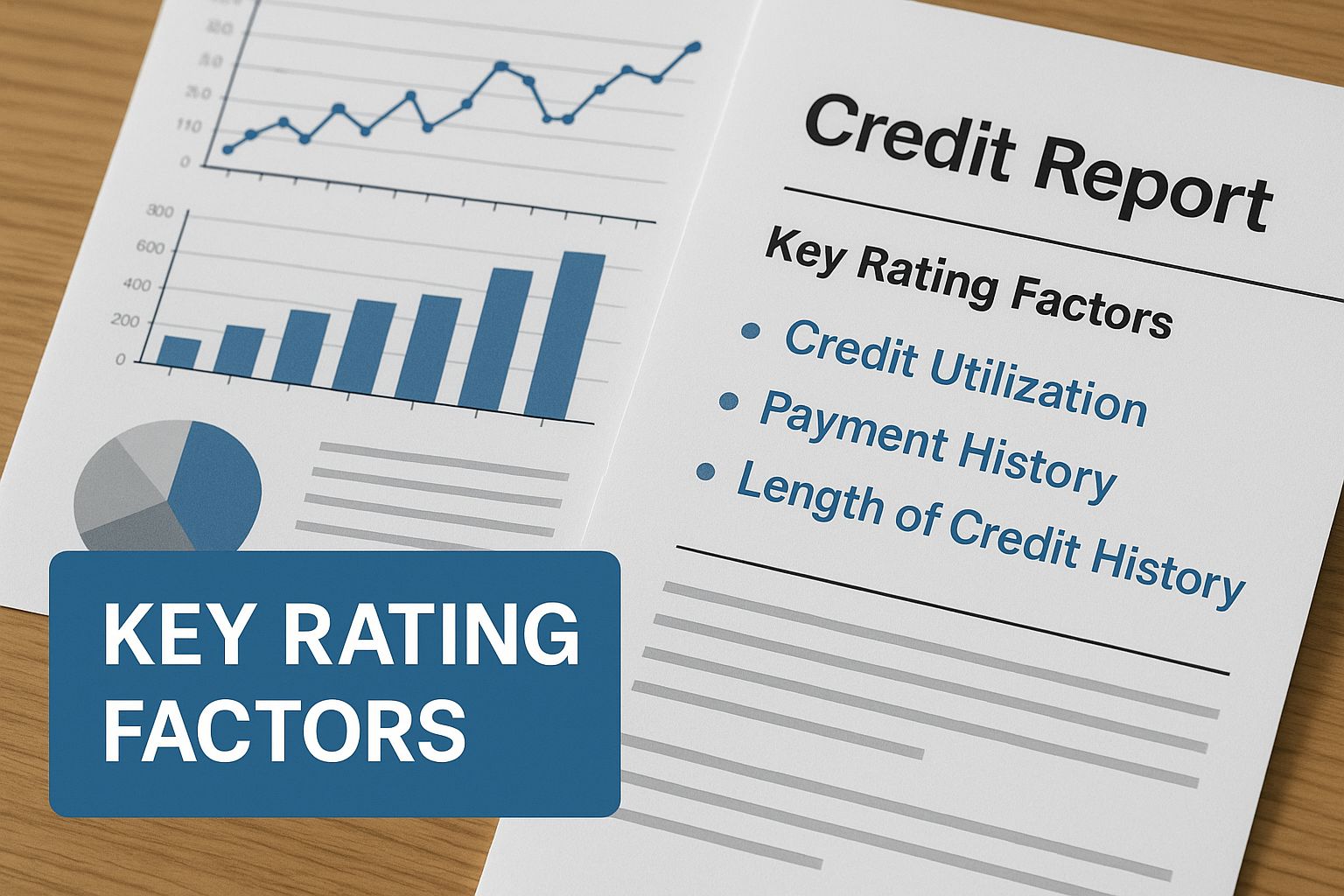
As illustrated, a bank's rating is a composite assessment derived from several interconnected domains. This necessitates a holistic, enterprise-wide view from the executive team.
The Core Pillars of Agency Analysis
Ultimately, the credit rating process is anchored in five critical areas. Each serves as a distinct lens through which an agency assesses a bank's ability to meet financial obligations, withstand economic stress, and execute its strategic objectives. For any leadership team seeking a rating upgrade, mastering these domains is non-negotiable.
Here are the five pillars that define the analysis:
- Capital Adequacy: This extends beyond meeting regulatory minimums like CET1. Analysts scrutinize the quality of capital, the capacity for internal generation, and the alignment of the capital plan with the stated risk appetite.
- Asset Quality: An analyst looks past the headline Non-Performing Loan (NPL) ratio to identify risk concentrations in specific sectors—such as commercial real estate—and assess the adequacy of loan loss provisions against those identified risks.
- Management and Strategy: This is where quantitative analysis meets qualitative judgment. Agencies evaluate the credibility of the leadership team, the coherence of the strategic plan, and the robustness of the bank's risk management culture.
- Earnings Power: The focus is on stability and diversity. An over-reliance on volatile income streams (e.g., mortgage banking fees) is a significant concern compared to a foundation of stable net interest income from a well-diversified loan portfolio.
- Liquidity and Funding Profile: Analysts draw a sharp distinction between stable, low-cost core deposits and more volatile sources like wholesale or brokered funding. A high loan-to-deposit ratio or heavy reliance on short-term funding is a primary red flag.
Key Rating Drivers and Their Strategic Implications
To translate this knowledge into action, it is crucial to connect agency criteria with executive decision-making. The table below outlines these drivers and their corresponding executive action points.
| Rating Driver | What Agencies Look For | Executive Action Point |
|---|---|---|
| Capital Adequacy | Capital quality, internal generation capacity, and forward-looking plans. | Execute stress tests that exceed regulatory minimums to demonstrate capital resilience under severe but plausible economic scenarios. |
| Asset Quality | Risk concentrations in specific sectors and adequacy of loan loss provisions. | Continuously monitor portfolio segments and benchmark NPLs against peers to identify and mitigate adverse trends early. |
| Management & Strategy | Leadership credibility, strategic coherence, and robust risk management. | Articulate a consistent, data-backed strategic narrative during every agency interaction to demonstrate clear direction and foresight. |
| Earnings Power | Stability and diversity of revenue streams; reliance on volatile income. | Model the impact of macroeconomic shifts on various income sources to demonstrate the durability of the earnings profile. |
| Liquidity & Funding | Reliance on stable core deposits vs. volatile wholesale funding. | Track the loan-to-deposit ratio and cost of funds against market benchmarks to defend the stability of the funding base. |
This framework transforms the rating review from a reactive, compliance-focused exercise into a proactive, strategic one.
The Dominance of the Big Three
It is essential to understand the competitive landscape. The credit rating industry is dominated by Moody's, Standard & Poor's, and Fitch Ratings. These "Big Three" control an estimated 95% of the global market, a position solidified by their designation as Nationally Recognized Statistical Rating Organizations (NRSROs) in the US.
The implication for bank leadership is clear: their methodologies represent the industry standard. Aligning internal reporting and strategic planning with their frameworks is not optional; it is essential. You can learn more about the influence of these rating agencies on Wikipedia.
Understanding the rating agency playbook is the bedrock of strategic financial management. An analyst's opinion is the sum of their conclusions about each of these individual pillars.
For example, a sudden increase in the NPL ratio within a syndicated loan portfolio from 0.50% to 1.25% is not viewed in isolation. It is immediately connected to underwriting standards (Asset Quality), its impact on profitability (Earnings Power), and the board’s response (Management & Strategy).
A proactive approach requires viewing these pillars as an interconnected system. The key is leveraging data intelligence to continuously monitor performance across all five areas and, critically, to benchmark that performance against peers. A platform like Visbanking enables you to track these metrics, identify weaknesses before they precipitate downgrades, and enter agency reviews with a data-driven narrative of institutional strength.
The Four Pillars That Drive Your Bank's Rating

While the agency playbook is detailed, its foundation rests on four pillars. For bank leadership, mastery of these areas is not a compliance exercise but a demonstration of superior financial stewardship. A deep understanding of how agencies dissect these domains allows an executive team to shape the narrative with proprietary data long before a formal review commences.
These four pillars—Capitalization, Asset Quality, Profitability, and Funding & Liquidity—are interconnected. A deficiency in one creates stress on the others, a domino effect that analysts are trained to identify. A holistic, data-first perspective is the only effective way to manage your rating.
Capitalization: The Ultimate Shock Absorber
Capital is the institution's primary defense. Rating agencies look beyond regulatory minimums like the Common Equity Tier 1 (CET1) ratio, scrutinizing the quality, composition, and internal generation capacity of the capital base. For example, a bank with a 10% CET1 ratio built from consistent retained earnings is viewed more favorably than a peer at 10.5% that relied on a one-time capital injection.
The central question an analyst seeks to answer is: "Can this bank's capital absorb a severe, unexpected loss?" They employ proprietary models to stress-test the balance sheet against adverse economic scenarios.
A robust capital position is a strategic asset. It signals to the market an ability to withstand significant shocks, which is a key determinant of long-term creditworthiness and a cornerstone of a high credit rating for banks.
Demonstrating the ability to build capital organically through predictable earnings is paramount. It proves a sustainable, self-sufficient business model—a significant positive factor in any rating assessment.
Asset Quality: Beyond the Headline Ratio
Asset quality is the engine of a bank’s long-term health, and agencies dissect it with forensic precision. They look past the headline Non-Performing Loan (NPL) ratio to uncover underlying risks, focusing on concentration risk, underwriting discipline, and the adequacy of loan loss provisions.
Consider two banks, each with a 0.75% NPL ratio. Bank A’s non-performers are diversified across a broad small business portfolio. Bank B’s NPLs, however, are concentrated in a single $500 million portfolio of speculative commercial real estate developments. An analyst will immediately flag Bank B as having a materially riskier profile, as a downturn in a single sector could prove catastrophic.
The narrative presented to agencies must be substantiated by granular data. It is more powerful to demonstrate disciplined underwriting standards and proactive provisioning than to simply cite a low NPL figure. Mastering this pillar requires deep insight into the loan book—the kind of insight provided by robust banking data analytics.
Profitability: The Engine of Resilience
Sustainable profitability is the primary source of internal capital generation and a direct reflection of strategic efficacy. Agencies consistently favor stability and diversity of revenue over high but volatile earnings. A bank overly dependent on cyclical income—such as mortgage origination fees or trading revenue—presents a level of unpredictability that analysts view unfavorably.
A stable and healthy Net Interest Margin (NIM) is the bedrock of strong earnings. For example, a bank that consistently maintains a NIM of 3.25% through disciplined lending and effective deposit management demonstrates a more resilient model than a competitor whose NIM fluctuates between 2.50% and 4.00% with market shifts.
The objective is to prove that earnings are not just strong, but durable. This requires demonstrating a healthy mix of interest and non-interest income, rigorous cost control (as measured by the efficiency ratio), and a clear strategy for maintaining profitability through economic cycles.
Funding and Liquidity: The Foundation of Trust
Finally, an agency analyzes a bank's funding and liquidity to determine its ability to meet obligations without resorting to forced asset sales. A firm line is drawn between stable, low-cost core deposits from retail and business clients and more volatile, higher-cost sources like brokered deposits or wholesale borrowing.
A high loan-to-core-deposit ratio, particularly one exceeding 95%, signals an over-reliance on less stable funding. This is a significant red flag for rating agencies, as this funding is the first to exit during a crisis, potentially triggering a liquidity crunch.
The executive team's role is to demonstrate a conservative funding mix and a robust liquidity management framework. This includes maintaining an adequate stock of high-quality liquid assets (HQLA) and regularly stress-testing liquidity against severe, idiosyncratic scenarios. This pillar is fundamentally about trust—proving the bank can operate independently, even in turbulent markets.
How Peer Benchmarking Predicts Rating Changes
Rating agencies never evaluate a bank in a vacuum. Its performance, risk profile, and strategy are all assessed relative to its peers. For this reason, astute leadership teams treat benchmarking not as a retrospective reporting exercise but as a forward-looking early warning system.
To effectively manage a credit rating for banks, one must adopt the same comparative lens as an agency analyst. This involves using data to track key performance indicators against a well-defined peer group, enabling the early detection of negative drift long before it becomes a material issue.
Identifying Vulnerabilities Before the Agency Does
An analyst's primary function is to identify outliers. When a bank’s metrics begin to lag the peer average, it creates a narrative of underperformance that is difficult to overcome. The strategic imperative is to identify this narrative as it forms and alter its trajectory before it reaches an agency’s formal review.
Consider a practical example. A bank’s efficiency ratio has deteriorated from 62% to 68% over 18 months. In isolation, this might be explained by technology investments. However, if the peer group average held steady at 60%, this 800-basis-point gap is no longer a minor detail; it is a significant red flag.
An analyst will focus on this discrepancy with pointed questions:
- Are expenses inadequately controlled?
- Is revenue growth lagging the competition?
- Does this indicate a strategic misstep impacting profitability?
Without a proactive, data-backed answer, control of the dialogue is lost. A modern data intelligence platform identifies this trend in real time, providing quarters, not weeks, to rectify the issue or construct a well-supported explanation.
The greatest strategic advantage in managing a credit rating is foresight. Peer benchmarking provides this by transforming raw data into a predictive tool, enabling leadership to address emerging risks before they become glaring weaknesses.
A Data-Driven Comparison
To illustrate how this plays out, consider the following hypothetical comparison. It demonstrates how seemingly minor deviations can aggregate to paint a concerning picture for a rating agency.
Peer Benchmarking Scenario for Rating Assessment
This table shows how a bank's metrics might compare to its peers and, more importantly, the likely interpretation by a rating agency.
| Metric | Your Bank | Peer Average | Rating Agency Implication |
|---|---|---|---|
| Efficiency Ratio | 68% | 60% | Suggests potential expense control issues or revenue weakness compared to the market. |
| NPL Ratio (CRE) | 1.25% | 0.80% | Indicates higher-than-average credit risk concentration in a sensitive portfolio. |
| NIM | 3.10% | 3.35% | Signals potential pressure on core earnings power and profitability resilience. |
| Loan/Core Deposit | 98% | 90% | Points to a greater reliance on less stable, higher-cost funding sources. |
Individually, each of these metrics might be explainable. Collectively, they tell a story of a bank lagging its peers in profitability, asset quality, and funding stability. This is precisely the pattern that leads to a negative outlook or a downgrade.
Consistent tracking of these KPIs against an appropriate peer group is fundamental to effective governance. This ongoing analysis shifts the dynamic from reactive defense of past performance to proactive management of future outcomes.
Visbanking’s platform is engineered to provide this critical context. We transform complex call report data into clear, comparative insights, allowing your executive team to view the bank through the same lens as a rating agency. This perspective is key to identifying risks, leveraging strengths, and securing the strong credit rating the institution deserves. We invite you to explore our data and see how your bank truly measures up.
The Dance Between Regulation and Ratings
For bank executives, the link between credit rating agencies and regulators is inextricable. A formal action from the OCC or FDIC is not merely a compliance matter; it is a signal flare that commands the immediate attention of Moody’s, S&P, and Fitch. Understanding this dynamic is critical to managing the bank's reputation and financial stability.
A regulatory examination, particularly the assigned CAMELS rating, often serves as a precursor to a rating agency's own review. While not a direct one-to-one correlation, a downgrade in the CAMELS rating from a ‘2’ to a ‘3’ will prompt immediate inquiry from agency analysts. They will seek to understand the root cause—be it a capital deficiency, a management issue, or asset quality deterioration—and incorporate that weakness into their own assessment.
What Regulators Say, Rating Agencies Hear
The impact of a regulatory directive on a credit rating depends heavily on its framing. For example, a mandate to increase the Tier 1 capital buffer by 100 basis points is costly and can dilute shareholder returns.
However, rating agencies almost universally view such an action as a credit positive. It demonstrates proactive regulatory oversight and forces the bank to build a more resilient balance sheet. This enhanced capital cushion improves the bank’s ability to absorb future shocks, a significant positive factor for creditworthiness.
Astute leadership understands that narrative is paramount. A regulatory action framed as a proactive measure to fortify the balance sheet is received far more favorably than one that appears reactive to an emerging problem. Data must substantiate that narrative for both audiences.
What's Next? Stress Tests and Climate Risk
The regulatory landscape is in constant evolution, and rating agencies adapt their methodologies in tandem. Two areas of increasing focus are stress testing and climate risk.
- Stress Testing: Results from exercises like DFAST provide agencies with a forward-looking view of a bank’s resilience. Consistently passing with significant headroom signals robust risk management and durable earnings power.
- Climate Risk: Previously a peripheral topic, climate-related financial risk is now a core consideration. Agencies are actively assessing how these factors impact asset quality, particularly for institutions with significant exposure to vulnerable sectors like agriculture or coastal real estate.
This convergence underscores the necessity of an integrated data strategy. The same data used for regulatory reporting must also support a compelling narrative for rating agencies. This is especially true in critical areas like bank liquidity management, where both constituencies demand rigorous proof of stability.
The influence of rating agencies has grown in lockstep with global debt markets. Between 2001 and 2016, S&P alone saw the number of corporate issuers it rated increase by 33% in the U.S. and 48% in Europe. You can discover more insights about their growing market influence to appreciate the weight their opinions carry.
By leveraging an intelligence platform to monitor regulatory metrics and rating drivers simultaneously, leadership can anticipate difficult questions before they are asked. Benchmarking against peers provides the context needed to demonstrate strength and control the dialogue. Visbanking's data can help build this unified, forward-looking strategy.
Turn Data Intelligence Into a Stronger Credit Rating
Ultimately, a bank's credit rating is the market's definitive judgment on its resilience, strategy, and governance. Effective management of this critical asset demands a proactive, data-driven approach. Awaiting an agency's inquiry is a defensive posture; arriving with a data-backed narrative puts the institution in command.
This requires mastering the rating agency playbook, focusing on the core pillars of analysis, and continuously benchmarking against a relevant peer group. It is not about passing a single test, but about demonstrating a consistent, enterprise-wide story of financial strength. In this context, a sophisticated data intelligence platform is not an expense; it is the essential tool that enables the entire strategy.
Go From Defense to Offense
The traditional approach to rating management is defensive—reacting to agency questions during a review and explaining past performance. This is a position of weakness. The superior approach is to reverse this dynamic with real-time, comparative analytics.
Consider a bank whose net interest margin (NIM) has compressed by 15 basis points over two quarters. A premier data intelligence system immediately contextualizes this figure:
- Is this an institution-specific issue, or is the entire peer group facing similar pressure?
- How has this impacted internal capital generation relative to competitors?
- What is the resulting trend in our loan-to-core-deposit ratio?
Answering these questions internally, months ahead of a review, empowers leadership to either implement corrective actions or enter the meeting with a data-supported narrative. This shifts the conversation from a retrospective audit to a forward-looking strategic discussion.
The Power of Seeing the Whole Picture
Effective rating management is impossible with siloed data. Data silos create blind spots that rating agencies are trained to exploit. A unified system that integrates performance data across all pillars is necessary to construct a single, compelling narrative.
A strong credit rating is the outcome of hundreds of disciplined decisions made over time. Data intelligence provides the clarity to ensure those decisions are informed, timely, and aligned with the singular goal of building undeniable financial strength.
The path to a stronger credit rating begins with viewing the bank through the same critical, comparative lens as an analyst. It requires moving beyond surface-level metrics to understand the underlying trends that signal strength or weakness. The right data illuminates your competitive position and pinpoints exactly where to fortify your strategy, long before the next review is scheduled.
Visbanking provides the tools to achieve this clarity. Let us demonstrate how our data can help you benchmark performance and identify the precise actions needed to strengthen your bank’s credit rating.
Your Top Questions About Bank Credit Ratings, Answered
The subject of credit ratings inevitably prompts critical questions from the board and executive leadership. Here are direct answers to the most important ones.
How Often Should Our Board Be Looking at Rating Drivers?
Adopt a dual cadence. Quarterly, the board must review key performance metrics that drive the rating, benchmarked against a curated peer group. This regular review functions as an early warning system, preventing surprises from negative trends in asset quality or profitability.
Annually, conduct a comprehensive deep dive. This is a strategic session, timed before engaging with rating agencies, designed to arm leadership with the data needed to proactively manage the dialogue and control the bank's narrative.
What’s the Biggest Mistake Banks Make with Their Credit Rating?
Passivity. The most common and costly error is being reactive. Many institutions only scrutinize their rating drivers when a formal review is imminent or, worse, after a downgrade. A defensive posture means control has already been lost.
A proactive stance is not an expense; it is a strategic necessity. The cost of inaction—in the form of higher funding costs, lost opportunities, and reputational damage—will always exceed the investment in a data-driven, forward-looking strategy.
Can a Smaller Bank Actually Improve Its Rating?
Absolutely. It is a misconception that only large institutions can achieve top-tier ratings. Agencies frequently value consistent, disciplined management over sheer asset size. A smaller, well-managed bank with superior asset quality, a robust capital buffer, and a coherent strategy can readily outperform a larger, less-focused competitor.
Modern data tools level the playing field. They provide the sophisticated peer analytics once exclusive to money-center banks, enabling any institution to substantiate its operational discipline with empirical evidence.
Proactively managing your credit rating begins with possessing superior data intelligence. Visbanking is the bank intelligence system designed to help you benchmark performance, see what the agencies see, and build the data-driven case for a stronger rating. See how your institution compares today.
Latest Articles
Brian's Banking Blog
Automated Alerts and Notifications for Banks
Brian's Banking Blog
Customer Feedback Loop for Banks: A Practical Playbook
Brian's Banking Blog
Commercial Lending Trends: What Bank Executives Must Know
Brian's Banking Blog
Bank Marketing Dataset Analysis Strategy

Brian's Banking Blog
ESG Peer Benchmarking for Bank Leaders
Brian's Banking Blog