
A Guide to Capital Ratios for Banks: Beyond Compliance to Strategic Advantage
Brian's Banking Blog
A bank's capital ratios are more than a regulatory reporting line; they are a direct measure of its financial fortitude and capacity to absorb unexpected losses. For bank executives and directors, these metrics are the definitive scorecard of institutional health.
A higher ratio signals to regulators, investors, and the market that the institution can withstand economic stress. It is the foundation of effective strategic planning and risk management, enabling decisive action.
Why Capital Ratios Are a Bank's Ultimate Health Metric
For bank executives and directors, capital ratios cut through the complexity of the balance sheet to provide a powerful, consolidated measure of financial resilience. While meeting regulatory minimums is the baseline, the strategic value lies in understanding how these ratios reflect decisions in risk, growth, and shareholder returns. A strong capital position is not merely a defensive shield; it is the platform for confident decisions on lending, acquisitions, and capital distributions.

Beyond Compliance to Competitive Insight
Viewing capital ratios solely through a compliance lens is a critical strategic error. These metrics directly correlate with a bank's ability to compete and innovate.
Consider a community bank with a Common Equity Tier 1 (CET1) ratio of 12.0%—comfortably above the regulatory minimum. This capital cushion enables concrete strategic actions:
- Execute Acquisitions: The bank possesses the capital strength to absorb another institution's risk-weighted assets without jeopardizing its well-capitalized status. For example, acquiring a smaller bank with $500 million in RWA would only marginally decrease its ratio, keeping it well ahead of peers.
- Expand into Key Lending Markets: A robust capital base supports expansion into higher-yield areas, such as commercial real estate or C&I lending, with the capacity to absorb the associated increase in risk-weighted assets.
- Weather Economic Downturns: When a recession hits, this bank can absorb potential loan losses far more effectively than a competitor operating with a 9.0% CET1 ratio, which may be forced to curtail lending and enter a defensive posture.
Capital ratios are a critical component of the broader principles of financial risk management, providing the quantitative evidence to support strategic direction.
In essence, your capital ratio is a direct reflection of your board's risk appetite and strategic foresight. It answers the fundamental question: Do we have the financial fortitude to execute our long-term vision?
This is where precise, timely data intelligence becomes non-negotiable. Relying on static peer data from previous quarters is akin to navigating by looking in the rearview mirror. Modern banking leadership requires dynamic, real-time insights. When you can benchmark your capital ratios against a curated peer group in near real-time, the metric transforms from a historical record into a forward-looking strategic tool. Platforms like Visbanking provide this intelligence, enabling data-driven decisions that sharpen competitive edge.
Understanding the Building Blocks of Bank Capital
To leverage capital ratios as a strategic tool, executives must understand the composition of capital itself. Bank capital is not a monolithic fund; it is a tiered hierarchy of financial instruments, each designed to absorb losses at a specific point of stress. This structure functions like the layered defenses of a fortress, protecting the institution's solvency.
Common Equity Tier 1 (CET1): The Innermost Wall
Common Equity Tier 1 (CET1) represents the highest-quality, most loss-absorbing capital. It is the core of a bank's financial strength and the first line of defense against unexpected losses.
CET1 is composed primarily of:
- Common stock
- Retained earnings (accumulated net profits reinvested in the bank)
- Accumulated other comprehensive income (AOCI)
- Certain regulatory deductions and adjustments
When losses occur, CET1 absorbs them without triggering insolvency. A high CET1 ratio signals to the market that the bank is built on a solid foundation of shareholder equity and profitable operations.
Additional Tier 1 (AT1) Capital: The Secondary Defense
Additional Tier 1 (AT1) capital provides a crucial secondary buffer. While still high-quality, it ranks below CET1 in the loss-absorption hierarchy. AT1 primarily consists of instruments, such as perpetual preferred stock and contingent convertible bonds (CoCos), that have no maturity date. These instruments are designed to be converted to equity or written down if the bank's capital falls below a predetermined trigger, reinforcing the core equity base before it is severely depleted. Together, CET1 and AT1 form Tier 1 Capital, a key measure of a bank's ongoing viability.
Tier 2 Capital: The Outermost Fortification
Tier 2 Capital serves as a supplementary, or "gone-concern," layer of defense. It is considered less permanent than Tier 1 capital because its constituent instruments, such as subordinated debt, have fixed maturities. Tier 2 capital is designed to absorb losses in a liquidation scenario, protecting depositors and senior creditors from taking a loss after Tier 1 capital has been exhausted.
This infographic illustrates the capital hierarchy.
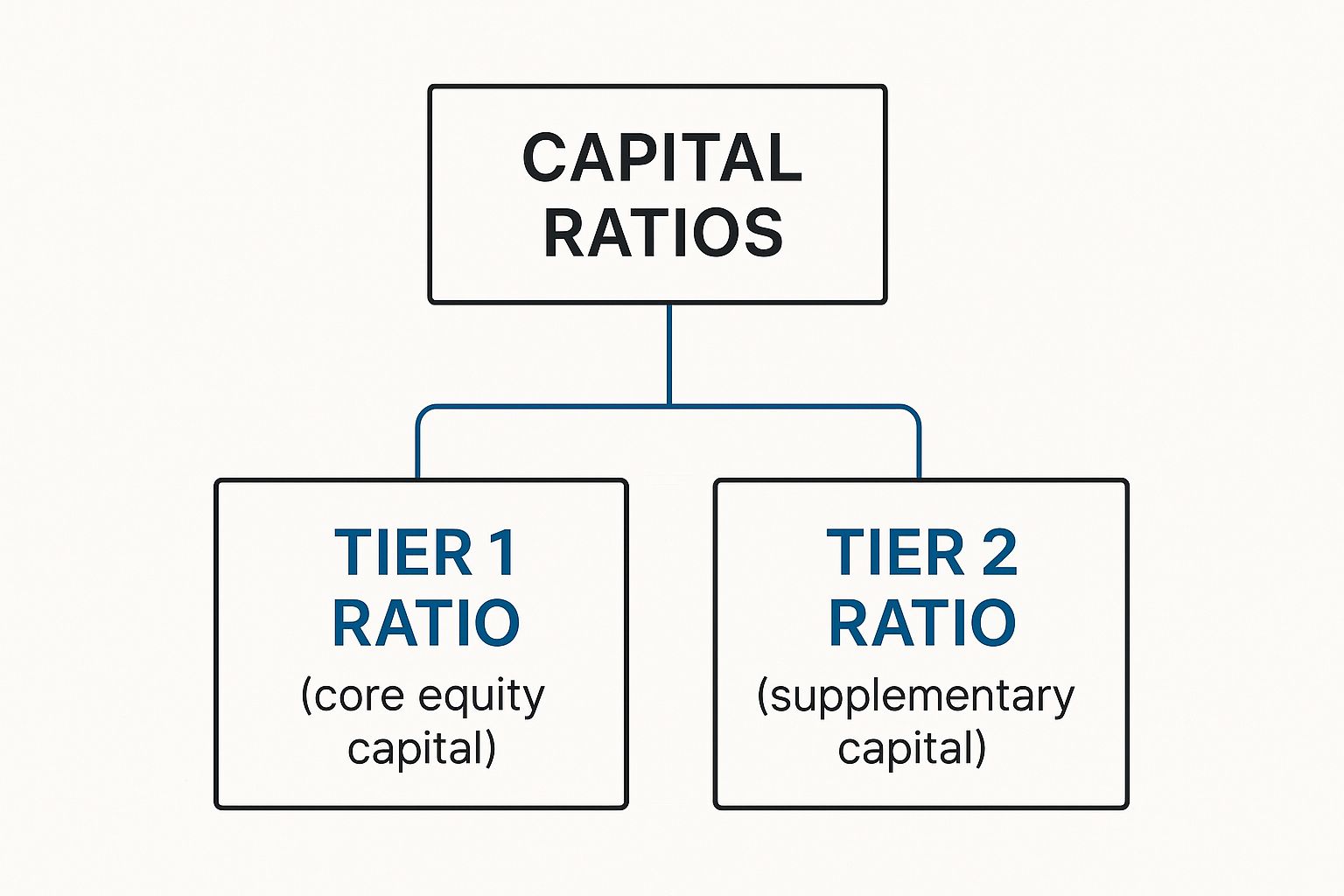
The management of these tiers evolved significantly following the 2007-2009 global financial crisis, with banks globally increasing their capital holdings. By 2021, U.S. banks held a Tier 1 capital to total assets ratio of approximately 8.5%, significantly higher than the next G7 country, Italy, at 6.1%. This was a deliberate, data-driven strategy to build more resilient institutions. For further detail, see this global banking analysis from the OCC.
The following table summarizes the key components.
Components of Regulatory Capital at a Glance
| Capital Tier | Key Components | Primary Function |
|---|---|---|
| CET1 | Common Stock, Retained Earnings, AOCI | Highest-quality "going-concern" capital; absorbs losses first to prevent insolvency. |
| AT1 | Perpetual Subordinated Bonds (CoCos) | Secondary "going-concern" buffer; can be converted to equity or written down under stress. |
| Tier 2 | Subordinated Debt (with maturity) | Supplementary "gone-concern" capital; absorbs losses in a liquidation scenario. |
Understanding the distinct function of each capital tier is not merely an academic exercise. It is fundamental to strategic capital planning, M&A due diligence, and effective risk management.
An imbalanced capital structure, such as over-reliance on Tier 2 capital without a robust CET1 foundation, signals a less resilient institution. This is precisely where data intelligence from platforms like Visbanking becomes indispensable, enabling you to benchmark your capital mix against peers to ensure your bank's structure is not just compliant, but strategically optimized.
How to Calculate Key Capital Ratios
Understanding the theory of capital tiers is foundational, but for executives, the value lies in translating these concepts into hard numbers that define the bank's risk capacity and growth potential. The calculations are straightforward, but the strategic narrative they reveal is what drives decisions.
The three primary capital ratios—CET1, Tier 1, and Total Capital—share a common denominator: Risk-Weighted Assets (RWA). This denominator is the mechanism that makes capital regulation risk-sensitive.

Defining Risk-Weighted Assets (RWA)
RWA is not simply total assets; it is a more intelligent metric that adjusts the value of assets based on their inherent risk. Safer assets receive a lower weight, while riskier assets are weighted more heavily, requiring more capital to support them. This system ensures that a bank holding low-risk government bonds is not required to maintain the same capital as a bank specializing in unsecured commercial lending.
Consider these practical examples of risk weights:
- Cash and U.S. Treasury Securities: Deemed risk-free, carrying a 0% risk weight.
- High-Quality Residential Mortgages: A loan to a prime borrower might carry a 50% risk weight. A $300,000 mortgage would contribute only $150,000 to RWA.
- Standard Corporate Loans: A loan to a creditworthy business typically has a 100% risk weight, meaning its full value contributes to RWA.
- Past-Due Loans: An unsecured loan over 90 days past due could be assigned a 150% risk weight. A $100,000 delinquent loan would add $150,000 to RWA, reflecting its higher probability of default.
By applying these weights, RWA provides an accurate representation of a bank's risk exposure.
The Core Capital Ratio Formulas
With RWA calculated, the capital ratio formulas are simple divisions, each providing a different lens on the bank's ability to absorb losses.
CET1 Capital Ratio: The most scrutinized metric, measuring the highest-quality capital against RWA.
- Formula:
CET1 Capital / Risk-Weighted Assets
- Formula:
Tier 1 Capital Ratio: A broader measure that includes Additional Tier 1 capital.
- Formula:
Tier 1 Capital (CET1 + AT1) / Risk-Weighted Assets
- Formula:
Total Capital Ratio: The most comprehensive view, incorporating all tiers of capital.
- Formula:
Total Capital (Tier 1 + Tier 2) / Risk-Weighted Assets
- Formula:
These calculations provide a multi-layered assessment of a bank's resilience, from the most conservative (CET1) to the most inclusive (Total Capital).
A Practical CET1 Calculation
Let's calculate the CET1 ratio for a hypothetical institution, Bank A.
- CET1 Capital: $1,000,000,000
- Risk-Weighted Assets (RWA): $10,000,000,000
The calculation is:$1,000,000,000 (CET1) / $10,000,000,000 (RWA) = 0.10
Bank A's CET1 Capital Ratio is 10.0%. But what does this number mean for the board?
A 10.0% CET1 ratio is not just a compliance figure; it is a strategic asset. It signals a strong cushion against economic shocks and provides leadership with the confidence to pursue growth opportunities—such as a strategic acquisition or market expansion—without taking undue risk.
However, a single number lacks context. A 10.0% ratio might be excellent for a large, systemically important bank but merely adequate for a community bank with a different risk profile. True insight comes from comparison. Is our 10.0% competitive? Does it align with our stated risk appetite? How does it compare to our direct competitors?
Answering these questions requires more than a calculator; it requires intelligence. Manual benchmarking by pulling individual call reports is inefficient and prone to error. This is where a data intelligence platform becomes a decisive advantage. Tools like Visbanking automate these calculations and provide instant, dynamic peer benchmarks, transforming a static number into a live, actionable strategic tool.
Basel III: The Rulebook That Reshaped Banking
Capital ratios are governed by the Basel III framework, a global set of regulatory standards established in response to the 2008 financial crisis. For bank leaders, understanding these rules is not about rote compliance; it is about comprehending the forces that shape modern capital strategy.
The crisis revealed systemic weaknesses in bank capitalization. Basel III was implemented to create a more resilient financial system by mandating higher quality and quantity of capital, ensuring banks could withstand severe economic stress without taxpayer bailouts. This framework provides the context for every capital decision made today.
The Regulatory Minimums (and Why They Aren't the Real Target)
Basel III establishes the following minimum capital ratios for all U.S. banks:
- Common Equity Tier 1 (CET1) Ratio: Minimum of 4.5%
- Tier 1 Capital Ratio: Minimum of 6.0%
- Total Capital Ratio: Minimum of 8.0%
However, targeting these minimums is a flawed strategy. The true operational requirement is dictated by the capital buffers stacked on top of these floors. Falling below these buffer-inclusive thresholds triggers restrictions on capital distributions, such as dividends and discretionary bonuses.
The Critical Role of Buffers
The primary buffer is the Capital Conservation Buffer (CCB), which requires banks to hold an additional 2.5% of CET1 capital above the minimum. This buffer is designed to ensure banks build up capital during favorable economic conditions to absorb losses during downturns. The CCB effectively raises the operational CET1 minimum to 7.0% (4.5% floor + 2.5% buffer).
A second, more dynamic buffer is the Counter-Cyclical Capital Buffer (CCyB). Regulators can activate this buffer (currently at 0% in the U.S.) to require banks to hold additional capital during periods of excessive credit growth, aiming to cool an overheating economy.
Meeting the regulatory minimum is not a strategy; it is a direct path to heightened regulatory scrutiny. The "well-capitalized" designation is the only prudent standard for a healthy, forward-looking institution.
The historical context is clear. In the 1840s, U.S. banks were funded with over 50% equity. By 2007, some major institutions operated with equity cushions as thin as 1.5%. The Basel Accords were designed to prevent a recurrence of this vulnerability. More on the history can be found in this overview of bank capital requirements and financial reform.
Strategic capital planning requires looking beyond today's minimums. It demands a clear understanding of how your ratios compare to peers and how strategic initiatives will impact them. This is where data intelligence provides a critical advantage. Visbanking delivers the tools to benchmark your capital framework, model scenarios, and transform compliance from a reactive exercise into a proactive strategic function.
Using Your Capital Ratios to Make Killer Strategic Moves
For a forward-thinking executive team, capital ratios are not a regulatory constraint but a strategic tool. These metrics define a bank's capacity for action, distinguishing between seizing an opportunity and ceding ground to a competitor. The operative question is not, "Are we compliant?" but, "How much capital do we have to deploy, and what is its highest and best use?"
Winning banks model the future. They understand the precise capital impact of a major initiative before it is executed. A strong capital position provides the strategic flexibility to acquire a rival, launch a new product line, or return value to shareholders.

Will That Acquisition Sink Your Ratios?
Consider a scenario. Your institution, Bank A, has a strong 12.5% CET1 ratio. Bank B, a potential acquisition target, is attractive but has a loan portfolio concentrated in commercial real estate, which carries higher risk weights.
- Bank A (Acquirer): CET1 Capital of $500 million; RWA of $4.0 billion.
- Bank B (Target): CET1 Capital of $150 million; RWA of $1.8 billion.
A pro forma calculation reveals a combined CET1 ratio of 11.2%, a 130 basis point decrease. While still well-capitalized, this transaction consumes a significant portion of the bank's strategic capital buffer. Data intelligence platforms allow you to benchmark this new ratio against similarly sized acquirers and stress-test the combined portfolio, providing a clear-eyed view of the risk being assumed.
The Balancing Act of Portfolio Strategy
Capital ratios should inform every portfolio management decision. Suppose the strategic plan calls for shifting $200 million from low-risk agency mortgage-backed securities (MBS) into higher-yielding commercial and industrial (C&I) loans to boost net interest margin.
The capital impact is direct and significant:
- Agency MBS (20% risk weight): Contributes $40 million to RWA.
- C&I Loans (100% risk weight): Contributes $200 million to RWA.
This strategic shift increases total RWA by $160 million, directly eroding capital ratios without adding a single dollar of new capital. The increased yield may justify the move, but the decision must be made with a full understanding of its impact on the bank's resilience.
The most effective boards view capital not as a constraint but as a finite resource to be allocated to the highest-return opportunities, risk-adjusted. Every decision is a capital allocation choice that must justify its cost.
The largest U.S. banks exemplify this discipline. Heading into 2025, many carry substantial capital buffers learned from the 2008 crisis. TD Bank's U.S. subsidiary reported a CET1 ratio of 16.65%, while JPMorgan Chase stood at 15.68%. This is not incidental; it is a deliberate strategy. You can explore more capital ratio statistics for large U.S. banks to observe this trend.
This scenario analysis table illustrates these trade-offs.
Scenario Analysis Capital Ratio Impact
This table illustrates how various strategic moves can directly impact a bank's CET1 ratio, forcing leadership to weigh growth against capital preservation.
| Strategic Decision | Change in RWA | Impact on CET1 Ratio | Key Consideration |
|---|---|---|---|
| Acquire a mortgage-heavy bank | Increase | Negative | Goodwill and higher-risk assets can significantly dilute capital ratios. |
| Shift to high-yield C&I lending | Increase | Negative | The potential for higher income must be weighed against capital consumption. |
| Issue new common stock | No change | Positive | Strengthens capital base but dilutes existing shareholders. |
| Aggressive share buyback | No change | Negative | Reduces capital, signaling confidence but decreasing the bank's shock absorption capacity. |
Each path has distinct consequences. The key is knowing them before you commit.
To Return Capital or Not to Return?
Finally, the decision to return capital to shareholders via dividends or buybacks must be data-driven. If your bank holds a 14.0% CET1 ratio against an internal target of 10.5% (to remain well-capitalized with a management buffer), the difference represents deployable "excess" capital. This analysis prevents premature capital distributions that could expose the bank in a downturn or attract regulatory scrutiny.
In each of these scenarios, foresight is paramount. Strategic decisions cannot be made with last quarter's data. Dynamic data that enables modeling, benchmarking, and planning is essential. Visbanking provides this intelligence, transforming complex capital data into clear insights that empower confident decision-making.
Turning Capital Data Into a Competitive Advantage
Capital ratios are not static figures for regulatory reports; they are dynamic indicators of a bank's health, risk posture, and operational efficiency. In a volatile market, relying on outdated peer data creates a significant strategic blind spot. The most effective leaders treat capital management as an offensive strategy.
The goal is to convert complex regulatory data into clear, actionable intelligence. Knowing your Total Capital Ratio is 13.5% is a starting point. Knowing that a curated peer group of active acquirers averages 14.2% provides critical context. That insight informs whether you can execute a transaction immediately or must first strengthen your capital base. This is the difference between raw data and a strategic decision.
Attempting this level of benchmarking manually is inefficient. Modern bank leadership requires tools that deliver insights in real-time, enabling you to anticipate market shifts and model strategic initiatives with confidence.
Stop reacting to historical data. Visbanking’s data provides the real-time peer analysis to see how your capital position truly compares, allowing you to make your balance sheet a competitive weapon.
Answering Your Top Questions About Capital Ratios
Even for seasoned executives, the nuances of capital management can prompt important questions. The following provides direct answers that connect these critical metrics to strategic action.
What's the Real Difference Between the Tier 1 Leverage Ratio and Risk-Based Ratios?
The difference is one of simplicity versus sophistication. The risk-based capital ratios (CET1, Tier 1, and Total Capital) are sophisticated metrics that weigh assets based on their specific credit risk. This nuanced approach requires less capital for a secured mortgage than for an unsecured commercial loan.
In contrast, the Tier 1 Leverage Ratio is a simple, non-risk-based backstop. It measures Tier 1 capital against total average assets, treating a U.S. Treasury bill and a speculative loan identically. Its purpose is to constrain balance sheet growth and guard against risks that complex risk-weighting models might underestimate.
How Often Should My Board Be Looking at Capital Adequacy?
At a minimum, capital adequacy should be a standing agenda item for every quarterly board meeting, timed to coincide with the filing of the Call Report. This ensures discussions are based on the most current, verified data.
However, a quarterly review is only the baseline. Leading institutions employ a dynamic process, using real-time data intelligence to continuously monitor capital levels against internal targets and peer benchmarks. Any significant deviation can be flagged for the board's immediate attention, regardless of the reporting cycle.
A best practice is to integrate the quarterly capital review directly into strategic planning sessions. This transforms a backward-looking compliance exercise into a forward-looking dialogue about funding growth, managing risk, and optimizing shareholder returns.
What Are the First Red Flags of a Weakening Capital Position?
The earliest indicators of a deteriorating capital position often appear not in the ratios themselves, but in the underlying trends that drive them. Astute leaders monitor these leading indicators:
- Excessive RWA Growth: If risk-weighted assets are growing significantly faster than retained earnings, capital ratios will inevitably come under pressure. This often indicates a shift into riskier asset classes without a corresponding capital plan.
- Sustained Operating Losses: Negative net income directly erodes retained earnings, the core component of CET1 capital. A series of unprofitable quarters represents a direct drain on the bank's foundational strength.
- Rising Asset Concentrations: Over-reliance on a single industry, loan type, or geography creates correlated risk. A downturn in that specific sector can lead to concentrated credit losses that rapidly deplete capital.
Identifying these triggers early provides the strategic latitude to adjust asset mix, raise capital from a position of strength, or pivot strategy before regulatory intervention becomes a risk.
Stop reacting to yesterday's capital reports. It's time to get ahead of the curve. Visbanking gives you the real-time peer benchmarks and trend analysis to make your capital data a true competitive weapon. Explore our data and see where you truly stand.
Related Articles

Visbanking Blog
Why Your Bank's Tier 1 Capital Ratio Could Save It From Crisis

Visbanking Blog
Why Tier 1 Capital Ratio Matters in Banking Regulation and Safety

Visbanking Blog
What is a good Tier 1 capital ratio?

Visbanking Blog
Capital Banking in the USA: An Overview of Investment Services, Financial Instruments, and Regulations

Visbanking Blog
Bank Capital Requirements: The Ultimate Survival Guide

Visbanking Blog