
The 12 Best Financial Analysis Software Platforms for 2025
Brian's Banking Blog
In today's compressed-margin environment, relying on outdated analytics and manual data pulls is no longer a viable strategy; it's a liability. Bank executives and directors require more than just data. They need an intelligence engine that transforms raw numbers into a clear strategic advantage, enabling them to anticipate market shifts, benchmark performance accurately, and identify growth opportunities before the competition.
This analysis cuts through the noise to evaluate the best financial analysis software available today. We focus on platforms that deliver actionable insights for critical banking functions, from risk management and compliance to customer acquisition and strategic planning. These tools are indispensable for modern financial analysts navigating complex markets and making strategic decisions with confidence.
We will assess each solution not on its marketing claims, but on its capacity to drive tangible outcomes and empower leadership with the clarity needed to navigate a complex financial landscape. Inside, you'll find detailed breakdowns of each platform's strengths, limitations, ideal use cases, and pricing, complete with screenshots and direct links to help you make a well-informed decision for your institution. This guide is built to help you find the right intelligence engine to secure your competitive edge.
1. Visbanking
Visbanking earns its position as the top choice for best financial analysis software by offering a dedicated Bank Intelligence and Action System (BIAS) that fundamentally transforms how banking leaders operate. It moves institutions from a reactive stance to a proactive, data-driven strategy, integrating over 30 years of disparate data sources into a single, actionable platform. For executives, this means no longer piecing together insights from separate reports on market trends, regulatory changes, and internal performance.
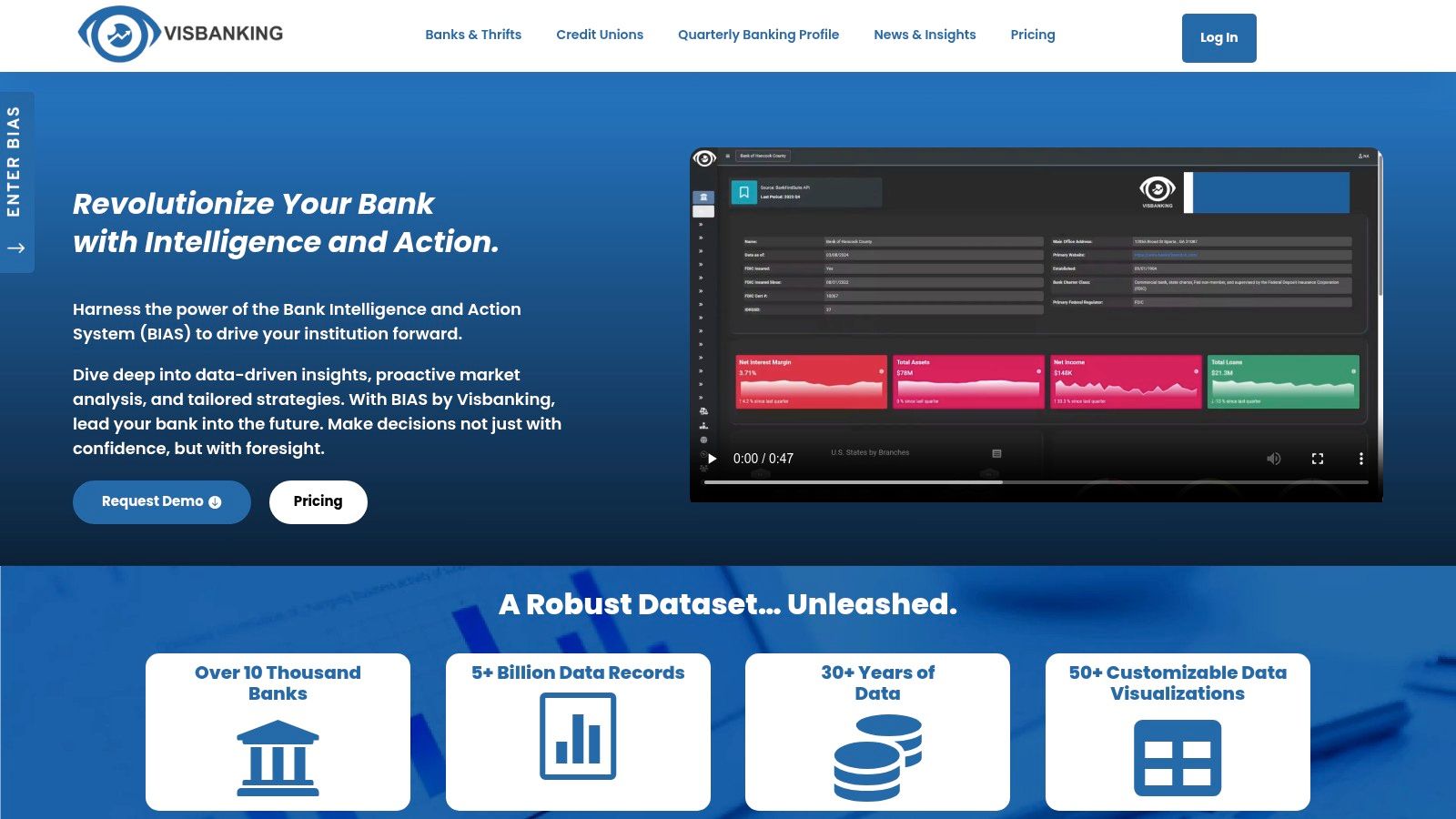
This unified intelligence is where Visbanking’s true power lies. Imagine a community bank’s board needing to assess the risk of expanding its commercial real estate portfolio. Instead of manually compiling peer data, Visbanking allows them to instantly benchmark their proposed loan-to-value ratios and concentration levels against 50 similar-sized institutions in their region, revealing that top-quartile performers maintain a 5% lower CRE concentration. This insight directly informs a more resilient growth strategy. The platform covers over 10,000 banks with more than 5 billion data records, providing unparalleled depth for strategic decision-making.
Key Features and Use Cases
- Proactive Customer Targeting: By analyzing market and financial data, a bank can identify its "next best customer" profile, such as businesses in a specific sector showing strong deposit growth, and direct its marketing and sales efforts with precision.
- Comprehensive Peer Benchmarking: The platform allows for granular comparisons on key performance indicators, from efficiency ratios to loan portfolio quality, helping executives understand their competitive standing and identify operational weaknesses.
- Flexible Data Delivery: Visbanking integrates seamlessly into existing workflows. Insights can be accessed via API, direct SQL connection, or through interactive dashboards in Tableau and Power BI, ensuring data is available where decisions are made.
Pricing and Access
Pricing for Visbanking is not publicly listed and requires a direct inquiry for a custom quote. This approach allows them to tailor the solution to an institution's specific needs, but it can make initial cost comparisons challenging. Interested parties are encouraged to request a demo to see the platform's capabilities firsthand.
- Website: https://www.visbanking.com
| Pros | Cons |
|---|---|
| Comprehensive dataset integrates financial, regulatory, market, and news data for over 10,000 banks. | Pricing is not transparent and requires direct contact for a quote. |
| Enables proactive, data-driven decisions on customer targeting, risk management, and competitive benchmarking. | New users may face a learning curve due to the platform's extensive features and customization. |
| Flexible data delivery through APIs, SQL, interactive dashboards (Tableau, Power BI), and PDF reports. | |
| Highly tailored for banking executives, analysts, and regulators, supporting both strategic and operational initiatives. |
For institutions ready to lead with foresight, Visbanking provides the critical intelligence to navigate complexity and seize growth opportunities. Explore its data to benchmark your institution’s performance against the industry’s best.
2. Bloomberg Terminal — Bloomberg Professional
The Bloomberg Terminal is the undisputed institutional standard for real-time market data, analytics, and news, making it an essential tool for investment banks, asset managers, and corporate finance departments. Its strength lies in the sheer breadth and depth of its professional-grade content, covering every conceivable asset class with extensive historical data. Beyond its vast data offerings, the Terminal provides users with sophisticated tools, including advanced market trend forecasters, vital for navigating complex financial landscapes. This platform's comprehensive ecosystem integrates trading, messaging, and a powerful Excel API, establishing it as the central nervous system for many financial institutions.

For a bank’s leadership, the Terminal provides indispensable, real-time intelligence for treasury and capital markets functions. For instance, a treasurer can instantly analyze the yield curve to optimize the bank’s investment portfolio or execute a swap to hedge interest rate risk, all within a single, secure environment.
Use Cases, Pros, and Cons
| Category | Details |
|---|---|
| Best For | Institutional investors, traders, and analysts requiring immediate access to mission-critical, comprehensive market data and analytics. |
| Pricing | Extremely high, costing approximately $31,980 per user, per year, making it prohibitive for smaller firms or individual investors. |
| Pros | Unmatched Content: Access to an unparalleled range of real-time and historical multi-asset data and news. Industry Standard: Widely adopted, creating a universal language and skillset across the financial sector. |
| Cons | High Cost: The premium price point is a significant barrier to entry. Vendor Dependency: Occasional outages can disrupt operations, highlighting the risk of relying on a single dominant provider. |
Website: https://www.bloomberg.com/professional/solution/bloomberg-terminal/
3. S&P Capital IQ Pro — S&P Global Market Intelligence
S&P Capital IQ Pro is a powerful integrated platform providing deep financial data and sophisticated analytics essential for corporate finance, investment management, and banking. It distinguishes itself with extensive coverage of both public and private companies, offering granular data on financials, M&A transactions, private equity, and ownership. For banking executives, the platform’s strength lies in its comprehensive sector-specific data and robust screening tools, enabling precise competitor benchmarking and market analysis. Its powerful Excel and Office add-ins create a seamless workflow, allowing analysts to pull and model complex data directly within their familiar environments.
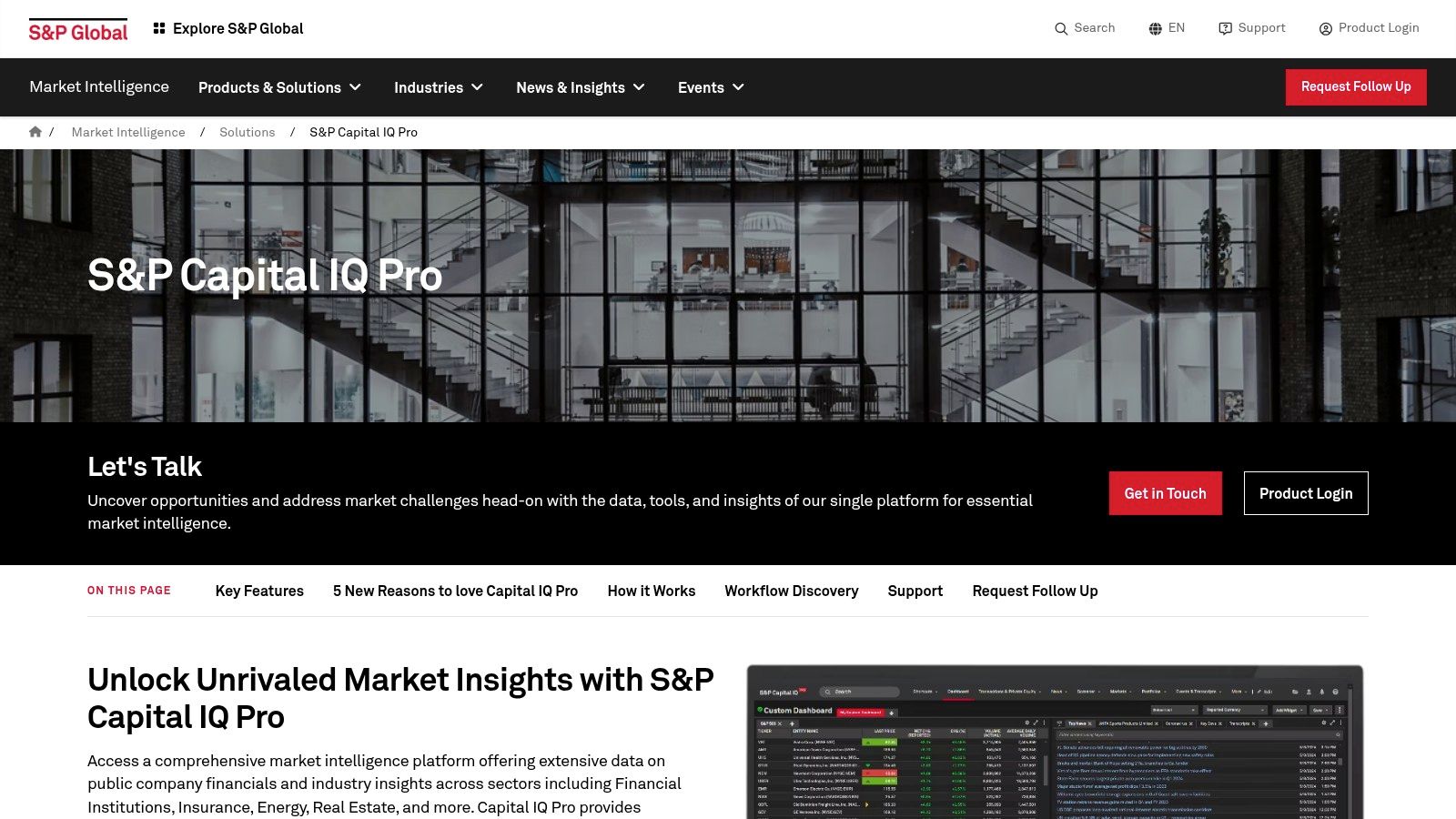
A commercial lending division, for example, can use Capital IQ to conduct due diligence on a potential borrower by analyzing their financial health, ownership structure, and credit ratings from S&P Global Ratings. This data intelligence allows the bank to price risk more accurately and structure loans that align with its credit policy, moving from subjective assessments to data-backed decisions.
Use Cases, Pros, and Cons
| Category | Details |
|---|---|
| Best For | Corporate finance teams, investment bankers, and equity researchers needing deep company and industry data for valuation, M&A, and market intelligence. |
| Pricing | Custom enterprise pricing, which requires direct contact with a sales representative. It is primarily geared toward institutional and academic clients. |
| Pros | All-in-One Workflow: Combines deep public and private company data with powerful Excel integration. Expanding AI Capabilities: GenAI tools for smarter search and document summarization accelerate research tasks. |
| Cons | Institutional Focus: Pricing and access are structured for corporations and large institutions, not individual users. Sales-Led Pricing: The lack of transparent pricing can be a hurdle for initial evaluation. |
Website: https://www.spglobal.com/marketintelligence/en/solutions/sp-capital-iq-pro
4. LSEG Workspace (formerly Refinitiv Eikon/Workspace) — London Stock Exchange Group
LSEG Workspace is a formidable, cloud-first platform that directly rivals the Bloomberg Terminal, offering a comprehensive suite of data, news, and analytics tailored for financial professionals. It integrates the trusted global news coverage of Reuters with deep financial data, sophisticated screening tools, and extensive ESG metrics. For banking executives and analysts, its key strength lies in its powerful combination of deep macroeconomic data via Datastream and a vast repository of broker research. This allows for thorough due diligence and strategic analysis, from evaluating M&A targets to assessing industry-wide economic shifts.
A bank's strategic planning team could leverage LSEG Workspace to model the impact of projected Federal Reserve interest rate changes on their net interest margin. By combining Datastream’s economic forecasts with their internal balance sheet data, they can run scenarios to inform ALCO decisions, demonstrating how external data intelligence drives proactive risk management.
Use Cases, Pros, and Cons
| Category | Details |
|---|---|
| Best For | Financial analysts, advisors, and portfolio managers who need a blend of real-time news, extensive company data, and powerful macroeconomic analytics. |
| Pricing | Quote-based and tailored to enterprise needs, requiring direct engagement with a sales representative. Pricing can be complex depending on data packages. |
| Pros | Strong Global News: Unparalleled access to Reuters news provides a critical edge in market intelligence. Modern Interface: A flexible and intuitive user experience with extensive training resources available for teams. |
| Cons | Complex Pricing: The quote-based model can make it difficult to quickly evaluate costs against competitors. Enterprise Focus: Licensing is typically structured for institutions, posing a barrier for smaller firms or individual users. |
Website: https://www.lseg.com/en/data-analytics/financial-data/lseg-workspace
5. Morningstar Direct (Direct Platform + Direct Advisory Suite)
Morningstar Direct is an enterprise-grade investment research platform that unifies Morningstar’s extensive data, proprietary ratings, and portfolio analytics. Tailored for asset managers, wealth managers, and institutional consultants, it provides a comprehensive toolkit for in-depth fund analysis, portfolio construction, and client reporting. The platform excels at delivering deep insights into investment vehicles, supported by powerful tools like the Direct Lens for portfolio analysis and a new advisory suite designed specifically for financial advisors. It integrates modern technology with its core offerings, including APIs and a Python package for custom automation and integration.
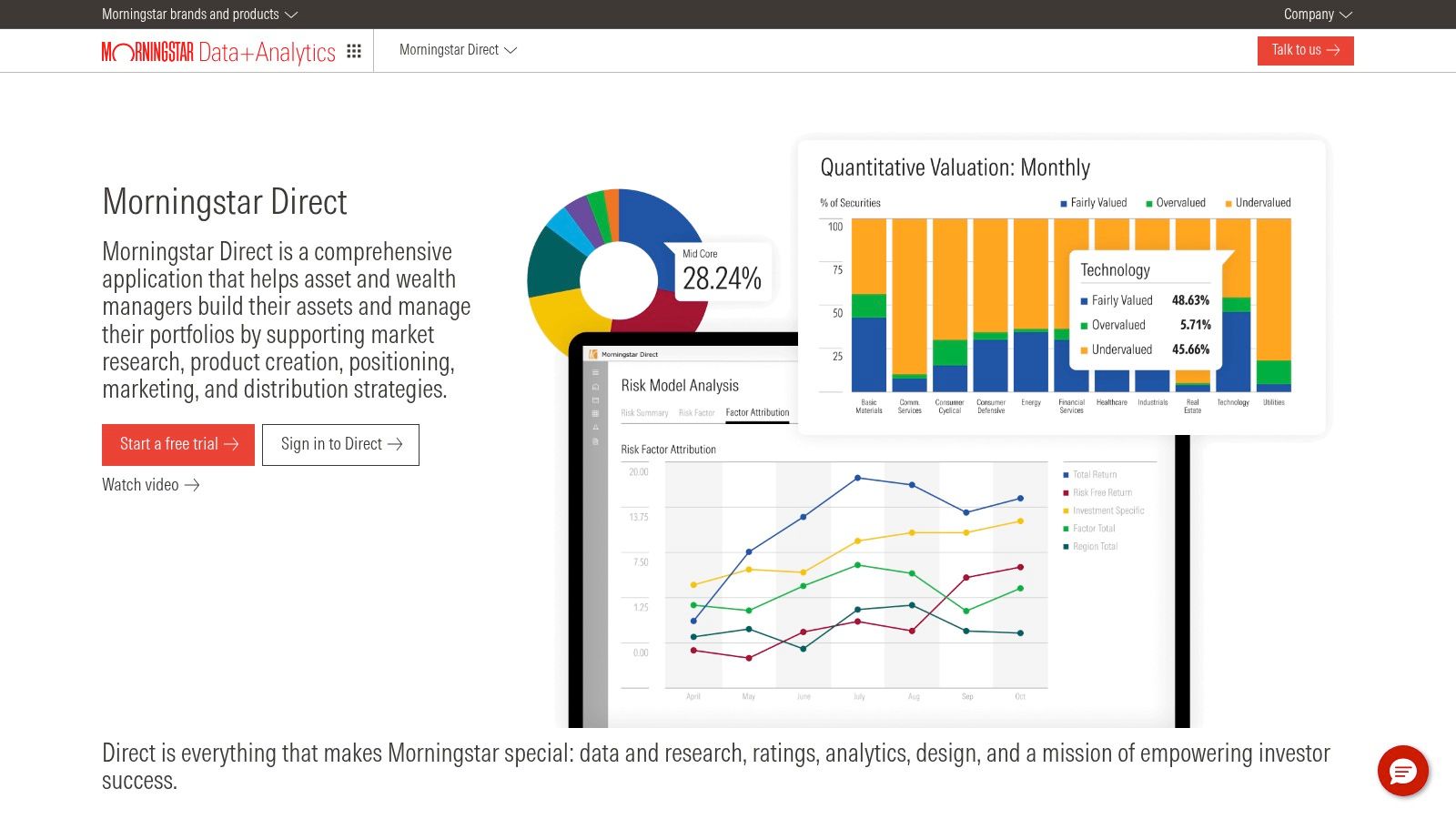
For a bank’s wealth management division, Morningstar Direct is the definitive tool for due diligence. An investment committee can use the platform to screen for mutual funds that have consistently outperformed their benchmarks over a 10-year period with below-average fees and top-quartile Morningstar Ratings, ensuring that client portfolios are built on a foundation of rigorous, data-driven research.
Use Cases, Pros, and Cons
| Category | Details |
|---|---|
| Best For | Asset managers, wealth managers, and institutional consultants requiring deep fund research, portfolio analytics, and client reporting tools. |
| Pricing | Enterprise-level, quote-based pricing. It is not designed or priced for individual retail investors. |
| Pros | Authoritative Research: Renowned for its independent fund and equity research, ratings, and data quality. Integrated Workflow: Combines portfolio analysis, data, and reporting in a single, cohesive platform. |
| Cons | Niche Focus: Heavily geared towards investment and fund analysis, making it less suitable for corporate finance or broader market trading. Enterprise Pricing: The cost structure makes it accessible primarily to professional teams and institutions. |
Website: https://www.morningstar.com/business/products/direct
6. YCharts
YCharts is a web-based investment research platform prized for its powerful data visualization and charting capabilities, making complex financial information accessible and presentable. The platform excels at transforming raw data, covering over 4,000 metrics, into compelling charts and reports that are ideal for client communication and internal strategy meetings. Its intuitive interface allows for seamless screening, portfolio analysis, and the creation of custom scoring models, supporting data-driven investment theses. For financial advisors and asset managers, it serves as a critical tool for building and communicating investment strategies.
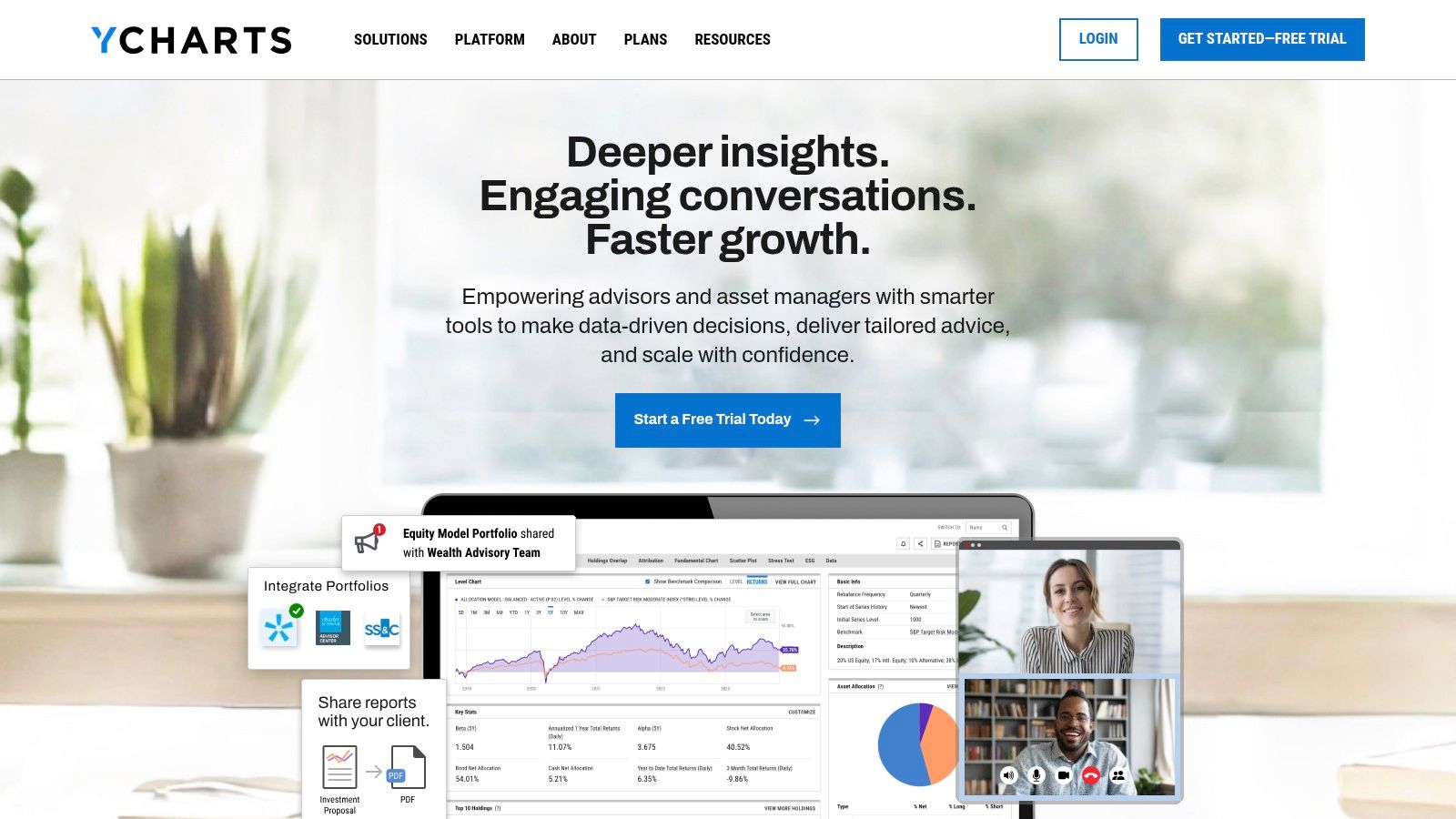
YCharts enables a bank’s trust department to create a clear, one-page report illustrating a client’s portfolio performance against the S&P 500, highlighting key metrics like the 25% lower volatility achieved over the past five years. This data-driven communication builds client trust and reinforces the value of the bank’s advisory services.
Use Cases, Pros, and Cons
| Category | Details |
|---|---|
| Best For | Financial advisors, asset managers, and investors who need strong visualization tools for research, client proposals, and reporting. |
| Pricing | Plans range from approximately $300 to $500 per month. Specific pricing for advanced features often requires direct contact with their sales team. |
| Pros | Excellent Visualizations: Superior charting and reporting tools make it easy to create client-facing materials. Strong Advisor Workflow: Streamlines the process from research and screening to proposal generation. |
| Cons | High Cost for Individuals: The pricing is geared toward professionals and can be prohibitive for retail investors. Opaque Pricing Tiers: Full cost details for higher-tier plans are not publicly available, requiring a sales consultation. |
Website: https://ycharts.com/
7. Koyfin
Koyfin is an exceptionally powerful financial data and analytics platform designed to give investors professional-grade tools without the institutional price tag. It democratizes access to sophisticated market intelligence, offering extensive dashboards, advanced charting, and comprehensive data on equities, ETFs, and mutual funds. The platform excels at providing deep insights into market trends and company fundamentals, integrating everything from financial statements and analyst estimates to news and SEC filings. Its clean, modern interface makes it an accessible yet robust tool for serious analysis.
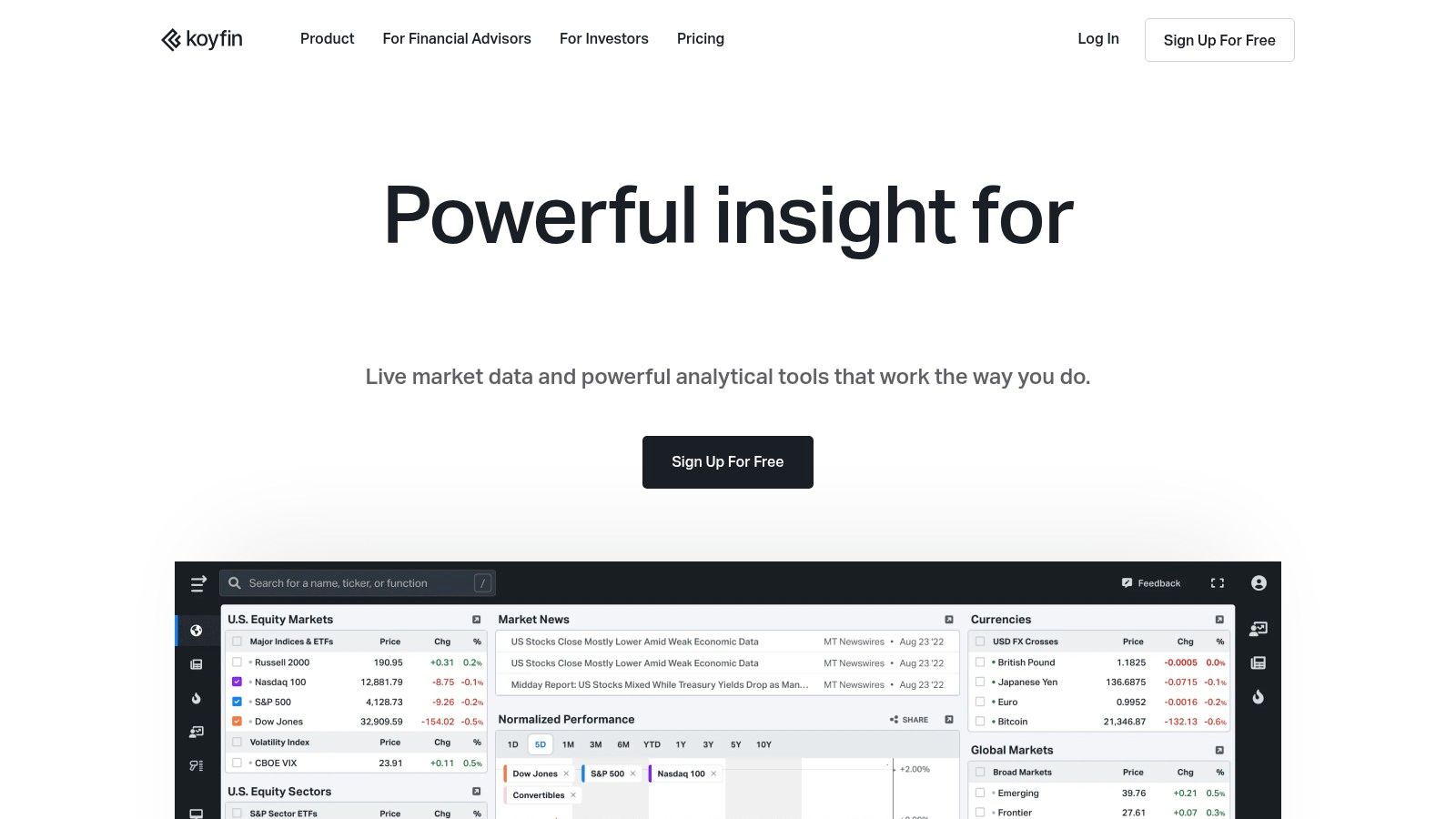
While primarily for individual investors, a bank analyst could use Koyfin for rapid initial screening of publicly traded companies in a specific sector, such as regional banks, to compare price-to-book ratios and ROE trends before committing to a deeper dive with an institutional platform. This efficiency demonstrates how accessible banking data analytics can complement enterprise systems.
Use Cases, Pros, and Cons
| Category | Details |
|---|---|
| Best For | Individual investors, financial advisors, and small-to-midsize funds needing professional-grade data and analytics at an affordable price point. |
| Pricing | Offers a free tier with robust features. Paid plans include Plus ($39/mo), Premium ($79/mo), and specialized Advisor tiers up to $299/mo. |
| Pros | Exceptional Value: Provides a significant portion of institutional-level functionality for a fraction of the cost. Modern UI: The user interface is intuitive, fast, and highly customizable, ensuring a smooth user experience. |
| Cons | Limited Coverage: Lacks the extensive multi-asset depth (e.g., fixed income, commodities) of top-tier institutional terminals. Advanced Features Gated: Key tools for professional advisors are reserved for the most expensive subscription tiers. |
Website: https://www.koyfin.com/
8. TradingView
TradingView has carved out a significant niche as a premier charting platform, celebrated for its intuitive design and powerful analytical tools that cater to both individual traders and institutional analysts. Its strength lies in combining best-in-class charting capabilities with an extensive social network, allowing users to share strategies, custom scripts, and market analysis. The platform supports a vast array of technical indicators, drawing tools, and its proprietary Pine Script language for creating custom indicators and backtesting strategies. This blend of accessibility and advanced functionality makes it an invaluable resource for technical analysis and market visualization.
While more focused on technical trading, a bank’s capital markets desk can use TradingView to monitor real-time price action and volatility in specific asset classes, like the 10-year Treasury note, to identify optimal entry and exit points for hedging activities, adding a layer of tactical insight to broader strategic decisions.
Use Cases, Pros, and Cons
| Category | Details |
|---|---|
| Best For | Traders and analysts focused on technical analysis, custom strategy development, and collaborative market research. |
| Pricing | Offers a free basic plan with multiple paid tiers (Essential, Plus, Premium) ranging from approximately $14.95 to $59.95 per month, with annual discounts. |
| Pros | Superb Charting: Industry-leading charting interface with extensive customization and technical indicators. Large Community: Access to a vast library of community-created scripts and trading ideas. Flexible Plans: Robust alerting, screening, and backtesting capabilities available across different tiers. |
| Cons | Data Costs: Real-time data from major exchanges often requires additional monthly subscription fees, increasing the total cost. |
Website: https://www.tradingview.com/
9. FINVIZ Elite
FINVIZ Elite is a powerful stock screening and data visualization platform designed for speed and efficiency, making it a favorite among active traders and individual investors. It excels at quickly identifying market trends and investment opportunities through its comprehensive set of filters, real-time data, and intuitive heatmaps. The platform's strength lies in its ability to condense vast amounts of market information into easily digestible visual formats, allowing users to spot patterns and outliers at a glance. For financial professionals, this tool can serve as a rapid idea-generation and market-monitoring system.
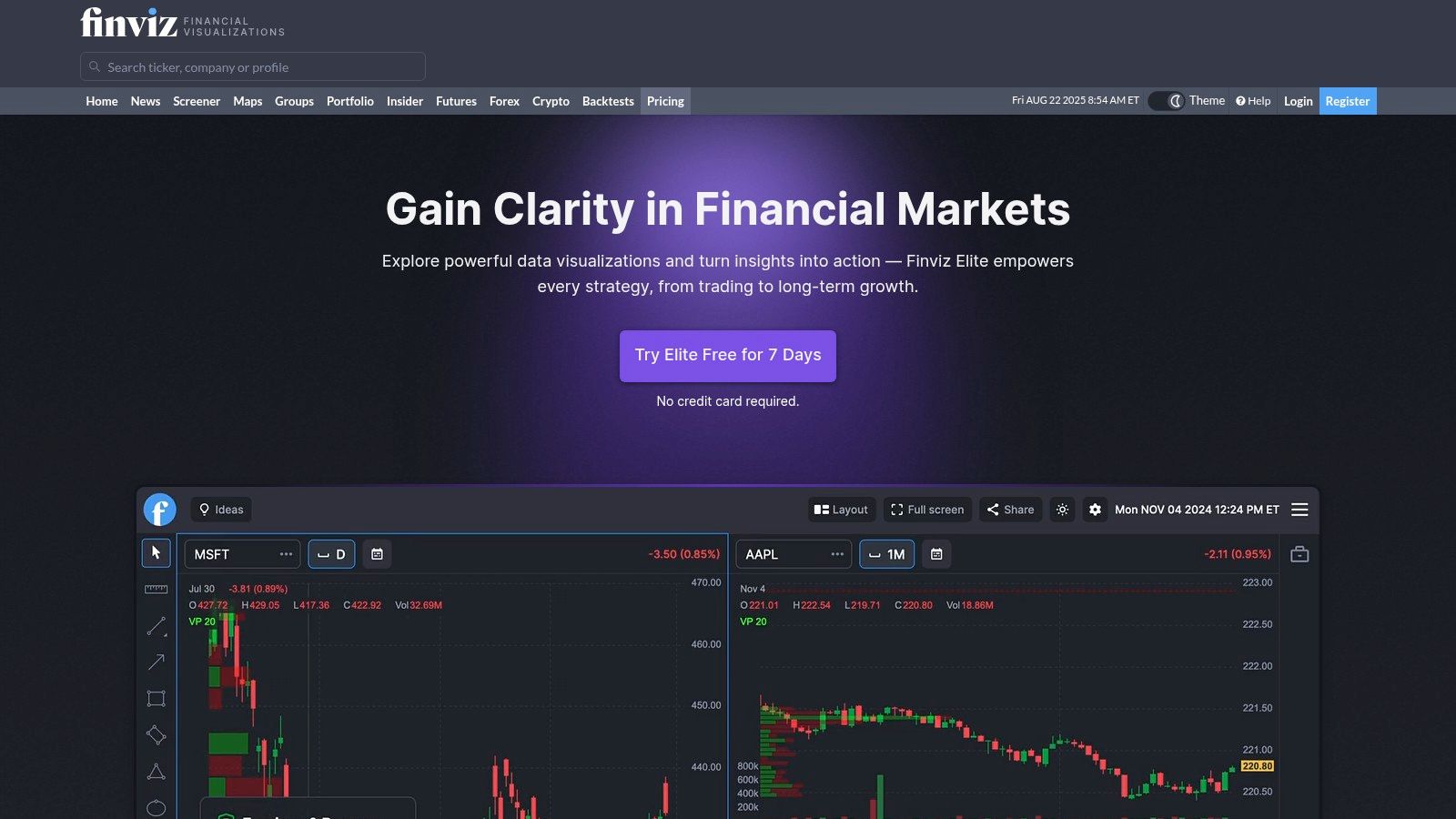
A bank analyst can use FINVIZ’s heatmap to get an immediate, visual understanding of sector performance on a given day. For instance, observing that the entire financial sector is down 3% except for a handful of regional banks can be the starting point for a deeper investigation into what drives that specific outperformance.
Use Cases, Pros, and Cons
| Category | Details |
|---|---|
| Best For | Active traders and analysts seeking a fast, intuitive, and highly visual platform for stock screening and idea generation. |
| Pricing | Subscription-based, with the Elite plan costing $39.50 per month or $299.50 per year, offering excellent value. |
| Pros | Exceptional Speed: Incredibly fast screening and charting capabilities. Visual Interface: Heatmaps and charts provide quick, intuitive market insights. Great Value: Offers advanced features at a very competitive price point. |
| Cons | Limited Fundamentals: Lacks the deep fundamental analysis and modeling tools found in institutional-grade platforms. Focus on Equities: Primarily designed for stock analysis, with less coverage of other asset classes. |
Website: https://finviz.com/elite
10. Seeking Alpha Premium
Seeking Alpha Premium is an investment research platform that crowdsources insights from a vast community of contributors, providing a unique blend of fundamental analysis, breaking news, and quantitative ratings. While not a direct institutional competitor to platforms like Bloomberg, it offers a powerful and accessible layer of analysis, particularly for U.S. equities. The platform's strength is its diverse commentary and data, including detailed earnings call transcripts, author performance ratings, and proprietary "Quant Ratings" that grade stocks on value, growth, and profitability. For banking professionals, this provides a valuable channel for tracking market sentiment and uncovering perspectives often missed by traditional sell-side research.
An analyst covering the banking sector can use Seeking Alpha to read earnings call transcripts and gauge investor sentiment on a competitor bank’s recent M&A announcement. This qualitative data provides crucial context that quantitative screens alone cannot capture, informing the bank’s own strategic positioning.
Use Cases, Pros, and Cons
| Category | Details |
|---|---|
| Best For | Individual investors and professionals seeking diverse, crowdsourced U.S. equity analysis, quant screening tools, and earnings insights. |
| Pricing | Annual subscription is typically $239, but frequent promotions and a free trial are often available. |
| Pros | Extensive Content Base: A large volume of articles from a wide array of contributors offers multiple viewpoints. Affordable: Significantly more accessible than institutional-grade terminals. |
| Cons | Variable Quality: The contributor-based model means content quality and analytical rigor can be inconsistent. Limited Scope: Primarily focused on U.S. equities and lacks the multi-asset data depth of professional terminals. |
Website: https://seekingalpha.com/
11. QuantConnect
QuantConnect is an algorithmic trading platform that empowers quantitative analysts and financial institutions to research, backtest, and deploy systematic trading strategies. It operates on the open-source LEAN engine, offering a versatile environment for strategy development across cloud and local setups. The platform's strength lies in its comprehensive ecosystem, providing access to diverse datasets and multiple broker integrations, which allows for a seamless transition from historical testing to live execution. This makes it a powerful tool for banks looking to develop and validate proprietary trading models with institutional-grade infrastructure.
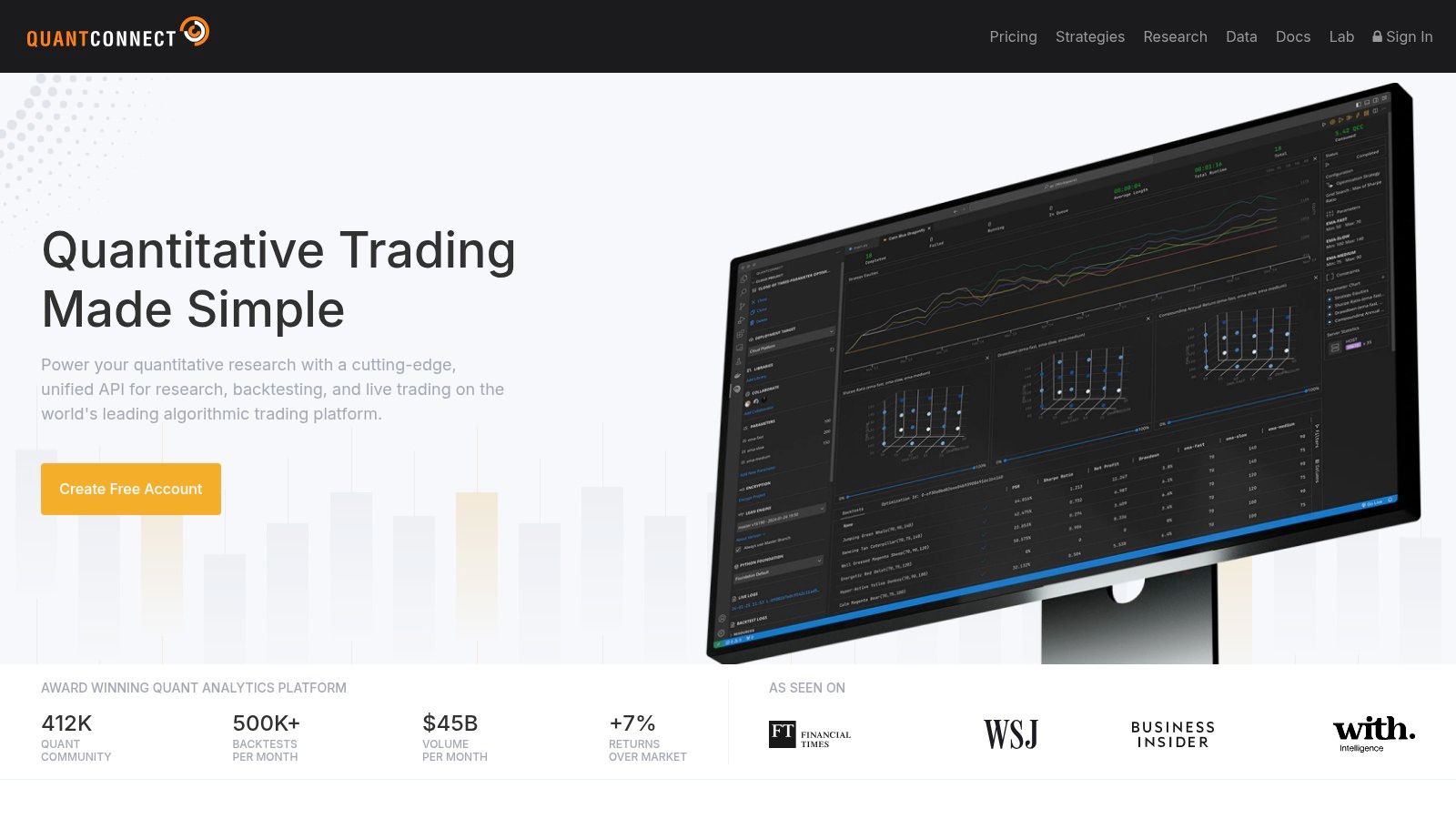
A bank's quantitative research group could use QuantConnect to build and backtest a sophisticated pairs trading strategy between two major financial ETFs. By simulating the strategy over 15 years of historical data, they can validate its risk-adjusted returns and correlation with the bank's broader portfolio before deploying capital.
Use Cases, Pros, and Cons
| Category | Details |
|---|---|
| Best For | Quantitative analysts, hedge funds, and bank proprietary trading desks needing a powerful platform for developing and deploying algorithmic strategies. |
| Pricing | Offers a free tier with unlimited backtesting. Paid plans (Quant Researcher, Team, Firm, Institution) scale up in price, providing more resources and collaboration features. Data add-ons are priced separately. |
| Pros | Powerful Backtesting: Utilizes the robust LEAN engine for detailed and accurate historical strategy testing. Active Community: Provides access to a large community and a wealth of shared knowledge and strategies. |
| Cons | Complex Pricing: The cost structure for data and advanced features can be complex, requiring careful navigation of in-app pricing matrices. Niche Focus: Primarily tailored for algorithmic trading, making it less suitable for traditional fundamental analysis. |
Website: https://www.quantconnect.com/
12. Portfolio123
Portfolio123 is a comprehensive quantitative research platform that empowers sophisticated retail investors and professionals to design, test, and implement complex stock selection models. It excels at providing clean, point-in-time financial data, which is critical for avoiding look-ahead bias in backtesting. The platform’s strength is its powerful backtesting engine, allowing users to simulate intricate strategies that include rules for hedging, shorting, and dynamic rebalancing, far surpassing the capabilities of typical retail screeners.
Latest Articles
Brian's Banking Blog
Option Adjusted Spread: A Banker's Practical Framework
Brian's Banking Blog
How to Improve Margins: A Bank Leader's Playbook
Brian's Banking Blog
Automated Alerts and Notifications for Banks
Brian's Banking Blog
Customer Feedback Loop for Banks: A Practical Playbook
Brian's Banking Blog
Commercial Lending Trends: What Bank Executives Must Know
Brian's Banking Blog