
A Data-Driven Analysis of Maryland's Top-Performing Credit Unions
Brian's Banking Blog
Identifying Maryland’s top credit unions requires a quantitative analysis that moves beyond asset size and member sentiment. For banking executives and directors, a rigorous, data-driven assessment is fundamental to strategic planning, competitive positioning, and identifying market opportunities. This analysis provides a framework for such an evaluation.
Maryland's credit union landscape, representing over $45 billion in assets, is a competitive environment where operational efficiency and balance sheet strategy dictate market leadership. A superficial ranking fails to deliver the actionable intelligence required for executive decision-making. This analysis moves beyond conventional lists to provide a quantitative framework for evaluating Maryland's key credit unions, demonstrating how granular data informs superior strategic outcomes.
We will dissect the primary data sources and methodologies for assessing institutional performance. By leveraging NCUA 5300 Call Reports and other regulatory filings, a simple directory can be transformed into a powerful strategic tool. This article provides a comprehensive overview of essential platforms for researching and analyzing these institutions. Each entry includes direct links and actionable insights for effective opportunity assessment. By employing a unified data intelligence platform like Visbanking, executives can move from observation to action, identifying specific growth vectors and competitive risks within this critical market.
1. NCUA – MyCreditUnion.gov
For any banking professional conducting market analysis, the foundational data source is the National Credit Union Administration (NCUA). The MyCreditUnion.gov site is the definitive, authoritative directory for all federally insured credit unions. While not a "best of" list, its value lies in providing an unvarnished, comprehensive landscape of the credit union sector in Maryland. It is an essential tool for baseline competitive intelligence.

The platform is free of advertisements or paid placements, ensuring data integrity. Its primary function, the Credit Union Locator, allows searches by city, ZIP code, or name to generate a complete list of institutions in a specific geographic market. This tool provides the foundational map for understanding the competitive footprint in key Maryland territories.
Strategic Application for Banking Professionals
For executive and business development teams, MyCreditUnion.gov serves as the primary source for initial market mapping. It facilitates the rapid identification of every credit union operating in a target area like Baltimore or Montgomery County, offering a baseline view of their service offerings and a direct link to their official websites. This is a crucial first step in due diligence before committing resources to deeper financial analysis. For example, a bank planning a branch expansion into Anne Arundel County can use this tool to generate an exhaustive list of incumbent credit unions, providing an initial competitor count of approximately 25 institutions.
Direct Takeaway: Use the NCUA locator to build a definitive roster of all potential competitors or partners in a given Maryland market. This government-backed data provides the most accurate starting point for any strategic analysis, validating the existence and operational status of every federally insured credit union.
Using the Platform Effectively
The platform's strength is its data purity, not its user interface. The interface is utilitarian, designed for consumer accuracy rather than executive-level analysis.
Actionable insights are derived by:
- Market Mapping: Systematically search by ZIP code across a target region (e.g., the I-270 Technology Corridor) to compile a complete list of credit unions. This identifies all competitors, ensuring none are overlooked.
- Service Verification: Monitor the listed services for each credit union. If a key competitor with $500 million in assets suddenly lists "Business Services," it signals a strategic expansion into commercial lending that warrants immediate, deeper investigation through a data intelligence platform.
- Foundation for Deeper Analysis: Once a validated list of Maryland credit unions is established, advanced tools like Visbanking can extract detailed financial health, loan portfolio composition, and growth trend data. The NCUA site provides the "who," while data platforms provide the "why" and "how."
While MyCreditUnion.gov does not offer comparative analytics, its role is indispensable. It provides the official roster of market players. Understanding the core differences and competitive advantages of these institutions is critical; explore the fundamental distinctions in our analysis of the credit union versus bank model.
Access the Tool: https://mycreditunion.gov
2. NCUA – Research a Credit Union
If MyCreditUnion.gov provides the market map, the NCUA’s "Research a Credit Union" tool provides the topographical detail. This data hub is the next logical step for professionals moving from market identification to initial qualification. It offers direct access to institution profiles and quarterly call report metrics, allowing for a preliminary assessment of a credit union's financial health, scale, and strategic focus.
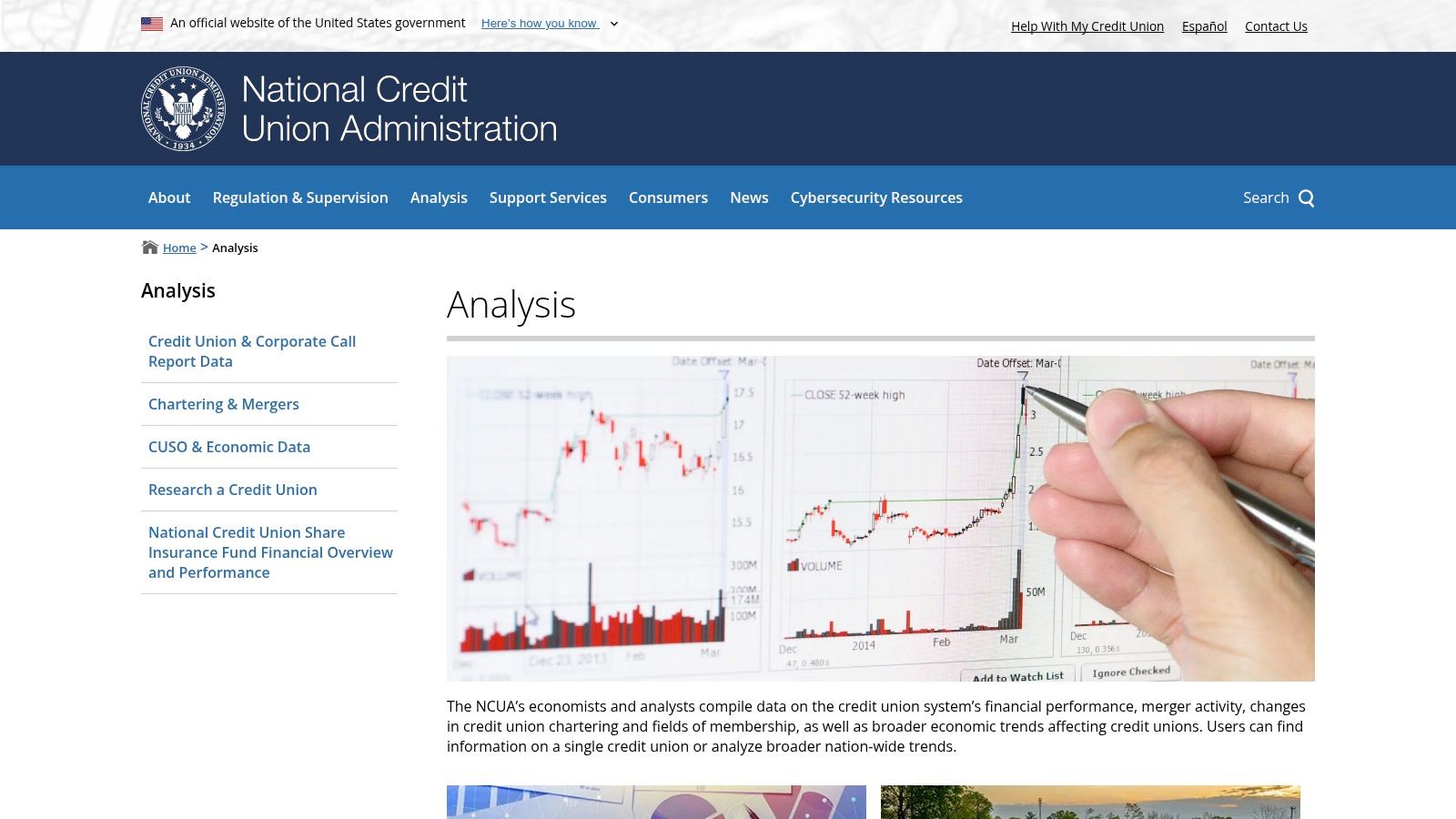
This free government platform is where core metrics are validated before committing resources to deeper analysis. By searching by name or charter number, an analyst can instantly pull a credit union’s asset size, membership count, net worth ratio, and loan-to-share ratio. This is an essential due diligence step for confirming the scale of any Maryland credit union being evaluated.
Strategic Application for Banking Professionals
For banking leaders evaluating the competitive landscape, this tool is invaluable for high-level segmentation. It allows for the rapid differentiation of market players. For instance, a small, community-chartered credit union with $50 million in assets is strategically distinct from a multi-billion-dollar institution with a statewide field of membership.
This initial data helps prioritize targets. A credit union showing 15% year-over-year asset growth but a declining net worth ratio from 10.5% to 9.8% might be an aggressive competitor for loans but could also present partnership opportunities related to capital or loan participations. Understanding their charter type (e.g., community, single common bond, or multiple common bond) provides immediate insight into their potential growth corridors and target market.
Direct Takeaway: Use the NCUA's research tool to stratify the list of Maryland credit unions. Filter by asset size, membership growth, and financial stability to focus competitive analysis on the institutions that materially impact your market share.
Using the Platform Effectively
The interface is data-centric and designed for regulatory transparency rather than business intelligence. However, its raw data is its greatest asset.
Actionable insights are derived by:
- Quick Financial Snapshot: Before any business development outreach, pull the target credit union's profile. A review of key metrics like ROA and delinquency rates over the last four quarters can gauge performance and risk appetite. A sudden spike in 60+ day delinquencies from 0.45% to 0.85% is a red flag requiring further analysis.
- Validate Field of Membership (FOM): The profile defines an institution's FOM, revealing precisely who they can serve. This clarifies whether their target market overlaps with yours or if they are expanding into new territories.
- Historical Context: The platform provides access to historical call report data. Charting a credit union's asset growth or loan portfolio changes over the past three years can reveal strategic shifts, such as a recent push into commercial or mortgage lending.
This platform provides the raw numbers, but competitive advantage comes from interpretation. For a deeper dive into the operational differences these numbers imply, explore our guide to understanding credit unions in the United States. The NCUA data is the starting point for building a sophisticated, data-driven strategy.
Access the Tool: https://ncua.gov/analysis
3. Maryland Office of Financial Regulation – State‑Chartered Credit Unions Directory
While the NCUA provides a comprehensive view of federally-chartered institutions, a complete market analysis requires data on state-level players. The Maryland Office of Financial Regulation’s directory is the official source for identifying all state-chartered credit unions. This resource is crucial for completing the competitive picture and understanding the regulatory nuances that differentiate local institutions.
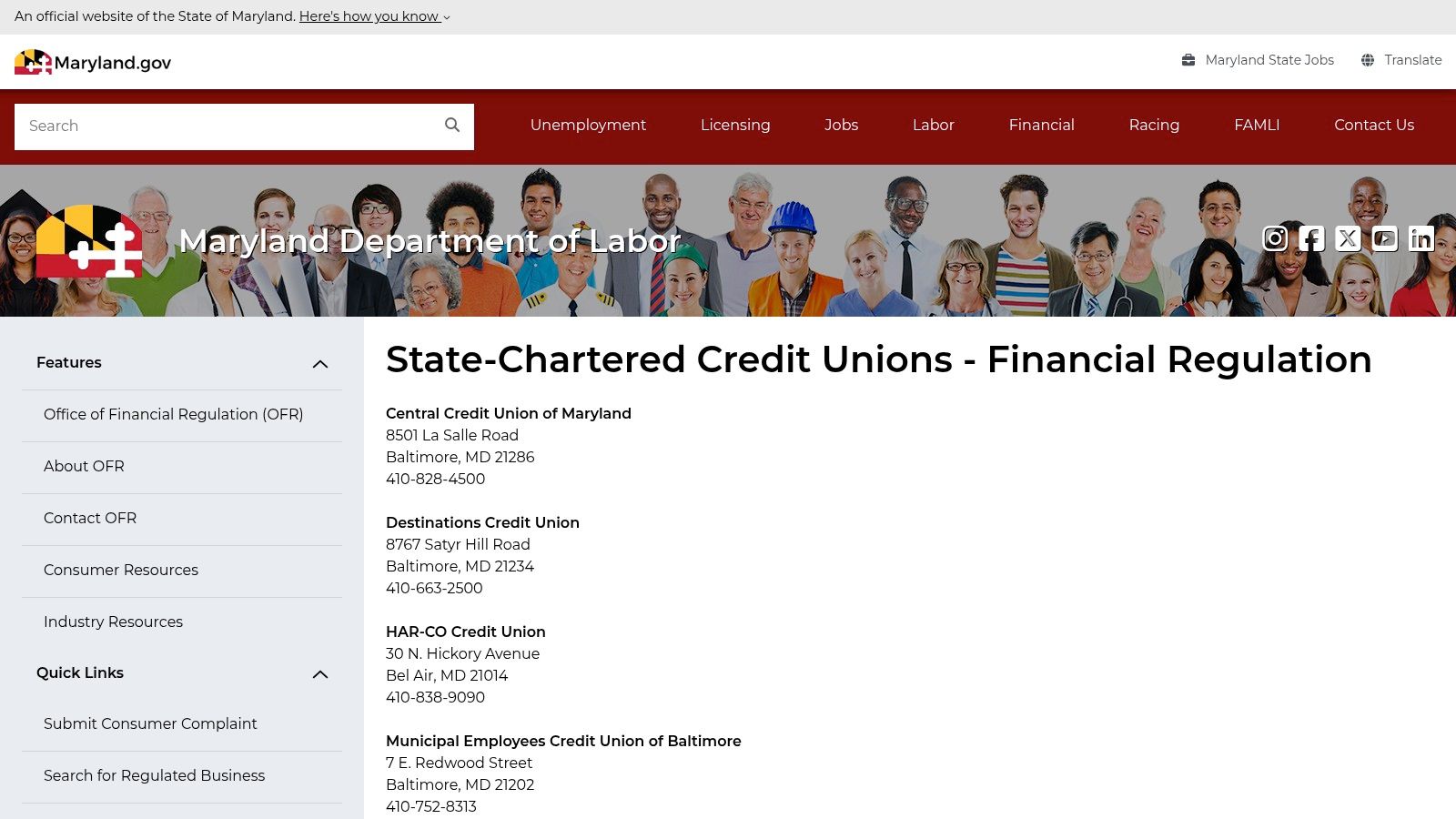
This government-run platform is the authoritative list for any credit union operating under a Maryland state charter. It provides direct contact information and clarifies regulatory oversight. Its value lies not in ranking but in providing a verified list of institutions that may have unique fields of membership or strategic priorities shaped by state-level regulations.
Strategic Application for Banking Professionals
For strategy teams, this directory is a vital cross-referencing tool. State-chartered credit unions often have deep community ties and may serve specific local industries or employee groups not captured by broader federal charters. Identifying these institutions is key to uncovering niche competitive threats or partnership opportunities. This list clarifies which players are governed by state rules, potentially impacting their product offerings, expansion capabilities, and compliance frameworks.
Direct Takeaway: Use the Maryland Office of Financial Regulation directory to identify and validate all state-chartered competitors. This insight complements federal data, providing a full-spectrum view of the market and revealing niche institutions with strong local influence essential to competitive intelligence.
Using the Platform Effectively
The website is a straightforward directory, not an analytical tool. Its utility is in its official capacity as a state regulator's record.
Actionable insights are derived by:
- Complete Market Scans: Combine this state list with the federal list from the NCUA to build an exhaustive map of all credit unions in Maryland. This ensures no competitor is missed in your analysis.
- Regulatory Intelligence: Note which credit unions are state-chartered. This distinction can be a critical data point when assessing a competitor’s potential for M&A activity, geographic expansion, or changes in business services, as state regulations can differ from federal ones.
- Prospecting Refinement: A credit union with a state charter tied to a specific county's teachers or a local municipality’s employees signals a highly concentrated and loyal member base. For example, the Baltimore County Employees Federal Credit Union represents a defined market segment. This is an actionable insight for tailoring a competitive strategy in that micro-market.
This directory provides the definitive "who" for the state-chartered segment. To understand the "what" and "why" behind their performance, this information must be layered with financial data. After identifying a state-chartered competitor, a platform like Visbanking can reveal its asset growth, loan portfolio mix, and overall financial health, turning a name on a list into a complete competitive profile.
Access the Tool: https://www.labor.maryland.gov/finance/banks/creditun.shtml
4. WalletHub – Best Credit Unions in Maryland
While regulatory data provides the quantitative foundation, consumer-facing sites like WalletHub offer qualitative sentiment analysis. WalletHub’s state-specific page for Maryland credit unions aggregates member reviews, ratings, and basic product information. For banking professionals, this platform serves as a tool for gauging public perception and identifying potential service gaps among competitors that hard data alone cannot capture.
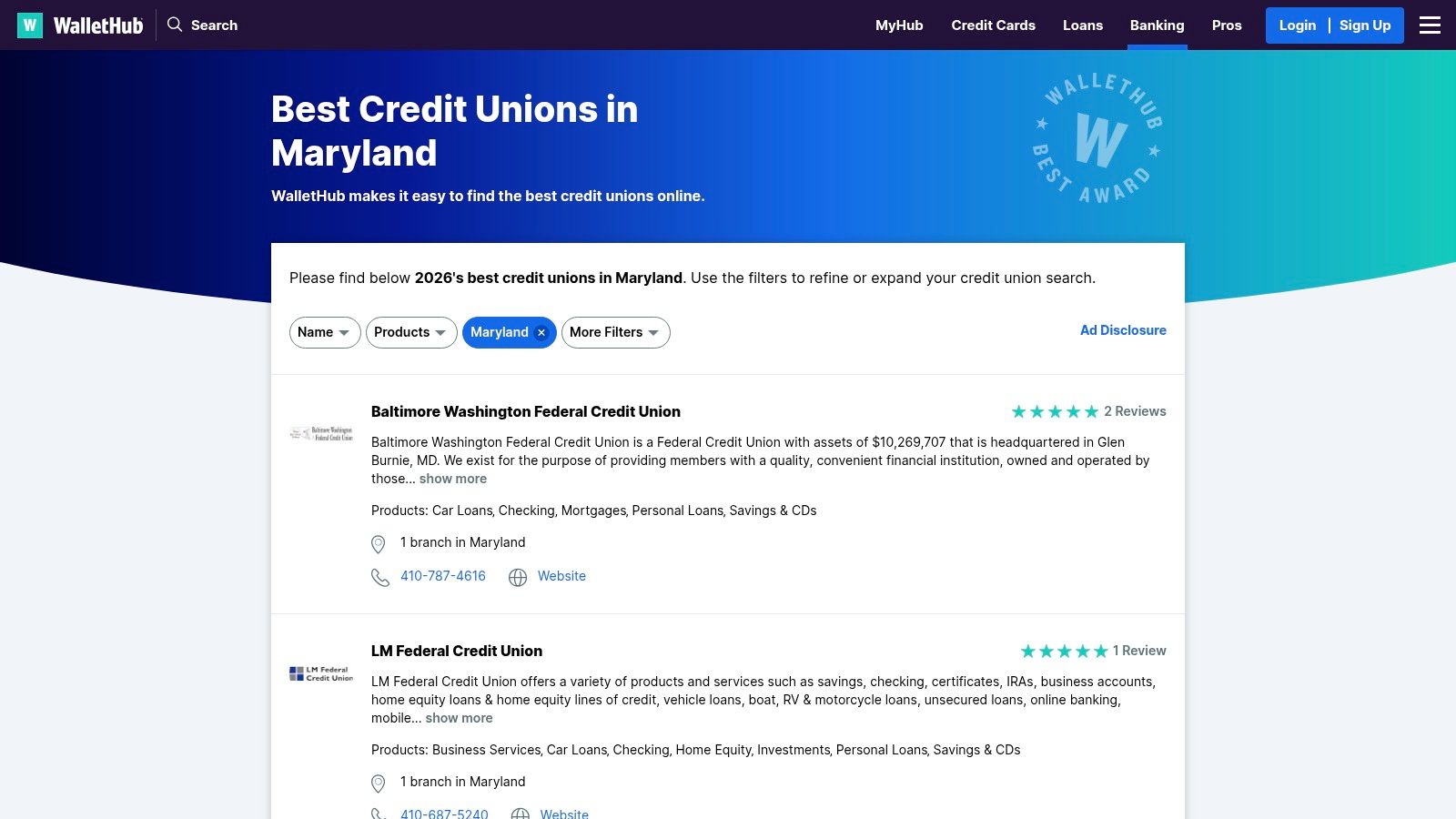
The platform provides a scannable overview of the consumer landscape. Its filters for products like checking accounts and auto loans, combined with member-generated ratings, create a snapshot of how the market perceives the value proposition of various institutions. This is particularly useful for identifying which Maryland credit unions are winning on member experience versus simply on rates.
Strategic Application for Banking Professionals
WalletHub translates raw financial data into market intelligence by adding a layer of consumer sentiment. A credit union might exhibit a strong balance sheet, but if its WalletHub profile is filled with one-star reviews citing poor mobile app functionality or slow loan processing, that signals a significant operational vulnerability. For instance, a competitor showing 10% annual member growth but a 2.3-star rating signals a potential churn risk and an opportunity to attract dissatisfied members with a superior digital experience.
Direct Takeaway: Use WalletHub to gauge public perception and identify service-level weaknesses at competitor credit unions. Consistently low ratings in specific product areas, such as mortgages or personal loans, are strong signals of an underserved market segment receptive to a better alternative.
Using the Platform Effectively
The primary value of WalletHub is in the patterns revealed by user feedback, not in its real-time rate accuracy.
Actionable insights are derived by:
- Competitor Service Audits: Scan reviews for competing credit unions in target markets. Recurring complaints about digital banking tools, branch service, or loan application experiences are direct indicators of operational friction points.
- Product Perception Analysis: Use the product tags to filter for credit unions offering similar products. Assess their ratings and read corresponding reviews to understand perceived strengths and weaknesses in that specific vertical.
- Lead Generation Angles: When a competitor shows high asset growth but poor member reviews, it presents a clear angle for your relationship managers. Outreach can be tailored to solving the exact pain points mentioned in public reviews.
WalletHub provides the voice of the member, a crucial component of a comprehensive competitive analysis. While financial data tells you if a competitor is growing, consumer sentiment tells you if that growth is sustainable or at risk.
Access the Tool: https://wallethub.com/credit-unions/maryland
5. DepositAccounts (LendingTree) – Credit Union Finder
For competitive analysis focused on retail product strategy, DepositAccounts by LendingTree is an invaluable resource. While the NCUA provides the official roster, DepositAccounts offers a consumer-centric view, translating institutional data into intelligence on product rates, eligibility, and institutional health. It’s a powerful tool for understanding how Maryland's credit unions position themselves in the market, particularly regarding deposits and loans.
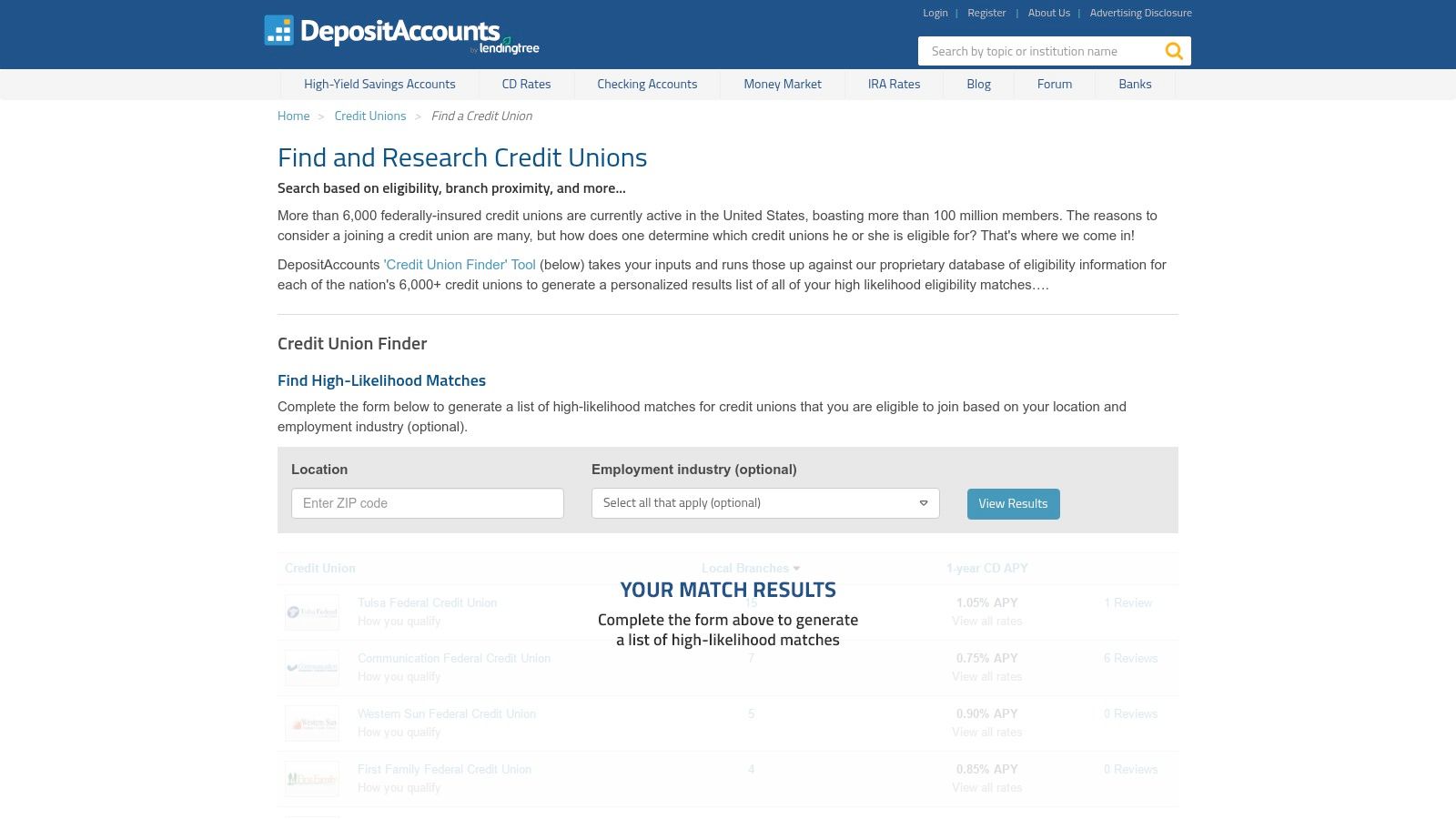
The platform offers deep insights into rate-sensitive products like high-yield savings, money market accounts, and CDs. Its proprietary health grading system, while not a substitute for NCUA financial performance data, provides a quick reference for institutional stability from a consumer perspective. This is a critical lens for understanding a competitor's market reputation.
Strategic Application for Banking Professionals
DepositAccounts is an effective tool for product development and pricing teams. It provides an instant view of which Maryland credit unions are aggressively competing on rates for specific deposit products. For instance, if a Frederick-based credit union with $300 million in assets consistently offers a 12-month CD rate 25 basis points above the market average, it signals a strategic push to attract liquidity. This warrants a closer investigation into their balance sheet and growth strategy using a data intelligence platform to analyze their loan-to-share ratio and net interest margin.
Direct Takeaway: Use DepositAccounts to monitor the competitive rate landscape in key Maryland markets. This platform reveals which institutions are using deposits as a strategic lever for growth, providing early warnings of aggressive pricing strategies that could impact your market share.
Using the Platform Effectively
The strength of DepositAccounts lies in its granular product data and user-friendly interface. It translates complex financial data into easily digestible comparisons.
Actionable insights are derived by:
- Rate Benchmarking: Use the interactive rate maps to identify which institutions are leading on deposit rates in specific counties like Anne Arundel or Howard County. This helps benchmark your own product offerings against the most competitive players.
- Eligibility Reconnaissance: The platform outlines field of membership (FOM) requirements, which is crucial for understanding a competitor’s target audience and potential market reach.
- Health Score as a Proxy: While proprietary, the "A+" to "F" health grade can be a useful proxy for public perception. A competitor with a declining score may be facing operational or financial challenges, creating an opportunity to attract their members.
This platform provides an excellent snapshot of the consumer-facing strategies of Maryland's top credit unions. To understand the financial power behind these institutions, cross-reference these findings with a detailed analysis of the largest credit unions and their balance sheet composition.
Access the Tool: https://www.depositaccounts.com/credit-unions/search/
6. Newsweek – America’s Best Regional Banks & Credit Unions (Maryland)
Third-party accolades and media recognition serve as powerful market signals. Newsweek’s annual ranking is a notable source for identifying high-performing institutions. This list combines financial stability metrics with consumer feedback, offering a blended view of which credit unions are successfully balancing operational health with member satisfaction. For banking professionals, this provides a pre-vetted list of competitors who have demonstrated market excellence.
The platform is freely accessible and leverages data from LendingTree and other sources to score institutions. Its value is not in its comprehensiveness—it is a curated awards list, not an exhaustive directory—but in its ability to highlight institutions capturing positive public and financial attention. Inclusion on this list is a strong indicator of a well-run organization.
Strategic Application for Banking Professionals
This ranking provides a qualitative overlay to quantitative analysis. When a competitor appears on Newsweek's list, it signifies effective execution of their member-facing strategy. This serves as a trigger for deeper competitive analysis. It points to institutions that likely have strong leadership, effective marketing, and a competitive product suite worth examining. For instance, if a direct competitor in the Baltimore metro area is recognized, it's a prompt to benchmark your institution's key performance indicators—such as efficiency ratio and member growth—against theirs over the last eight quarters.
Direct Takeaway: Use the Newsweek list to identify top-performing competitors in Maryland that are winning on both financial and service metrics. This recognition can signal market momentum and provides a shortlist for analyzing the strategies of the most successful players.
Using the Platform Effectively
This resource adds context to raw financial data, helping to answer the "so what?" behind the numbers by incorporating consumer sentiment.
Actionable insights are derived by:
- Identify High-Achievers: Scan the Maryland-specific list to quickly see which credit unions received accolades. Institutions like SECU of Maryland or Tower Federal Credit Union often appear, signaling consistent market leadership.
- Competitive Benchmarking: If a direct competitor is on the list, it's a prompt to investigate why. Use a tool like Visbanking to dissect their loan growth, member growth, and efficiency ratio to understand the financial engine driving their public success.
- Prospecting Trigger: A credit union making this list is likely in a growth phase. This can signal opportunities for partnerships or identify them as a more aggressive competitor for talent, deposits, and loans.
While Newsweek’s methodology provides a valuable snapshot, it is not a substitute for in-depth financial due diligence. The list indicates who is performing well; platforms with granular data are required to understand how and why.
Access the Tool: https://rankings.newsweek.com/americas-best-regional-banks-credit-unions-2025/maryland
7. CreditUnionMatch (by CUCollaborate)
While most tools focus on what a credit union offers, CreditUnionMatch addresses a more fundamental question for market analysis: who can join. This eligibility-based matching platform is an invaluable resource for understanding the often complex and overlapping fields of membership (FOM) that define the potential customer base for Maryland's top credit unions. It provides a unique lens for competitive intelligence by revealing the specific pathways through which consumers can access a competitor's services.
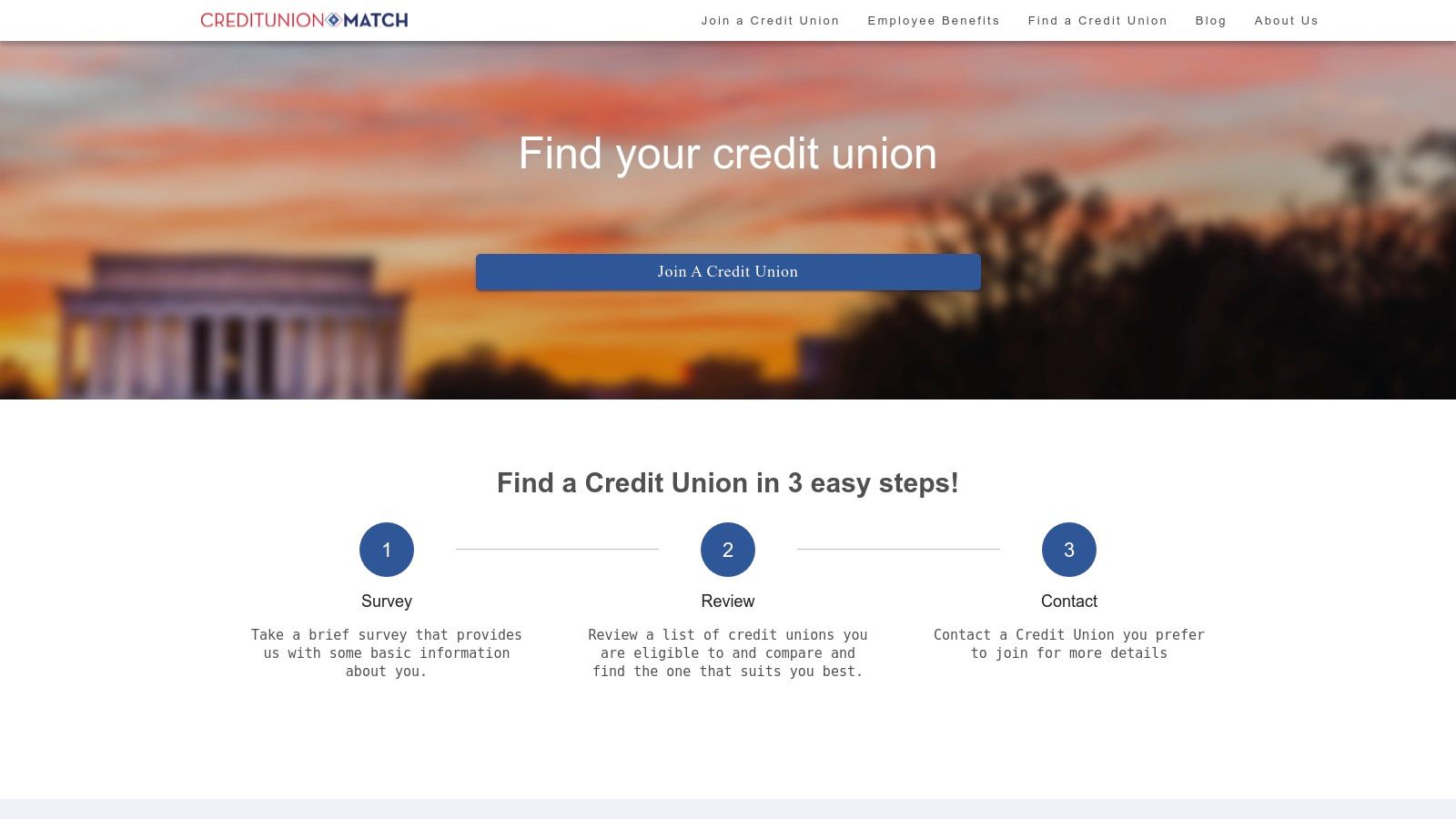
The platform operates on a simple premise: a user provides their location, employer, and affiliations, and the tool returns a list of credit unions they are eligible to join. This demystifies the membership puzzle, a significant competitive advantage for credit unions with broad FOMs. For banking professionals, it is a direct window into how competitors are acquiring new members.
Strategic Application for Banking Professionals
For a bank’s market intelligence team, CreditUnionMatch is a tool for reverse-engineering a competitor’s membership acquisition strategy. By inputting data for various fictional personas (e.g., an employee of a large company, a resident of a certain county, a member of a statewide association), an analyst can map which credit unions are actively targeting those segments. This reveals potential vulnerabilities or areas of untapped opportunity.
Direct Takeaway: Use CreditUnionMatch to model customer profiles and identify which Maryland credit unions are your primary competitors for specific employee groups, associations, or community charters. This insight helps refine your own targeting strategies and value propositions.
Using the Platform Effectively
The platform's strength is its specialized focus on eligibility, not financial data or product comparisons.
Actionable insights are derived by:
- Segment-Specific Competitive Analysis: Test major employers in a target market like Howard County (e.g., Johns Hopkins Applied Physics Laboratory). The results will show which credit unions have established Select Employee Group (SEG) relationships, signaling a focused B2B2C strategy.
- Identify Broad-Reach Competitors: Some credit unions gain eligibility through nominal donations to partner associations. Identifying these institutions helps you understand which competitors have a statewide or even national reach, despite a seemingly local brand presence.
- Inform Partnership Strategy: If a key competitor is consistently listed for employees of a certain industry, it may indicate a successful partnership model that your institution could replicate.
CreditUnionMatch does not replace financial analysis, but it provides critical context on market access. Once you identify which credit unions are competing for your target demographics, you can pivot to a platform like Visbanking to analyze their financial health, loan growth, and product focus to build a complete competitive picture.
Access the Tool: https://creditunionmatch.com/
7-Source Comparison: Best Credit Union Resources in Maryland
| Resource | Complexity 🔄 | Resource requirements ⚡ | Expected outcomes 📊 ⭐ | Ideal use cases 💡 | Key advantages ⭐ |
|---|---|---|---|---|---|
| NCUA – MyCreditUnion.gov | Low — simple locator/search | Low — web/mobile access, minimal effort | Authoritative listings + share‑insurance estimator; high trust (⭐⭐⭐⭐) | Find federally insured CUs by ZIP/city; verify insurance; link to join | Government‑maintained data, no ads, direct account links |
| NCUA – Research a Credit Union | Medium — data‑heavy interface | Moderate — time to read call reports and metrics | In‑depth financial & regulatory metrics for due diligence (⭐⭐⭐⭐) | Validate safety, charter type, assets and performance before joining | Primary source data; confirms federal oversight and operating status |
| Maryland Office of Financial Regulation – Directory | Low — straightforward directory | Low — web lookup, little interpretation | Accurate list of state‑chartered CUs and regulator contacts (⭐⭐⭐) | Confirm state charter status; find contact info; escalate complaints | Official state view; consumer help and complaint pathways |
| WalletHub – Best Credit Unions in Maryland | Low–Medium — consumer UI with filters | Low — quick browsing; depends on review volume | Quick product overviews + member ratings; variable depth (⭐⭐⭐) | Scan member feedback, filter by product (checking/CDs/loans), shortlist CUs | Easy to browse state‑focused lists with consumer ratings |
| DepositAccounts (LendingTree) – Credit Union Finder | Medium — interactive maps and matching | Moderate — use for rate tracking and eligibility checks | Current rates, health grades and rate maps for rate‑sensitive shoppers (⭐⭐⭐) | Find high‑yield CDs/deposits, check eligibility and link to account openings | Deep rate tracking, eligibility guidance, links to CU sites |
| Newsweek – America’s Best Regional Banks & Credit Unions | Low — curated ranking pages | Low — review shortlist; occasional registration | Independent, data‑driven recognitions; good shortlist quality (⭐⭐⭐⭐) | Shortlist award‑winning CUs to research further | Independent awards combining metrics and consumer feedback |
| CreditUnionMatch (CUCollaborate) | Low — 3‑step survey flow | Low — brief survey, quick results | Fast list of joinable credit unions based on eligibility (⭐⭐⭐) | Discover membership pathways when unsure how to join | Rapid eligibility matching; uncovers joinable CUs you might miss |
From Data to Decision: Activating Maryland Market Intelligence
Evaluating Maryland’s top-performing credit unions is a critical component of strategic market intelligence. Public-facing tools and directories, from NCUA's raw data portals to curated lists from WalletHub and Newsweek, offer essential baseline information. However, for leaders tasked with driving growth, these static lists are merely the starting point.
True competitive advantage is forged by synthesizing disparate information into a coherent market view and acting upon it with precision. The value lies not in knowing who the largest players are, but in understanding the nuanced performance metrics and market signals that reveal opportunities and threats.
Translating Raw Data into Actionable Strategy
Moving from high-level rankings to granular, actionable insights requires a deeper analytical approach. The difference between a successful market entry and a costly misstep hinges on the ability to connect disparate data points.
Consider these practical scenarios where data intelligence drives action:
- For Business Development: A bank’s commercial lending team can use NCUA Call Report data to identify a Maryland-based credit union with a high concentration of commercial real estate loans—for example, $25 million—approaching maturity in the next 12-18 months. This is a precisely timed prospecting signal for a competitive refinancing campaign.
- For Strategic Partnerships: A regional bank analyzing a credit union showing rapid membership growth of 12% but a lagging net worth ratio of 8.5% could identify a capital-constrained institution. This makes it a prime candidate for a strategic partnership, a targeted acquisition, or an opportunity to purchase loan participations.
- For Competitive Benchmarking: An executive team can benchmark their institution's 2.75% loan-to-share ratio and 65% efficiency ratio against a specific peer group of Maryland credit unions. Identifying a competitor with a significantly lower cost of funds (e.g., 50 basis points lower) can trigger a strategic review of deposit product pricing and marketing.
These actionable insights are not found in public rankings. They are surfaced through rigorous, multi-source data analysis that transforms raw numbers into a clear strategic directive. For organizations seeking to implement such initiatives, exploring proven methodologies like advertising account planning can provide valuable frameworks for structuring data-driven decision-making processes.
The Power of an Integrated Intelligence Platform
The core challenge for any leadership team is the time and resources required to manually gather, clean, and analyze this data. A dedicated financial intelligence platform is indispensable for this task. Platforms like the Visbanking Bank Intelligence and Action System (BIAS) are designed specifically to accelerate this process.
By unifying regulatory data, market signals, and key performance metrics into a single, intuitive interface, Visbanking allows executives to move beyond static lists. Instead of spending hours compiling data, leaders can build dynamic, data-driven strategies for the Maryland market, identifying opportunities and mitigating risks with confidence. The objective is to spend less time on data aggregation and more time on strategic execution—a critical shift for any institution aiming to outperform the market.
Ready to move from static lists to dynamic strategy? Visbanking provides the comprehensive data and analytics needed to benchmark your institution, identify opportunities, and gain a decisive competitive edge in the Maryland market. Explore our platform to see how we turn financial data into your most powerful strategic asset.
Related Articles

Visbanking Blog
Transforming Credit Unions: Visbanking's Data Revolution

Visbanking Blog
List of Credit Unions in the United States

Visbanking Blog
Largest U.S. Credit Unions by Asset Size in 2025

Visbanking Blog
Credit Union vs Bank: The $2 Trillion Member Advantage

Visbanking Blog
BIAS: Your Competitive Edge in Banking Data Driven Strategy

Visbanking Blog