
Mastering Bank Secrecy Act Requirements: A Guide for Bank Executives
Brian's Banking Blog
The Bank Secrecy Act requirements are not a checklist; they are a core component of your institution's risk management framework. In essence, the BSA mandates a partnership between financial institutions and the U.S. government to detect and deter financial crime. This is not about paperwork; it's about diligent recordkeeping, intelligent reporting, and building a defensible anti-money laundering program that protects the bank and the financial system.
Why BSA Compliance Is a Core Executive Function

Let's be direct: the Bank Secrecy Act (BSA) is far more than a regulatory hurdle. For any executive or director, a strategic command of BSA principles is non-negotiable. It is fundamental to protecting your bank from crippling fines and reputational damage. Viewing compliance as a mere cost center is a significant strategic error.
Forward-thinking executives see it differently. They view BSA compliance not as a burden, but as a data-rich intelligence operation critical to both national security and the bank's own strategic health. This perspective transforms your compliance function from a reactive, back-office cost center to a proactive intelligence unit. Your BSA program is a data goldmine. When analyzed correctly, it illuminates hidden risks and, in some cases, uncovers market opportunities.
The Foundation of BSA Obligations
At its core, the BSA rests on three pillars of action for every financial institution. A weakness in any one of these pillars compromises the entire structure.
- A Defensible AML Program: You are required to design, implement, and maintain a formal Anti-Money Laundering program. Its objective is clear: to reasonably prevent the institution from being used to facilitate money laundering.
- Meticulous Recordkeeping: This entails precise records of cash purchases of negotiable instruments, specific funds transfers, and all required customer identity information.
- Intelligent Reporting: Your institution has a duty to file specific reports with FinCEN. The two most critical are Currency Transaction Reports (CTRs) for cash transactions exceeding $10,000 and Suspicious Activity Reports (SARs) for activity that indicates potential criminal behavior.
The scale of this effort is immense. In fiscal year 2019 alone, financial institutions filed over 20 million BSA-related reports. This volume underscores the vast amount of data flowing from banks to law enforcement. You can see the full scope of BSA data collection to grasp its national importance.
Core Pillars of Bank Secrecy Act Compliance
For executives, translating these complex regulations into strategic implications is paramount. This table frames the BSA's foundational pillars in terms of executive-level responsibility and oversight.
| Pillar | Executive-Level Implication |
|---|---|
| Robust AML Program | You are ultimately accountable for instilling a culture of compliance, not merely funding a department that follows rules. |
| Diligent Recordkeeping | Your systems must ensure data integrity. A failure here is not a clerical error; it’s a critical gap in your risk management infrastructure. |
| Timely Reporting | This is your direct line to law enforcement. Delays or inaccuracies undermine the entire system and attract significant regulatory scrutiny. |
Understanding these pillars is not just about avoiding penalties; it's about leading with integrity and ensuring your institution operates as a trusted, secure component of the financial system.
A proactive compliance posture is the only defensible position. Regulators expect you not only to follow the letter of the law but also to understand its spirit—actively identifying and mitigating risk before it materializes into an enforcement action.
This proactive approach is impossible without clear, accessible data. How can a board effectively oversee a compliance program without benchmarking its performance against peers? How can a BSA officer detect sophisticated illicit activity without the tools to analyze patterns across the entire customer base? They cannot. This is where data intelligence shifts from a "nice-to-have" to a strategic imperative. By benchmarking your bank's compliance metrics, you gain the context required to make sound, defensible decisions. Visbanking provides executives with the analytical tools to move beyond reactive compliance, turning raw BSA data into a strategic asset that strengthens your bank’s position as a secure financial gatekeeper.
The Five Pillars of a Defensible BSA Program
When regulators examine your institution, they are not evaluating intentions. They are assessing the documented structure and, more importantly, the demonstrated effectiveness of your BSA program. A program that can withstand this level of scrutiny is built upon five distinct pillars. As a banking executive, you need to grasp these pillars to ensure your bank's risk management foundation is sound.
Think of it as the foundation of a building. If one pillar is weak, the entire structure is at risk of collapse, exposing your institution to significant enforcement actions. Let's analyze what these regulatory requirements mean for your strategy.
1. Designated and Empowered BSA Officer
First, you must appoint a BSA Compliance Officer. This is not a ceremonial title. Regulators demand this individual possess the authority, independence, and resources—personnel and technology—to execute their duties effectively.
From a leadership perspective, your BSA Officer requires a direct, unfiltered line to senior management and the board. A BSA Officer buried in the organizational chart or consistently struggling for resources is a major red flag for examiners, signaling that compliance is not a genuine priority.
2. Robust Internal Controls and Policies
The second pillar is a system of internal controls and risk-based policies. This is the operational framework of your BSA program—the specific, documented procedures for identifying, measuring, monitoring, and controlling money laundering risks.
A common failure is treating these policies as static documents. Your internal controls must be dynamic systems that adapt as new threats emerge and your bank’s risk profile changes.
This is the distinction between reactive and proactive risk management. For example, a sudden increase in wire transfers to a newly designated high-risk jurisdiction. A static, outdated system might not flag this for weeks. A dynamic, data-driven one identifies the anomalous pattern immediately, enabling the BSA Officer to take swift action.
3. Relevant and Ongoing Training
The third pillar is ensuring that all relevant personnel receive ongoing training. This extends beyond the compliance team to include front-line staff, lending officers, and senior management. Every employee plays a role in upholding the Bank Secrecy Act.
Training must be practical and tailored to specific job functions. Tellers must be experts at identifying structuring. Commercial lenders must recognize the red flags associated with complex shell companies. Using practical, real-world examples transforms your entire staff into an informed, human-led defense.
4. Rigorous Independent Testing
Pillar four requires independent testing to validate your program's effectiveness. This audit, whether conducted internally or by a third-party firm, must be comprehensive and objective. Its purpose is to identify weaknesses and report findings directly to the board of directors.
This independent review provides the board with an unbiased assessment of the program's health. It is a critical feedback loop that either validates your controls or provides a clear roadmap for remediation—long before an examiner does.
5. Comprehensive Customer Due Diligence
The final pillar is Customer Due Diligence (CDD), which includes the foundational requirement of a Customer Identification Program (CIP) and beneficial ownership identification for legal entity customers. This is your bank’s fundamental obligation to know with whom you are conducting business.
This is about more than photocopying a driver's license.
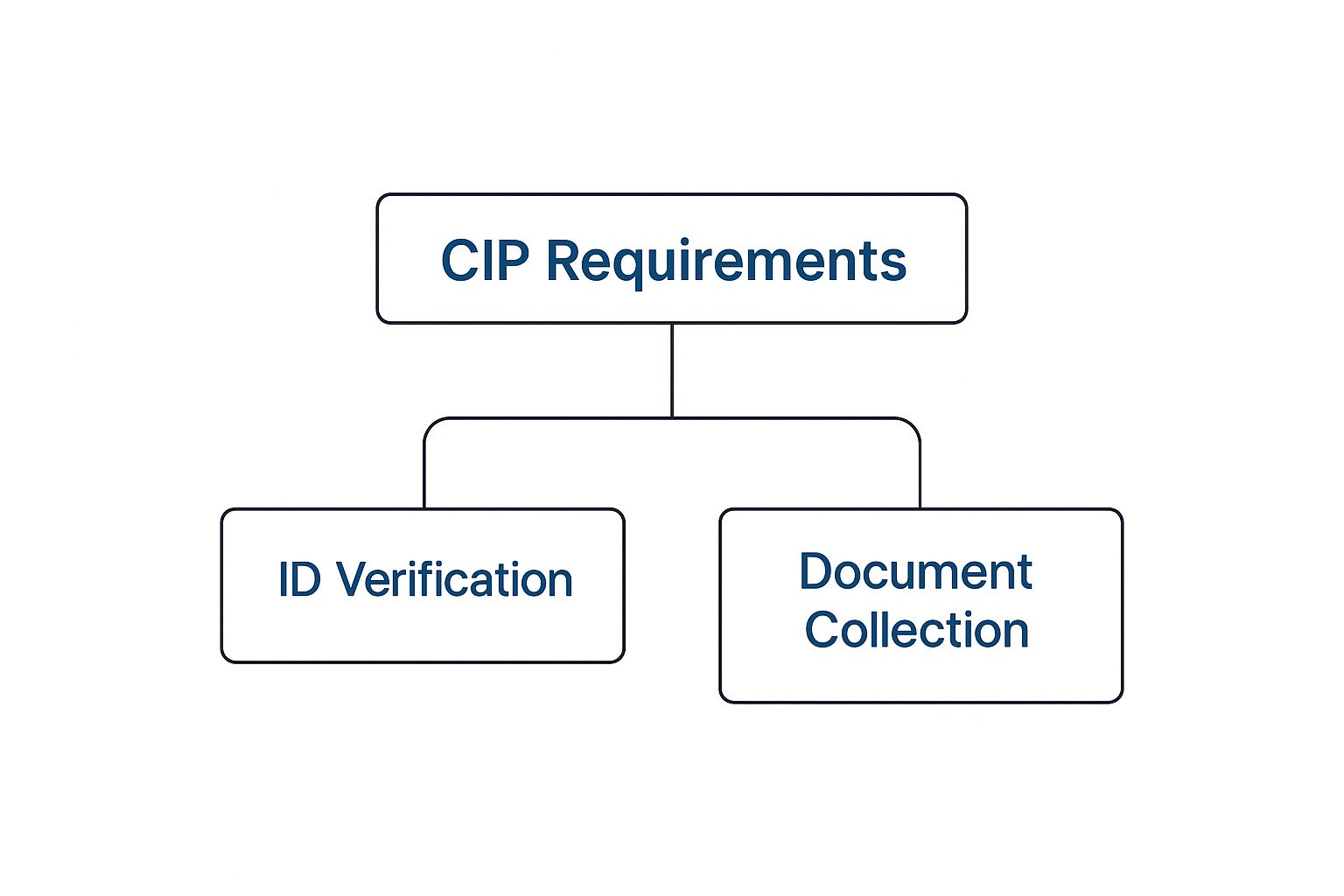
As the chart indicates, a proper CIP involves verifying identity through reliable, independent source documents and maintaining meticulous records of the verification process. Effective CDD is unachievable without a platform that can aggregate customer data and analyze it against known risk indicators.
To keep all five pillars strong, you need more than policies. You need powerful data intelligence. See how your institution’s BSA metrics compare by exploring a platform built to provide that clarity.
Turning Reporting Rules into Actionable Intelligence

The engine of any effective BSA program consists of two key reports: the Currency Transaction Report (CTR) and the Suspicious Activity Report (SAR). While the Bank Secrecy Act requirements provide the filing rulebook, visionary leaders understand the true value lies not in the forms, but in the data that powers them.
A mechanical, check-the-box approach to filing reports misses the strategic point. The objective is to achieve a comprehensive view of risk, which requires moving beyond basic compliance. Too many programs operate as simple reporting factories rather than the analytical powerhouses they should be.
The question every executive must ask is this: Do we possess the tools to connect the dots?
From Raw Data to a Defensible SAR
Consider a common scenario. A data analytics platform flags anomalous activity for a commercial customer. Over three weeks, the account holder makes nine separate cash deposits across five different branches.
- Deposit 1 (Branch A): $9,500
- Deposit 2 (Branch B): $8,000
- Deposit 3 (Branch C): $9,900
- Deposit 4 (Branch A): $7,500
- Deposit 5 (Branch D): $9,200
Individually, none of these transactions trigger a CTR, as they fall below the $10,000 threshold. But the aggregate picture reveals $44,100 in structured cash deposits in under a month—a textbook money laundering technique.
Without a robust data platform, these transactions remain isolated data points buried in disparate branch logs. The pattern is invisible. With a centralized, analytical view, the structuring scheme becomes obvious and a SAR filing is non-discretionary. This is the leap from reactive reporting to proactive risk management.
The ability to aggregate and analyze transactional data from across the entire institution is not a luxury; it is a fundamental requirement. Without it, you are effectively blind to sophisticated schemes designed to evade detection.
This analytical capability changes the strategic landscape. A SAR is no longer a decision based on intuition; it is a conclusion supported by hard, empirical data. When examiners ask why you filed, you can present a clear, data-driven narrative that demonstrates a comprehensive understanding of your customer activity. That level of preparedness is the definition of sound https://visbanking.com/banking-regulatory-compliance/.
The Staggering Cost of Not Connecting the Dots
What happens when you cannot connect these dots? The consequences are severe. The recent $80 million enforcement action against Block, Inc., operator of Cash App, found significant deficiencies in its BSA/AML program, creating vulnerabilities for illicit activity.
A key component of the penalty was the requirement to engage an independent consultant to conduct a comprehensive review and overhaul their compliance program.
This serves as a stark warning for every banking executive. The investment in a robust data intelligence system is fractional compared to the potential fines, reputational harm, and mandated remediation that follow a compliance failure. Your ability to see the complete picture is not just a strategy—it is your best defense.
The right platform transforms your BSA/AML team from a cost center into an intelligence unit, empowering them to move beyond checking boxes to actively mitigating hidden risks.
Your BSA Data is a National Security Asset
It is easy for bank executives to develop a narrow perspective, viewing the Bank Secrecy Act solely as a domestic compliance exercise. This view is dangerously incomplete. Every CTR and SAR your team files has national security implications that resonate globally.
Your BSA data is a primary source of intelligence for U.S. authorities, providing the raw material used to dismantle transnational criminal organizations and enforce global sanctions. Your filings are not sent into a bureaucratic void; they are actively analyzed by agencies like FinCEN to map illicit networks. Grasping this transforms your understanding of why regulators are so relentless about data accuracy and program integrity.
From Your Core System to Global Intelligence
Consider a real-world application. In a recent initiative to counter Russian export control evasion, FinCEN relied heavily on BSA data from U.S. financial institutions. This data did not merely identify a few domestic shell companies; it illuminated a sprawling, global network of illicit procurement.
This demonstrates the power of aggregated BSA reporting. A single analysis identified 1,795 individuals and entities involved in sanctions evasion across numerous countries. While the reporting originated in the U.S. with 976 subject references, its value extended globally, connecting illicit actors in Russia (322 subjects), China (130), and Hong Kong (126). You can review the direct impact of this data in the full FinCEN analysis on Russian export control evasion.
The narrative your bank's BSA data tells is far larger than any single report. It is a vital thread in the fabric of global financial intelligence. A single, well-documented SAR from your institution could provide the missing piece of a complex law enforcement puzzle.
This global context places an immense responsibility on your bank. Investing in superior data analytics is not just about satisfying examiners; it is about ensuring the intelligence you provide is clean, accurate, and robust enough for high-stakes international investigations. Your bank is more than a financial intermediary; you are a gatekeeper for the global financial system.
Fulfilling this role is impossible with siloed data and outdated technology. To detect the patterns that matter, your BSA team must be able to connect disparate data points across your entire customer base. This requires a platform capable of transforming raw transactional data into clear, actionable intelligence. When you can benchmark your own filing activity and risk profiles against peers, you gain the context needed to build a world-class program. See how Visbanking’s data intelligence can help you benchmark your BSA program and solidify your bank's role as a trusted partner in protecting global financial integrity.
From Cost Center to Strategic Asset: A New Way to Think About Compliance

For too long, the industry has treated Bank Secrecy Act requirements as a necessary evil—a line item on the budget. That is an outdated perspective. The most competitive banks are fundamentally changing this equation.
They recognize that the vast datasets collected for AML compliance are not merely a regulatory burden, but an untapped source of business intelligence. Within that data are powerful insights waiting to be leveraged.
Finding Business Clues in Compliance Data
As a bank executive, you are constantly seeking a competitive edge. What if the same tools your BSA team uses to detect suspicious activity could also identify your next market opportunity? This is not theoretical; it is a practical strategy for driving smarter business decisions.
For example, while monitoring transaction patterns for illicit activity, your analysts might also observe a surge of legitimate, high-volume commercial transactions concentrated in a specific geographic area. This could be your earliest indicator of a local economic boom—an ideal target for commercial lending initiatives.
Conversely, a sharp decline in activity from a key local industry could serve as an early warning of economic distress, allowing you to proactively adjust risk models before loan portfolios are impacted.
Compliance is no longer solely a defensive function. It becomes part of your offensive strategy, providing a real-time pulse on the economic health of the communities you serve.
It is a fundamental shift in perspective. Cease viewing compliance as a cost. Begin seeing it as an intelligence-gathering operation that fuels growth, sharpens risk management, and informs enterprise strategy. The key is the data you already possess.
This is a proven concept. The UK's Joint Money Laundering Intelligence Taskforce (JMLIT) demonstrated the power of this approach, leading to over 63 arrests, more than 1,000 new law enforcement investigations, and the seizure of £7 million in illicit funds. You can read more in Verafin’s deep dive on BSA/AML modernization.
The Executive Call to Action
The directive for banking leaders is clear. Modernizing your compliance function is not just about regulatory appeasement; it is about unlocking the strategic value embedded in your data. This necessitates moving beyond manual, inefficient processes to embrace a true data intelligence platform. This is an essential component of modern regulatory compliance for banks.
This is precisely why platforms like Visbanking exist. We provide the analytical horsepower to not only master your Bank Secrecy Act requirements but also to extract the insights that lead to smarter, more profitable banking. The first step is to understand your own data. It's time to benchmark your performance and uncover the strategic intelligence you've been sitting on.
Achieving Superior BSA Performance with Data Intelligence
In today's regulatory environment, your bank’s performance against the Bank Secrecy Act depends on one variable: the sophistication of your data utilization. This is no longer about checking boxes. It is about proving, with empirical evidence, that your compliance program is effective. For banking executives, this means building a program where risk is measured, performance is benchmarked, and oversight is defensible.
This requires a data-first culture. Imagine a system where customer risk profiles are not static, but are dynamically updated in near real-time based on transactional behavior. Imagine presenting the board with SAR filing metrics benchmarked against anonymized peer data, providing instant context on performance. This is the reality in institutions that have embraced data intelligence.
From Reactive Reporting to Proactive Oversight
A modern BSA program must excel at one core function: transforming a mountain of transactional data into clear, defensible insights. Without this capability, your compliance program is perpetually on the defensive, forced to justify actions long after events have occurred. A data-powered program puts you in command.
For example, a common executive question is, "Are we filing too many or too few SARs?" Answering with anecdotal evidence is a recipe for regulatory criticism. Answering with data demonstrates control.
For instance, benchmarking reveals your bank files 5 SARs per $1 billion in assets, while your peer group average is 12. This gap does not automatically indicate a deficiency. Instead, it provides the board and your BSA Officer with a specific, data-backed question to investigate.
This is the precise value Visbanking delivers. Our platform moves BSA oversight beyond guesswork and anchors it in solid data. We provide the tools to benchmark key metrics, identify statistical outliers that warrant investigation, and arm your board with the concise, empirical data needed to govern with confidence. It all starts with connecting the dots, which is why a sound strategy for financial data integration is the critical first step.
Ultimately, this approach transforms BSA compliance from a reactive cost center into an intelligence-led operation that strengthens the entire institution. It’s time to stop guessing about your performance and start measuring it. See how your institution's data stacks up, and begin the transition to truly data-driven compliance.
What Every Bank Executive Needs to Know About BSA Strategy
Let's be clear. As a bank executive or director, no one expects you to be in the weeds of daily Bank Secrecy Act operations. That's not your job. Your job is oversight and strategic leadership.
This is your high-level playbook—the essential questions the board and C-suite absolutely must have answers for.
What's the Board's Real Role in BSA?
The board's role isn't about managing the details; it's about active governance. Think of it in three simple, powerful actions:
- Formally approve the bank’s BSA/AML policy annually.
- Ensure the designated BSA Officer has genuine authority and adequate resources.
- Remain actively engaged with the bank's risk profile and the program’s performance metrics.
Directors must demonstrate they are asking substantive questions and scrutinizing the findings from independent audits. This is impossible without clear reporting. Data intelligence platforms are indispensable here, translating a firehose of compliance data into the sharp, executive-level reports that empower effective governance.
How Do We Actually Measure ROI on BSA Compliance?
If you're trying to calculate the ROI of your BSA program like it's a new marketing campaign, you're making a fundamental mistake. The real return isn't measured in profit, but in risk mitigation and operational horsepower.
Your primary return is the avoidance of multi-million dollar fines, crippling enforcement actions, and enduring reputational damage. A better metric is "Cost of Compliance vs. Risk Exposure." A well-tuned, data-informed program optimizes this ratio by automating low-value tasks and focusing expensive human capital on the highest risks.
Using a tool to benchmark key risk indicators—like SARs filed per billion in assets—and compliance spending against your peers gives you a concrete answer to whether your investment is delivering commensurate value.
The greatest risks of a weak BSA program are strategic, not just financial. A major compliance failure can result in a consent order that halts your bank's growth strategy. It can put mergers, acquisitions, or new product launches on indefinite hold.
The damage doesn't stop there. It erodes trust with customers, investors, and critical correspondent banking partners. Internally, the remediation effort becomes an all-consuming distraction, diverting the leadership team's focus from its primary mission: running the bank. A weak BSA program isn't just a line item; it's a strategic anchor that can drag down your institution's future.
At Visbanking, we provide the tools to eliminate guesswork. Our platform enables you to benchmark your BSA metrics against peers, identify the statistical red flags that signal hidden risk, and arm your board with the hard data required for confident, decisive oversight. Explore how your institution's data compares and transform your compliance program from a cost center into a strategic weapon.
Latest Articles
Brian's Banking Blog
Automated Alerts and Notifications for Banks
Brian's Banking Blog
Customer Feedback Loop for Banks: A Practical Playbook

Brian's Banking Blog
Commercial Lending Trends: What Bank Executives Must Know
Brian's Banking Blog
Bank Marketing Dataset Analysis Strategy

Brian's Banking Blog
ESG Peer Benchmarking for Bank Leaders
Brian's Banking Blog