
Decoding the Bank Rating System: A Guide for Executive Leadership
Brian's Banking Blog
A bank rating system is not a formal framework for regulatory box-checking. It is the definitive financial report card for a banking institution—a composite score distilling vast, complex data into a clear verdict on its health, risk profile, and management quality.
For executives, directors, investors, and regulators, this score is the ultimate benchmark of a bank's stability and strategic execution.
The Executive Imperative: Why Ratings Define Strategic Advantage
As a banking leader, you understand a rating is more than a letter grade. It is the market’s measure of your bank’s health, a reflection of your strategic execution, and the bedrock of your institution’s reputation. Mastering your rating is not about passing a compliance test; it is about wielding a powerful tool for strategic advantage.
To effectively guide your bank toward sustainable growth, it is crucial to understand how these scores are interpreted by key stakeholders. The infographic below outlines the three primary audiences whose critical decisions are shaped by every rating update.
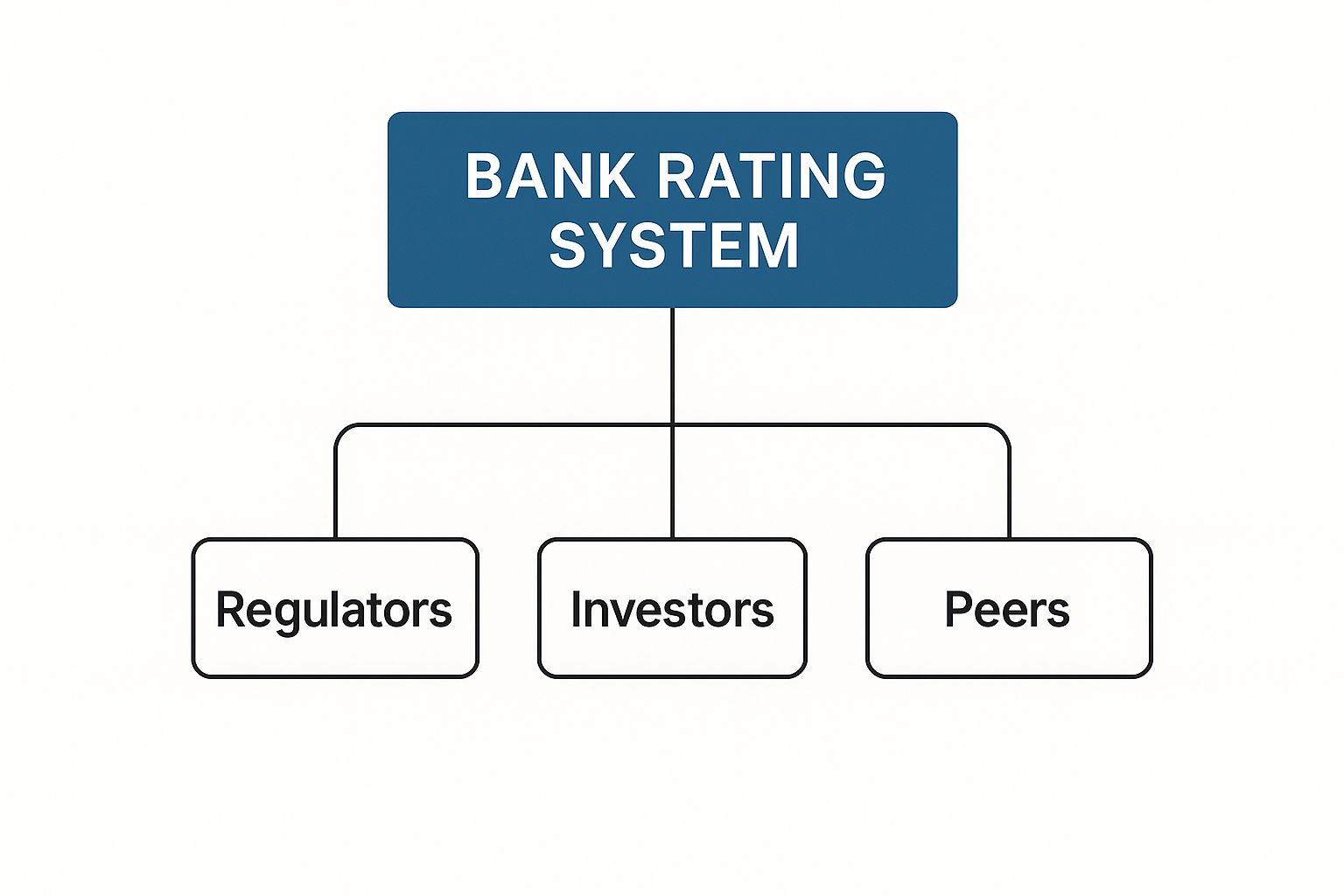
As illustrated, your bank's rating sends distinct signals to each of these groups, directly influencing regulatory scrutiny, capital costs, and competitive positioning.
The Strategic Value of Ratings
A strong rating is a significant strategic asset that directly impacts the bottom line and sharpens your competitive edge. It serves not merely as a snapshot of past performance but as a clear indicator of your bank’s resilience and the caliber of its management. For any executive, a deep understanding of rating components is non-negotiable for several critical reasons:
- Informed Decision-Making: Understanding the drivers of your rating allows you to accurately forecast how strategic initiatives—such as an acquisition or a new product launch—will affect your bank's perceived risk and stability. This is the essence of strategic foresight.
- Actionable Competitive Benchmarking: Ratings provide an objective framework for measuring performance against a curated peer group. This is where you uncover latent weaknesses and identify opportunities to outmaneuver the competition.
- Investor and Market Confidence: A top-tier rating acts as a powerful magnet. It lowers your cost of funding, attracts institutional investment, and builds profound trust with customers and partners. This is a durable competitive advantage.
At its core, a bank's health is assessed on several fundamental pillars. Regulators and rating agencies demand a balanced profile, not just isolated pockets of strength.
The Pillars of a Modern Bank Rating System
| Core Pillar | What It Measures | Executive Implication |
|---|---|---|
| Capital Adequacy | The bank's ability to absorb unexpected losses with its own capital. | A strong capital buffer signals resilience, affording the latitude to pursue growth without alarming regulators or investors. |
| Asset Quality | The credit risk inherent in the loan portfolio and other assets. | High asset quality translates to lower credit provisions and more predictable earnings—a cornerstone of market confidence. |
| Management | The board's and leadership's competence, risk appetite, and strategic vision. | This is the human factor. A top rating reflects a team and strategy capable of navigating any market condition. |
| Earnings | The stability, quality, and level of the bank's profitability. | Consistent, high-quality earnings prove a sustainable business model, distinct from short-term, volatile gains. |
| Liquidity | The bank's ability to meet its short-term cash obligations without resorting to asset fire sales. | Strong liquidity is the primary defense against a crisis, demonstrating the capacity to withstand market shocks and depositor demands. |
These pillars are not academic concepts; they are the active levers you can adjust to direct your institution’s future.
A superior rating is not an accident; it is the outcome of a deliberate, data-informed strategy. It requires leadership to move beyond compliance and actively manage the metrics that matter most.
Ultimately, the ability to dissect, understand, and influence your bank's rating separates reactive managers from proactive leaders. A robust data intelligence platform like Visbanking provides the granular insights needed to not just meet expectations, but to construct a compelling narrative of exceptional financial stewardship. This data-driven approach transforms the bank rating system from a regulatory report card into your roadmap for strategic excellence.
The Anatomy of a Bank Rating
To effectively manage your bank’s standing, you must first understand how ratings are constructed. While global frameworks vary, the gold standard for U.S. regulators is the CAMELS system. This is not a theoretical model; it is the operational playbook regulators use to assess your bank's health.
When your leadership team internalizes each component of CAMELS, you can shift from a defensive compliance posture to proactively managing the institution toward a top-tier rating. Each letter represents a critical, interconnected pillar supporting your bank.

Capital Adequacy (C)
Capital is the foundation—your bank’s ultimate buffer against unexpected losses. Regulators assess more than just a headline figure like your Tier 1 Capital ratio; they scrutinize the quality of that capital and its sufficiency relative to your specific risk profile and growth ambitions.
For example, a bank reporting a 12.0% Tier 1 Capital Ratio appears robust. However, if it plans an aggressive expansion into a higher-risk lending category, such as unsecured consumer credit, regulators will question if that capital is genuinely adequate. This is where modern data intelligence becomes indispensable, allowing executives to stress-test capital scenarios before committing to a strategic path.
Asset Quality (A)
Asset quality is a direct measure of your loan book, serving as a scorecard for underwriting discipline and credit risk management. The non-performing loan (NPL) ratio is a key metric, but it is a lagging indicator—it reveals problems that already exist. Effective analysis focuses on leading indicators and portfolio concentrations.
Consider a community bank with an excellent NPL ratio of 0.75%. An analytics platform could reveal that 40% of its commercial loan portfolio is concentrated in a single, volatile sector like commercial real estate office space. This concentration risk, invisible on the surface, may pose the most significant threat to its rating. Proactive leaders identify this exposure and act—by rebalancing the portfolio or tightening underwriting standards—long before NPLs begin to escalate. The anatomy of a bank rating is heavily influenced by the institution's risk profile, particularly when dealing with High Risk Banking activities.
Management (M)
The 'M' in CAMELS is the most subjective component, but its importance cannot be overstated. Regulators are making a judgment call on your leadership’s competence. They evaluate the board’s expertise, the executive team’s strategic vision, and the effectiveness of internal controls. It is an assessment of your team's ability to navigate both favorable and adverse conditions. A history of unresolved audit issues or a reactive response to market shifts is a red flag that will almost certainly lead to a downgrade.
Earnings (E)
Profitability is not enough; the quality and sustainability of earnings are paramount. Regulators want to see stable, high-quality earnings. A bank that bolsters its income with one-time asset sales or volatile trading gains will not be viewed favorably. A steady, diversified income stream from core activities, such as net interest income and fee-based services, is preferred. The objective is to demonstrate a business model that can generate consistent returns through economic cycles.
Liquidity (L)
Liquidity is your capacity to meet obligations without liquidating assets at distressed prices. Following recent market shocks, this pillar is under intense scrutiny. A bank with a stable base of core deposits and reliable access to contingent funding sources demonstrates true resilience. Regulators expect to see well-documented contingency funding plans and rigorous stress tests proving you can withstand a sudden deposit outflow or a freeze in credit markets.
Sensitivity to Market Risk (S)
This component measures how external market shifts—such as changes in interest rates, foreign exchange rates, or commodity prices—could adversely affect your earnings and capital. For most U.S. banks, the primary concern is interest rate risk (IRR). An institution with a significant mismatch between its asset and liability durations is exposed. For instance, holding a large portfolio of long-term, fixed-rate mortgage-backed securities funded by short-term deposits is a classic vulnerability in a rising-rate environment.
A strong bank rating is not achieved by excelling in a single CAMELS category. It requires consistent, disciplined management across all six. Each pillar reinforces the others, painting a complete picture of a well-run institution.
By leveraging a platform like Visbanking, executives gain a real-time dashboard for every metric feeding into their CAMELS score. This enables you to benchmark against peers and transform a regulatory exercise into a powerful tool for superior strategic decision-making.
How Global Rating Agencies Size Up a Bank
If your institution has public debt or engages with major institutional counterparties, a thorough understanding of how Moody’s, S&P, and Fitch operate is essential. These agencies are the gatekeepers of the capital markets. Their ratings directly influence your cost of funds, access to capital, and market perception.
Their process is a sophisticated blend of quantitative analysis and forward-looking qualitative judgment.
The analysis begins with quantitative metrics derived from your financial filings—capital ratios, asset quality, earnings stability, and liquidity. However, the true depth of their analysis lies in the narrative behind these numbers.
It's More Than Just the Numbers
The agencies place immense weight on qualitative factors. They are not merely assessing last quarter's performance; they are forming a conviction about how your bank will navigate future challenges. This is where your institution's strategic narrative is critical.
They will scrutinize your leadership and strategy, examining factors such as:
- Management Strategy & Risk Appetite: Is your strategic vision clear and credible? Is your risk framework robust enough to support your growth ambitions?
- Corporate Governance: Is your board independent and effective in its oversight role? Are internal controls sufficient to prevent material operational failures?
- Economic Outlook: How resilient is your bank to a potential economic downturn? They demand evidence of rigorous stress-testing against adverse scenarios.
This qualitative assessment is where many banks falter. A strong capital position offers little comfort if an agency perceives a lack of strategic direction or weak risk governance.
Consider a bank that reports an impressive efficiency ratio of 52.0%. A discerning analyst will probe whether this was achieved by underinvesting in critical technology, thereby creating significant future operational risk.
The Sovereign Ceiling: A Hard Limit on Your Rating
A critical concept for every executive is the sovereign rating ceiling.
An agency will almost never assign a rating to a domestic bank that is higher than the rating of the government in its country of operation. The logic is straightforward: a severe sovereign debt crisis would inevitably impact the entire domestic banking system through economic collapse, capital controls, or direct government intervention.
A clear example occurred when S&P downgraded the U.S. sovereign credit rating from AAA to AA+ in 2011. This single action created downward pressure on the ratings of the largest U.S. banks, irrespective of their individual balance sheet strength. Your bank's rating is intrinsically linked to the fiscal health of its home country.
An agency rating is a forward-looking opinion on creditworthiness. Your ability to provide a clear, data-supported narrative about your strategy, governance, and risk management is just as influential as your reported financials.
As key players in macro-level risk analysis, agencies like S&P maintain over 1,000,000 credit ratings globally as of June 2025. The World Bank's analysis demonstrates how these sovereign ratings are converted into quantitative risk scores for global comparisons.
Effective management of this process requires proactive engagement. Anticipate the agencies’ questions and prepare data-driven answers to their primary concerns. This is not a defensive exercise; it is an opportunity to showcase your bank's resilience. Using a data intelligence platform to model the scenarios that analysts will scrutinize allows your team to communicate with confidence how your strategy performs under pressure.
Mastering your relationship with rating agencies means ensuring the story they tell is the one you have authored. With deep data insights, you can shift from reacting to their assessments to actively shaping their perspective.
Curious how your institution's metrics stack up? Explore Visbanking’s powerful peer benchmarking tools.
Moving from Reactive to Proactive Ratings Management
A top-tier bank rating is not a passive outcome; it is the direct result of a deliberate, data-informed strategy. For too long, bank leadership has treated ratings as a report card received after the fact—a matter for reaction following an examination or agency review.
The modern approach inverts this dynamic. It requires transforming your rating from a historical scorecard into a forward-looking tool to guide the bank's future. This means moving beyond static call reports and embracing dynamic, real-time business intelligence. With the right tools, you can actively manage the metrics that constitute your rating, modeling the impact of major decisions before they are made.
The bank rating system ceases to be a compliance hurdle and becomes a strategic compass.

Modeling Strategic Moves with Precision
Consider a practical scenario. Your board is evaluating the acquisition of a smaller regional competitor. On the surface, the deal appears financially accretive and expands your market footprint. The reactive approach would be to close the deal and await the regulatory verdict on the combined entity.
A proactive, data-driven strategy operates differently.
Using an advanced BI platform, your team conducts a detailed pro-forma analysis, simulating precisely how the merger will affect each component of your CAMELS rating. You can model how the target bank's weaker asset quality—for example, a 2.5% non-performing asset (NPA) ratio compared to your own 1.2%—will dilute the combined portfolio. This is not an estimate; it is a granular forecast.
This foresight is invaluable. Your leadership team can now see exactly how the transaction would compress capital ratios and impact earnings projections. Armed with this intelligence, you can:
- Structure the Deal More Effectively: Negotiate a lower price or require the seller to fund specific loan loss provisions at closing.
- Adjust Capital Planning: Proactively raise capital before the transaction closes, demonstrating to regulators that you have already mitigated the increased risk.
- Refine Integration Strategy: The data may indicate an immediate need to apply your more stringent underwriting standards to the acquired loan book from day one.
This proactive stance safeguards your bank's rating post-merger. Instead of facing a potential downgrade, you present regulators with a well-reasoned plan that demonstrates sophisticated risk management.
The Power of Forward-Looking Data
This proactive mindset applies to all major strategic decisions, from launching a new lending product to adjusting your balance sheet's interest rate sensitivity. The core principle remains: use data to understand consequences before you act. Understanding the fundamental risk management principles that form the bedrock of financial stability is essential for mastering this forward-looking approach.
Ratings management is no longer about explaining historical performance. It is about using data to engineer a more resilient and profitable future for your bank.
By integrating real-time data and predictive analytics into your decision-making, you assume full control of your bank's narrative. You are no longer merely reporting numbers; you are demonstrating a clear, evidence-based strategy for navigating risk and driving performance.
This is the definitive shift from reactive compliance to proactive leadership. When you can model, test, and validate your most significant initiatives against the metrics that define your rating, you are not just managing a score—you are building a fundamentally stronger bank.
To see how your institution's key metrics stack up and begin modeling your next strategic move, explore the data intelligence capabilities within Visbanking.
Using Competitive Intelligence to Improve Your Standing
Your bank’s rating does not exist in a vacuum; it is perpetually benchmarked against your peers. The most effective leaders understand this. They view the bank rating system not as a regulatory report card, but as a powerful competitive intelligence tool.
The strategic breakthrough occurs when you cease to analyze your institution in isolation and begin benchmarking against a curated peer group across every critical metric, from efficiency ratios to loan growth composition. This provides context. Without it, your performance metrics are merely numbers. With it, they become a strategic roadmap, pinpointing gaps and market opportunities.

From Data to Actionable Strategy
Consider a $5,000,000,000 asset bank aiming to improve its ‘Earnings’ score. An internal review of its financials might not reveal any glaring deficiencies.
The perspective shifts entirely when its performance is benchmarked against the top quartile of its peers—banks of a similar size and business model. "Adequate" is no longer sufficient.
Using a platform like Visbanking for a deep-dive peer analysis, the leadership team discovers that leading competitors generate, on average, 15% more of their revenue from non-interest income. Further analysis reveals this is driven by targeted wealth management and treasury services offered to their core commercial clients.
This single insight redefines the strategic conversation, moving it from a vague "we need to improve earnings" to a specific, data-backed initiative. The board now has a clear mandate to:
- Quantify the Opportunity: Model the revenue impact of launching a competitive wealth management division.
- Define the Roadmap: Allocate capital and talent to build or acquire the necessary capabilities.
- Set Measurable Goals: Establish specific targets for client acquisition and non-interest income growth over the next 24 months.
This is the process of converting competitive intelligence into decisive action. A proactive approach to the bank rating system transforms it into the ultimate tool for identifying pathways to growth and building a more resilient, profitable institution.
A deep understanding of your competitive landscape is not a defensive tactic; it is the most powerful offensive weapon in your strategic arsenal. It allows you to anticipate market shifts, replicate high-performing strategies, and build a durable competitive advantage.
Ultimately, superior market performance is driven by superior intelligence. By systematically benchmarking your bank against industry leaders, you can deconstruct their success and engineer a clear path to elevate your own standing.
To see precisely how your institution measures up against a custom peer group, explore the powerful benchmarking tools within the Visbanking platform.
Bank Rating FAQs
Key questions often arise among bank executives and directors regarding the rating system and its strategic implications. Here are concise answers to the most common inquiries.
How Often Do Banks Get a New Rating?
A formal CAMELS rating is typically assigned every 12 to 18 months following a comprehensive examination for healthy institutions.
However, this is not a fixed schedule. Regulators will not wait for the next cycle if they identify emerging risks. A sharp increase in non-performing loans, a significant decline in capital, or a change in senior leadership can trigger an immediate review. Credit rating agencies operate on a similar basis: an annual review is standard, but a major acquisition or unexpected loss will prompt a more immediate assessment. Ratings are dynamic.
What's the Single Most Important Factor in a Bank's Rating?
While all components are interconnected, Capital Adequacy is paramount.
Capital is the ultimate shock absorber, enabling a bank to absorb losses and maintain solvency during periods of stress. For both regulators and rating agencies, a robust capital position is the clearest indicator of prudent management and institutional resilience.
However, it is not a panacea. A well-capitalized bank with poor asset quality, weak leadership, or insufficient liquidity will still face a rating downgrade. This underscores the need for a balanced and consistently strong performance across all assessment pillars.
A strong rating is a function of balance. Capital provides the foundation, but it is the quality of management's execution across all other areas that builds confidence and earns a top-tier score.
How Can We Get Ahead of the Conversation with Regulators?
Proactive and transparent communication is the most effective way to manage your regulatory relationships. This extends far beyond responding to examination findings. Leading institutions provide regular, unprompted updates on their strategic initiatives.
If you are planning to launch a new line of business, present your strategic plan, risk assessments, and capital models to your regulators in advance. Using a data platform to substantiate your narrative with clear, compelling metrics demonstrates a complete command of your institution. This fosters a collaborative relationship and positively influences your management score by showcasing a competent, forward-thinking leadership team.
At Visbanking, we transform complex data into strategic clarity. Our Bank Intelligence and Action System (BIAS) provides the deep peer benchmarking and forward-looking analytics your team needs to shift from reacting to your rating to actively managing it. It’s time to move from dashboards to decisive action.
Related Articles

Visbanking Blog
Bank Failure: Understanding the Risks and Protections for Consumers

Visbanking Blog
Capital Banking in the USA: An Overview of Investment Services, Financial Instruments, and Regulations

Visbanking Blog
Get a Competitive Advantage with BIAS, the Proactive Banking Solution

Visbanking Blog
Bank Capital Requirements: The Ultimate Survival Guide

Visbanking Blog
The U.S. Banking System: Strength, Stability, and Credit Ratings

Visbanking Blog