
Top Anti Money Laundering Training Platforms for 2025
Brian's Banking Blog
In the current regulatory environment, the strength of your bank's Anti-Money Laundering (AML) program is a direct reflection of its strategic importance to leadership. Generic, check-the-box training is no longer a defensible position. Regulatory scrutiny is intensifying, and the financial and reputational costs of non-compliance are a primary concern for executives. A recent enforcement action saw a regional bank face a multi-million dollar penalty not just for transaction monitoring failures, but specifically for an inadequately trained staff unable to identify sophisticated layering techniques.
This underscores a critical executive-level truth: effective anti money laundering training is not an HR function; it is a core component of risk management and institutional stability. The challenge lies in selecting training that transcends rote memorization and instead builds a culture of proactive vigilance. This requires a curriculum grounded in real-world scenarios and integrated with the data intelligence your institution uses for strategic decisions. Without this link, training remains theoretical, and its impact on performance is negligible.
This guide provides a direct, executive-level assessment of the leading AML training resources available. We move beyond marketing claims to evaluate each platform on its ability to deliver measurable improvements in risk mitigation and operational intelligence. For each option, you will find direct links, screenshots, and an honest analysis to help you select the right solution to fortify your institution’s defenses.
1. Effective Bank Compliance Training to Reduce Risks
Visbanking’s Effective Bank Compliance Training program stands out as a robust solution for institutions aiming to move beyond basic regulatory check-boxes. It offers a comprehensive, data-centric approach to anti money laundering training that is specifically designed for the modern banking environment. This program excels by transforming compliance from a reactive necessity into a proactive strategic advantage.
The core strength of this training lies in its direct integration with Visbanking’s Bank Intelligence and Action System (BIAS). This connection provides a dynamic learning environment where training modules are not static but are continuously enriched with real-time regulatory intelligence and data-driven scenarios. This ensures that compliance teams are trained on current, relevant threats rather than outdated case studies.

Why It’s a Featured Choice
Visbanking’s offering is more than a simple training course; it's an integrated system for building a resilient compliance framework. For instance, as financial institutions navigate new digital frontiers, effective compliance training must extend to understanding the nuances of financial technology (Fintech), which introduces its own set of regulatory challenges and risks. Visbanking’s data-informed approach is particularly well-suited to address these evolving complexities.
The inclusion of practical tools, like a detailed AML compliance checklist, facilitates the immediate application of learned concepts, helping to standardize compliance procedures across the organization. This blend of actionable intelligence and targeted training empowers banks to cultivate a forward-thinking compliance culture, significantly reducing vulnerabilities.
- Best For: Banking institutions and compliance teams seeking to integrate real-world data intelligence into their AML and compliance training programs for a proactive risk management posture.
- Unique Feature: Direct integration with the BIAS platform, which leverages live regulatory data to create highly relevant and up-to-date training scenarios.
- Key Advantage: Moves beyond theoretical knowledge to provide actionable tools and a framework for implementing a robust, proactive compliance culture.
For those interested in seeing how this integrated approach can elevate their institution’s compliance framework, you can explore the details of their program. Learn more about the Effective Bank Compliance Training program on visbanking.com.
2. Association of Certified Anti-Money Laundering Specialists (ACAMS)
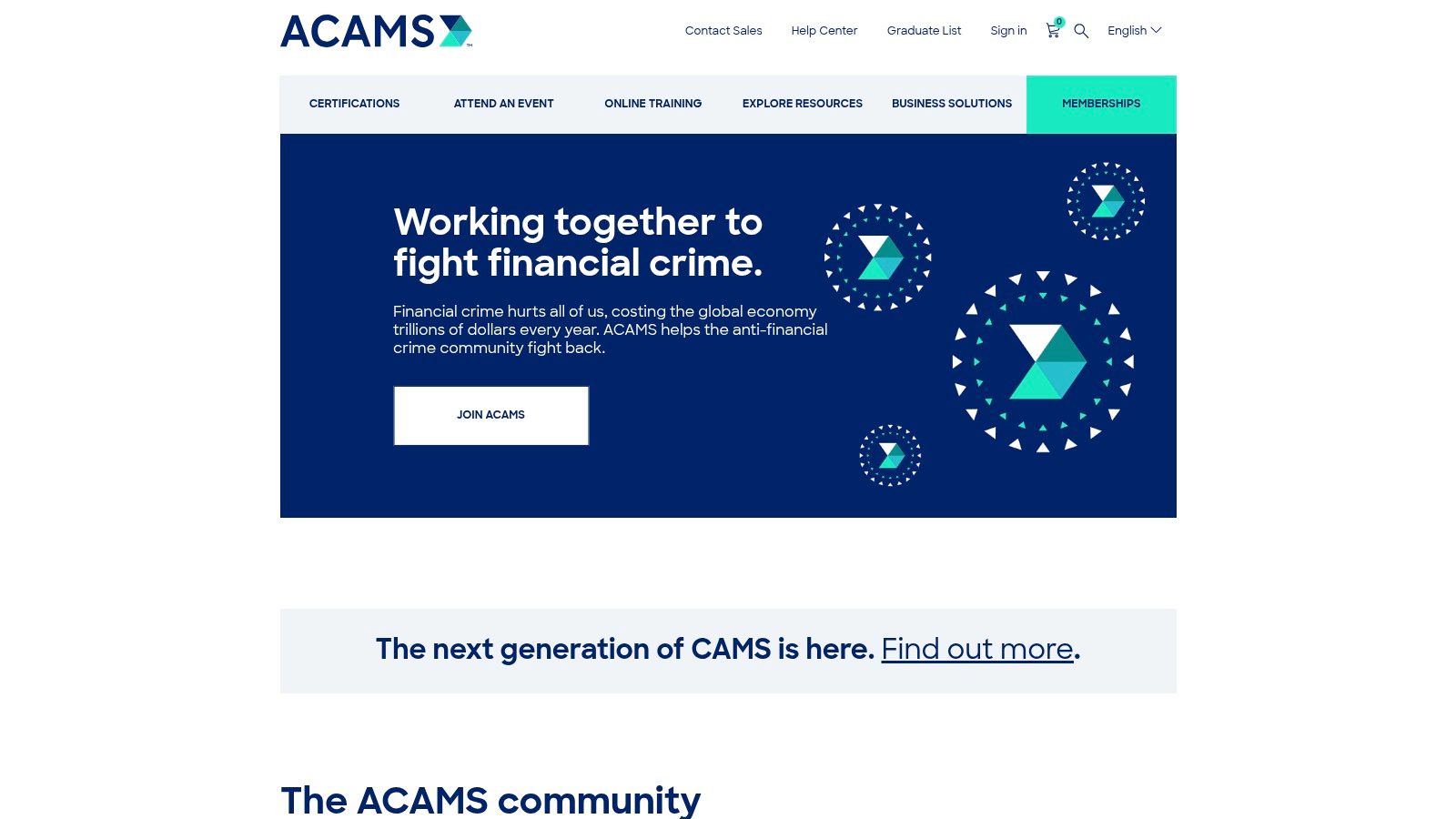
For institutions seeking to establish a gold standard in their compliance departments, ACAMS is the definitive resource. It offers the globally recognized Certified Anti-Money Laundering Specialist (CAMS) credential, which has become the benchmark for professional excellence in the field. Beyond certification, ACAMS provides a comprehensive ecosystem for continuous professional development, crucial for keeping teams ahead of evolving regulatory demands. For a financial institution, having CAMS-certified staff signals a serious commitment to robust compliance protocols to regulators and partners alike.
Practical Use and Considerations
The primary use case for ACAMS is formalizing and validating expertise through its rigorous certification programs. This is not a quick overview; it is an in-depth anti money laundering training curriculum designed to create subject matter experts.
- Pros: The CAMS certification is the most respected credential in the industry, and membership provides unparalleled networking opportunities and access to timely webinars and conferences.
- Cons: The investment is significant. Certification packages and annual membership fees can be substantial, making it a strategic decision rather than a broad-based training solution.
Effectively integrating this training means using your CAMS-certified professionals to elevate your internal standards and mentor junior staff. This expertise is critical for translating complex regulations into actionable steps, as outlined in an effective AML compliance checklist.
Website: https://www.acams.org/
3. Financial Crime Academy (FCA)
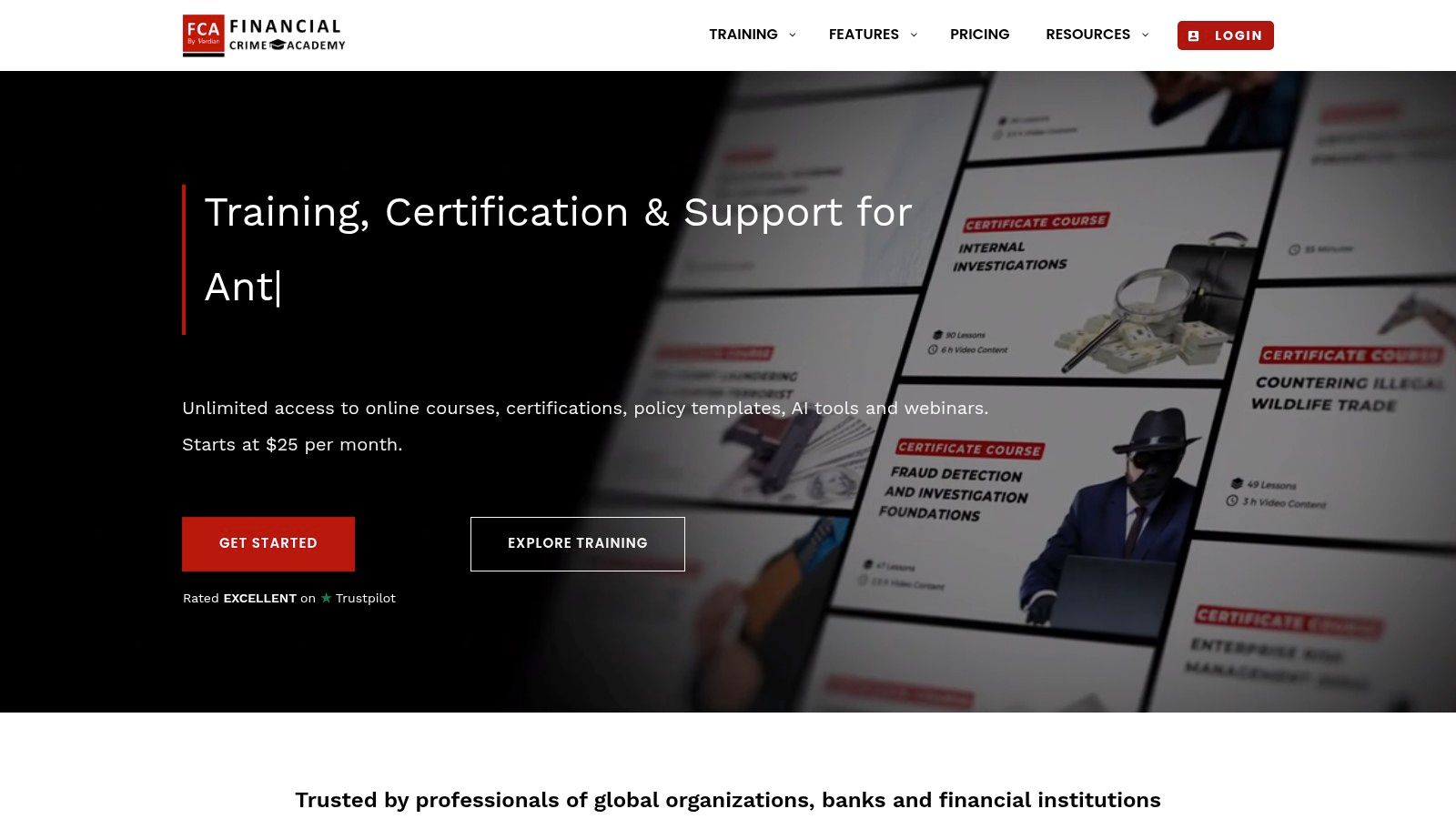
For financial institutions looking to provide scalable and continuous anti-financial crime education, the Financial Crime Academy (FCA) offers a compelling solution. It stands out with its flexible, on-demand subscription model, granting teams unlimited access to a vast library of courses covering anti-money laundering, compliance, and risk management. This approach allows banks to deploy targeted training across different departments and seniority levels without the per-seat cost constraints of traditional certification bodies, making it a highly cost-effective choice for enterprise-wide knowledge enhancement.
Practical Use and Considerations
The FCA is ideal for ongoing professional development and for building foundational knowledge across the organization. Its extensive course library serves as a practical resource for everything from introductory concepts for new hires to specialized topics for seasoned analysts. The platform’s strength lies in providing a comprehensive anti money laundering training curriculum that can be accessed anytime.
- Pros: The affordable subscription model offers exceptional value, providing access to over 100 courses and industry-recognized certifications. Its self-paced format is perfect for busy professionals.
- Cons: The model has limited live interaction with instructors, which may be a drawback for teams that thrive on direct, real-time engagement and mentorship.
Effectively, the FCA allows an institution to build a baseline of compliance literacy efficiently. This broad-based knowledge empowers staff to better identify red flags, which can then be investigated using sophisticated data tools like Visbanking’s that provide deeper context on transactional patterns and customer risk profiles.
Website: https://financialcrimeacademy.org/
4. Traliant
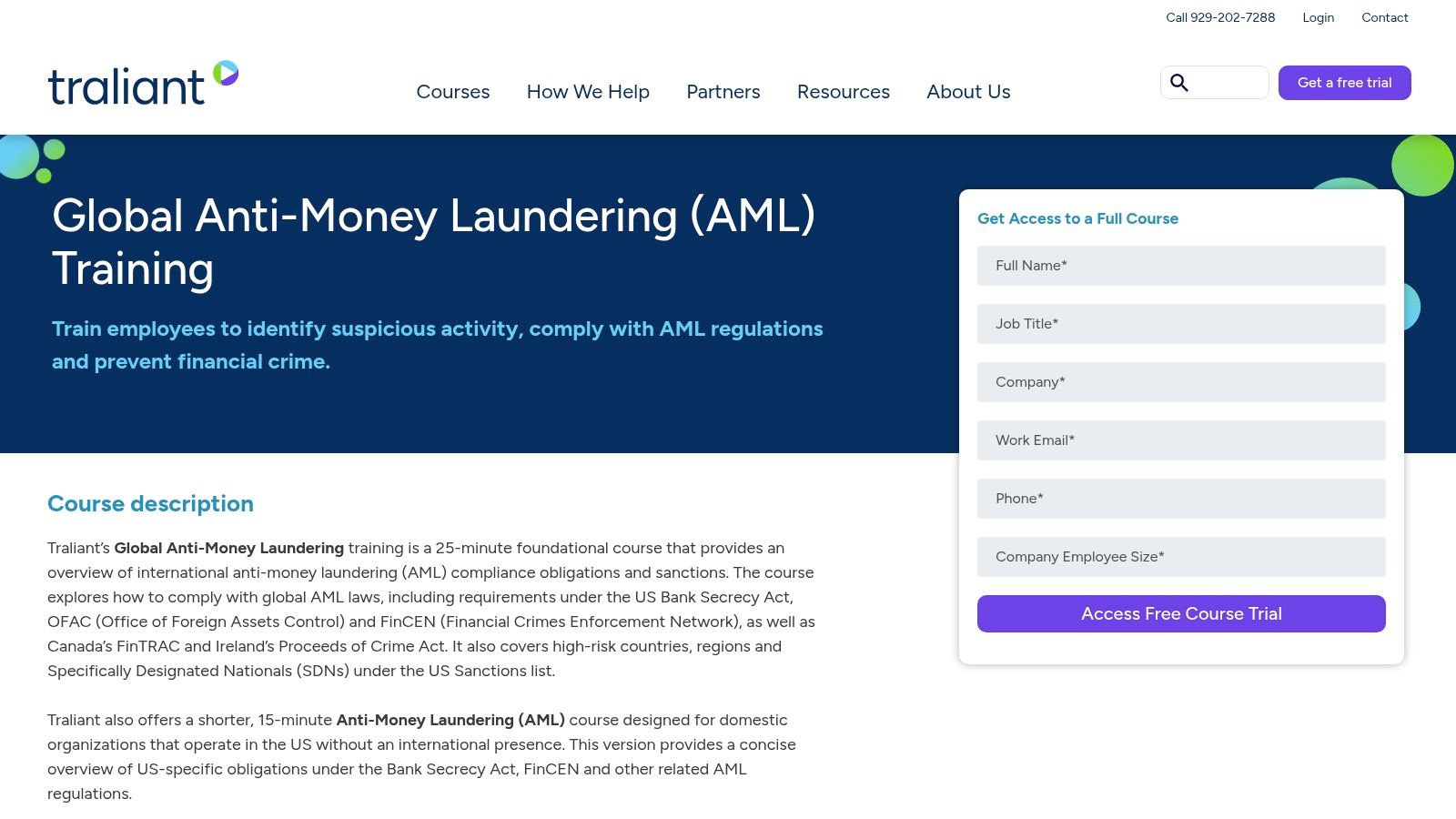
For organizations prioritizing broad employee engagement and comprehension, Traliant offers a modern, interactive approach to compliance education. It moves beyond static presentations, using scenario-based learning to immerse employees in realistic situations where they must identify suspicious activities. This method is particularly effective for training front-line staff who are the first line of defense but may not be compliance experts. The platform's mobile-first design and multilingual options ensure accessibility and relevance across diverse, global teams, making it a scalable solution for enterprise-wide awareness.
Practical Use and Considerations
Traliant’s primary value is in delivering foundational anti money laundering training that is both engaging and easily digestible for all employees, regardless of their role. Its focus on practical, real-world scenarios helps translate abstract regulatory requirements into concrete actions employees can take.
- Pros: The content is regularly updated to reflect new regulations, and courses are customizable to incorporate an institution's specific policies and branding. Its engaging format improves knowledge retention.
- Cons: Pricing is not publicly listed and requires a direct inquiry. This model may be less suited for professionals seeking advanced certification compared to specialized bodies.
Effectively, Traliant serves as a powerful tool for building a baseline of AML awareness across the entire organization. This widespread understanding is crucial for fostering a strong compliance culture from the ground up.
Website: https://www.traliant.com/courses/anti-money-laundering-training/
5. Quest CE
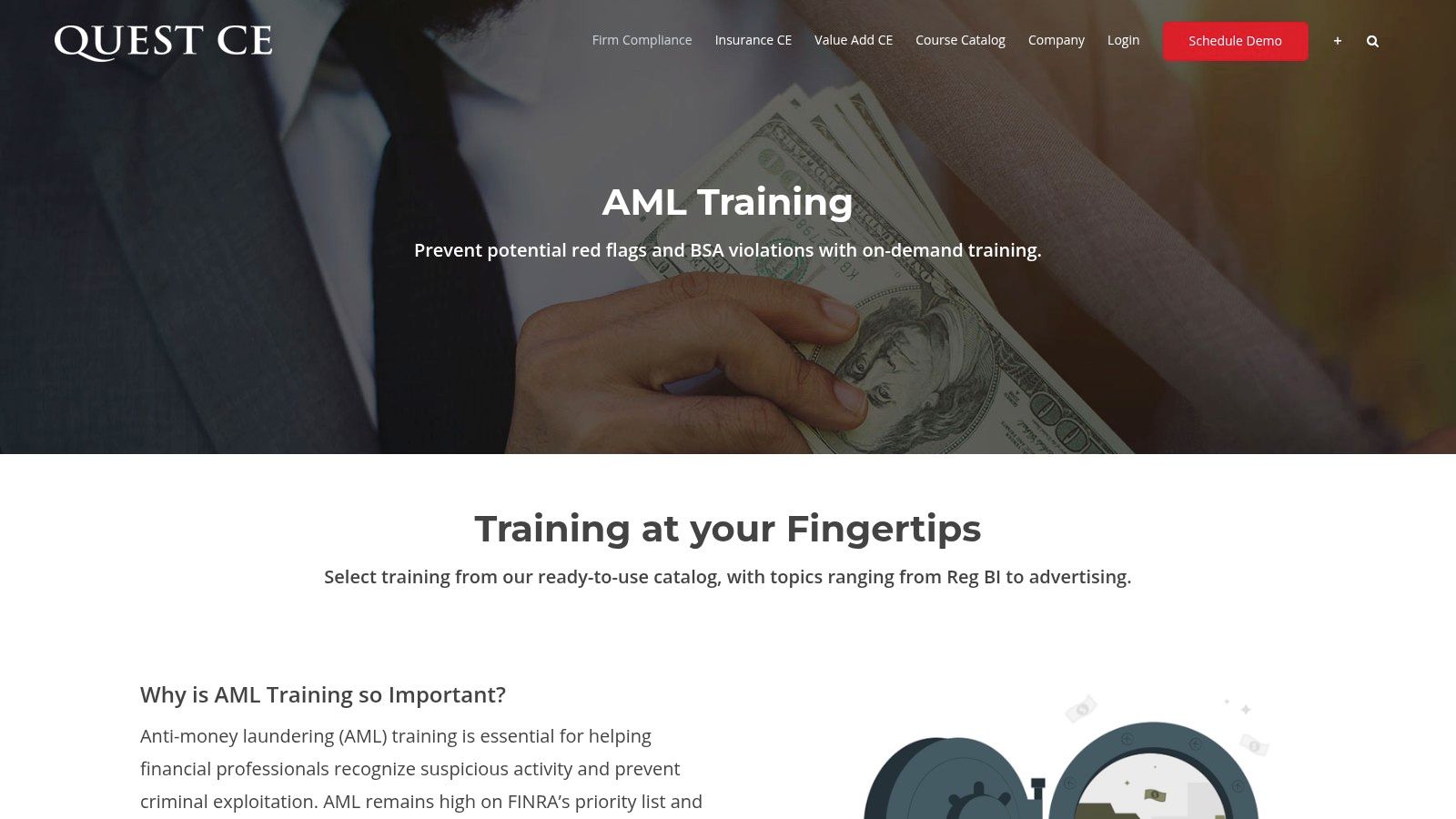
For organizations requiring efficient and scalable annual compliance training, Quest CE provides a streamlined solution. It focuses on on-demand e-learning modules designed for broad deployment, particularly for satisfying yearly requirements like Bank Secrecy Act (BSA) training. The platform excels at delivering foundational knowledge and identifying red flags, making it a practical choice for ensuring all staff members, not just specialized compliance officers, have a baseline understanding of their AML obligations. This approach is ideal for establishing a consistent, firm-wide awareness of critical compliance duties.
Practical Use and Considerations
The primary use case for Quest CE is fulfilling mandatory annual anti money laundering training requirements across an entire organization in a cost-effective manner. Its user-friendly interface and dynamic reporting dashboard simplify administration and tracking for compliance managers, while many courses qualify for state-level continuing education (CE) credits.
- Pros: The platform is known for its affordability and ease of use, making it accessible for institutions of all sizes. The ability to track course completion and generate compliance reports is a significant administrative benefit.
- Cons: The course catalog is less extensive than specialized providers like ACAMS, focusing more on general compliance rather than deep-dive certifications for advanced roles.
Effectively, Quest CE ensures your entire team meets its annual training mandate. While it builds a necessary foundation, executives should complement this with advanced data tools to turn that general awareness into actionable intelligence, proactively identifying and mitigating specific money laundering risks.
Website: https://www.questce.com/aml-training/
6. EasyLlama
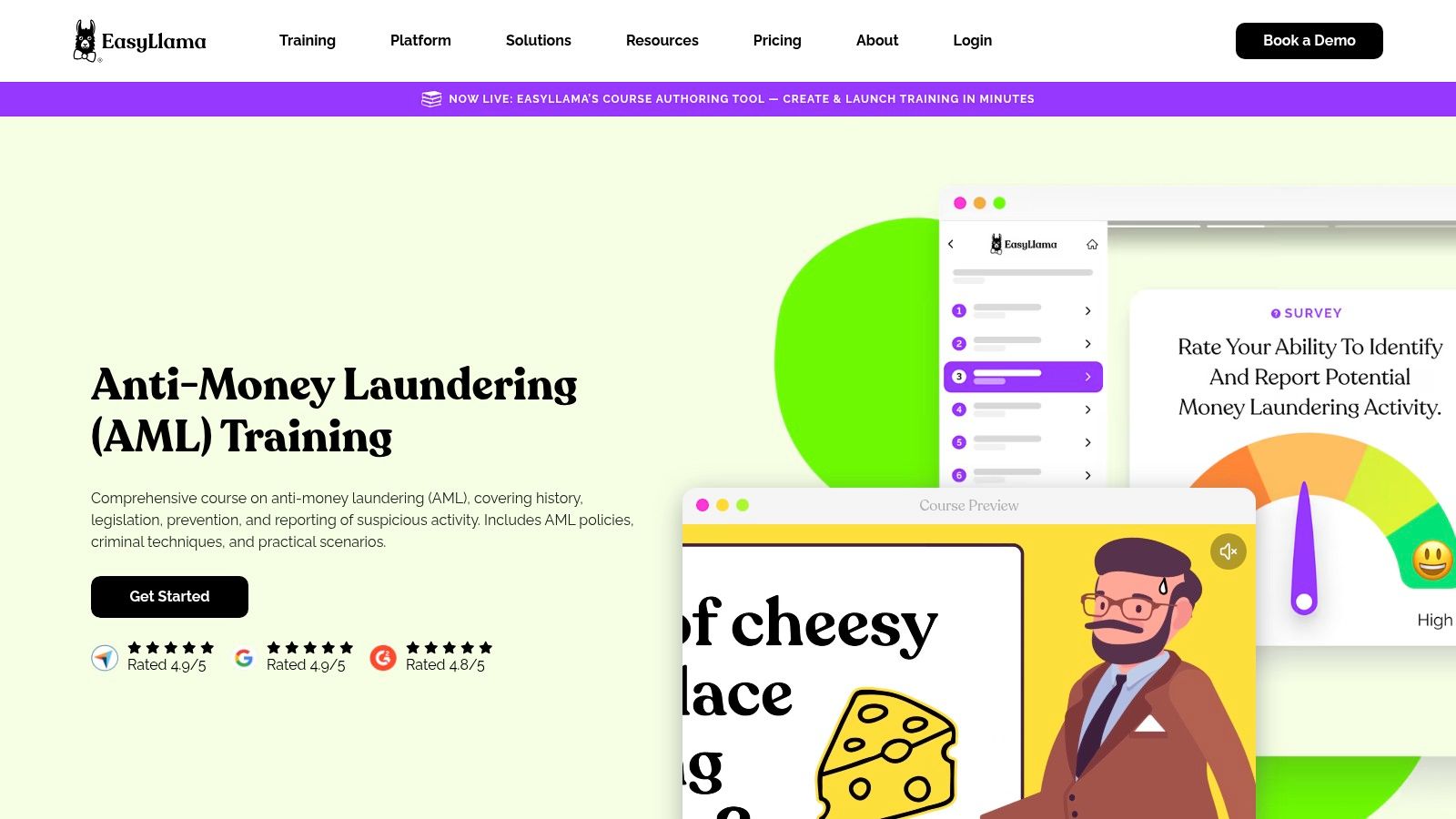
For organizations needing scalable, accessible, and efficient compliance training across a diverse workforce, EasyLlama offers a streamlined solution. Its platform specializes in delivering concise, engaging courses that cover the essentials of AML without requiring a significant time commitment from employees. This approach is ideal for ensuring baseline knowledge across all departments, not just specialized compliance teams. The platform's multilingual support and mobile-first design make it a practical choice for global institutions aiming for consistent, organization-wide training delivery.
Practical Use and Considerations
EasyLlama’s primary use case is for annual, mandatory compliance training that needs to be deployed quickly and tracked efficiently. This is an effective anti money laundering training solution for satisfying broad regulatory requirements and ensuring every employee understands their role in preventing financial crime, regardless of their native language.
- Pros: The speed of deployment and completion is a major advantage. Courses are interactive, available in over 100 languages, and certificates are issued instantly.
- Cons: The training is foundational and may lack the depth required for senior compliance officers or financial crime investigators who need advanced, specialized knowledge.
This platform excels at establishing a fundamental layer of awareness. While it meets broad training mandates, executives must ensure their specialized teams receive more advanced instruction to manage complex risks. Data intelligence from a platform like Visbanking on emerging threats should supplement this foundational knowledge, enabling your team to apply their training to real-world scenarios.
Website: https://www.easyllama.com/courses/anti-money-laundering
7. VinciWorks
For organizations that require tailored and practical training across diverse international teams, VinciWorks offers a compelling solution. The platform specializes in creating industry-specific courses that move beyond theoretical knowledge, immersing employees in realistic scenarios and case studies. Their strength lies in adaptability, providing customizable content and multi-language support, ensuring that a consistent compliance message is effectively delivered across a global workforce. This approach helps translate high-level policy into understandable, actionable behaviors for every employee.
Practical Use and Considerations
VinciWorks is best utilized for deploying engaging, role-specific anti money laundering training at scale, particularly within multinational corporations. The ability to customize content ensures that training directly addresses the specific risks and regulatory nuances relevant to your institution and its various jurisdictions.
- Pros: The focus on interactive, scenario-based learning and industry specialization makes the training more memorable and effective. Multi-language support and regularly updated materials are significant operational advantages.
- Cons: Pricing is not transparent and requires direct inquiry, which can complicate preliminary budget planning for compliance executives.
Integrating VinciWorks effectively means leveraging its customization features to align training scenarios with your bank's actual risk assessments and recent audit findings. For example, if data intelligence reveals a 30% increase in trade-based money laundering attempts in a specific region, VinciWorks can be used to deploy targeted training modules to that region's trade finance team within weeks.
Website: https://vinciworks.com/courses/aml/
8. International Compliance Association (ICA)
For financial institutions operating on a global scale, the International Compliance Association (ICA) offers qualifications that carry international weight and recognition. Similar to ACAMS, ICA provides a structured pathway for professional development in financial crime prevention, but with a distinct emphasis on flexible, online learning formats. This makes it a powerful option for multinational banks seeking to standardize compliance expertise across geographically dispersed teams without the logistical challenges of in-person training. Having ICA-certified staff demonstrates a commitment to a globally consistent standard of anti money laundering training.
Practical Use and Considerations
ICA is best utilized for building a deep bench of qualified compliance professionals through its comprehensive certification programs. The flexible online delivery is ideal for organizations that need to train staff across different time zones while ensuring a consistent and high-quality educational experience.
- Pros: The qualifications are globally recognized, and the extensive online resources and member network provide continuous support and valuable industry connections.
- Cons: The investment for ICA certifications is significant, positioning it as a premium choice for formal qualifications rather than a solution for general staff awareness training.
Integrating ICA-trained professionals means leveraging their advanced knowledge to enhance your institution's compliance framework. Their expertise helps bridge the gap between complex international regulations and the practical, day-to-day operational controls necessary for effective risk management.
Website: https://www.int-comp.org/
9. International Banker’s Association (IBA)
For banking institutions that require training grounded in current, real-world financial regulations, the International Banker’s Association (IBA) is an essential resource. It provides specialized anti money laundering training courses designed specifically for the banking sector's unique challenges. The IBA’s strength lies in its practical focus, ensuring that compliance teams are not just learning theory but are equipped to handle the latest regulatory shifts and operational demands. This makes it an ideal partner for banks looking to provide continuous, relevant education to their staff without the extensive commitment required by formal certification bodies.
Practical Use and Considerations
The IBA is best utilized for ongoing professional development and for onboarding new members of a banking compliance team. Its flexible learning schedules and access to expert instructors allow institutions to integrate training seamlessly into their operational workflow, minimizing disruption while maximizing knowledge retention.
- Pros: The curriculum is highly tailored to banking professionals, providing immediately applicable insights. Its content remains current with fast-changing AML regulations.
- Cons: The course selection is narrow, with limited applicability for professionals operating outside of the traditional banking industry.
Effectively, the IBA serves as a crucial tool for keeping your team’s practical skills sharp. It ensures that the day-to-day application of your AML program aligns perfectly with regulatory expectations, bridging the gap between high-level policy and front-line execution.
Website: https://www.ibabanks.org/
10. American Bankers Association (ABA)
For banking institutions looking for industry-specific compliance education, the American Bankers Association (ABA) provides meticulously tailored training solutions. Its offerings are designed by bankers, for bankers, ensuring the content directly addresses the unique challenges and regulatory pressures faced by U.S. financial institutions. The ABA's programs go beyond theoretical knowledge, grounding complex AML concepts in the practical realities of daily banking operations. This focus makes it an indispensable resource for organizations aiming to build a compliance culture that is both effective and operationally sound.
Practical Use and Considerations
The ABA is best utilized for foundational and specialized anti money laundering training across all levels of a banking organization, from tellers to the board of directors. Its flexible online options allow for scalable deployment, while its certifications, like the Certified AML and Fraud Professional (CAFP), offer a clear career path for compliance staff.
- Pros: The content is highly relevant to the U.S. banking sector, and its certifications are well-recognized within the industry. Members gain access to extensive support and a vast library of resources.
- Cons: The investment for certifications and comprehensive courses can be higher than more generalized online providers, reflecting its specialized, industry-centric value.
Effectively using the ABA involves integrating its curriculum into your bank’s broader professional development framework. The knowledge gained helps teams not only meet regulatory requirements but also understand the "why" behind them, fostering a more proactive and risk-aware workforce.
Website: https://www.aba.com/
11. International Compliance Training (ICT)
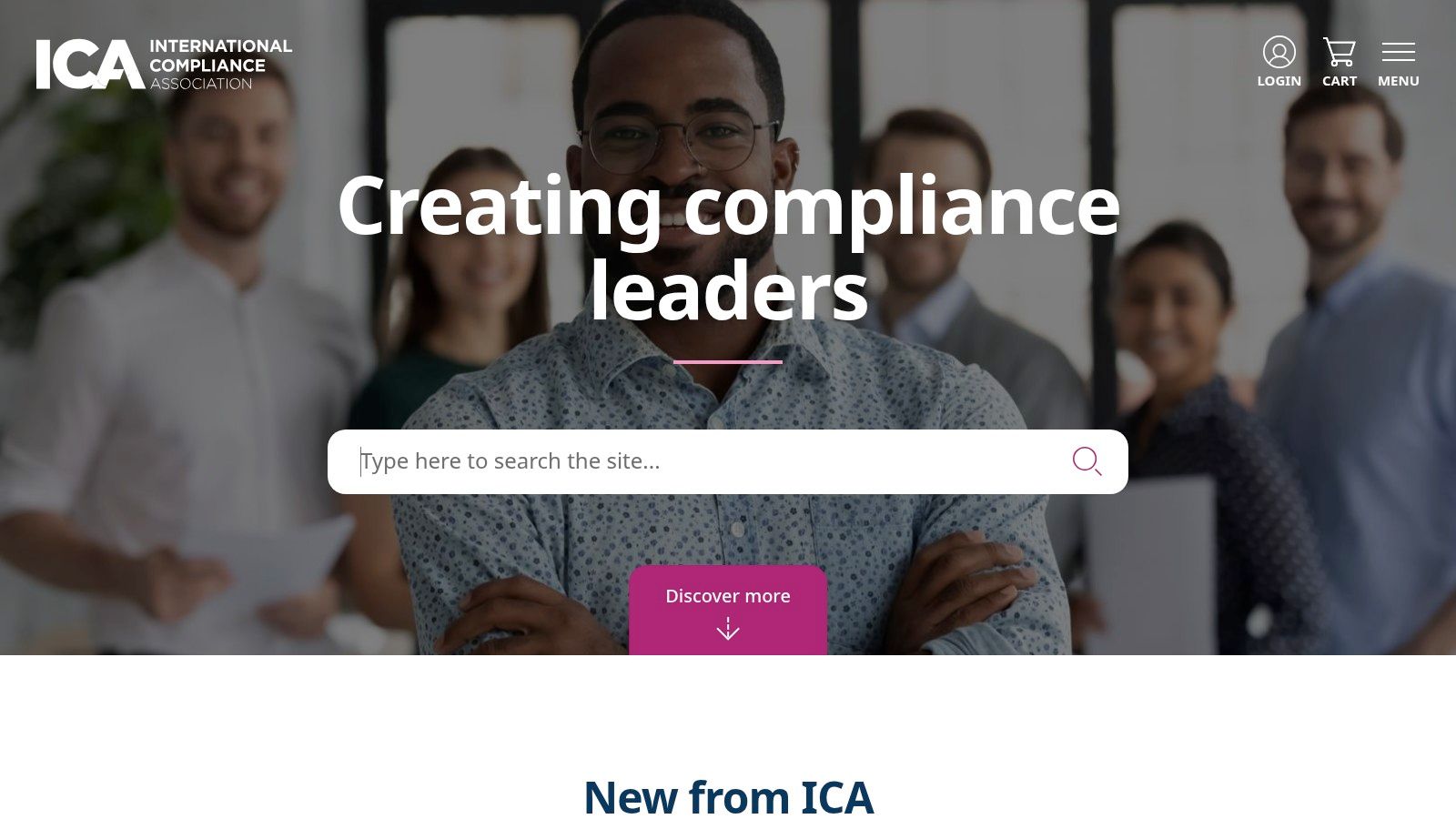
International Compliance Training (ICT), working in partnership with the International Compliance Association (ICA), offers another prestigious pathway for formal qualifications. For banking executives aiming to build a global standard of expertise within their teams, ICT provides structured courses that are recognized worldwide. Their offerings are particularly well-suited for organizations that need flexible, yet academically rigorous, training solutions to accommodate professionals at various career stages and locations. This approach ensures that your institution's compliance knowledge base remains current and aligned with international best practices.
Practical Use and Considerations
The primary use for ICT is to upskill compliance personnel through globally acknowledged qualifications, from introductory certificates to advanced diplomas. This structured anti money laundering training is ideal for creating a clear development ladder within a compliance department, fostering long-term expertise and retention.
- Pros: The partnership with ICA lends significant weight to their qualifications. The courses are known for their comprehensive materials, expert tutor support, and flexible online delivery.
- Cons: These formal qualifications represent a notable financial and time commitment, often costing more than other online training providers.
Effectively using ICT means strategically enrolling key staff in programs that match your institution’s risk profile and strategic goals. The knowledge gained helps ensure your internal controls are not just compliant, but are also intelligently designed and defensible under regulatory scrutiny.
Website: https://www.int-comp.com/
12. International Financial Management Association (IFMA)
The International Financial Management Association (IFMA) offers a specialized approach to AML education, embedding it within the broader context of financial management. This integration is ideal for financial professionals who need to understand how AML compliance intersects with their core responsibilities, from treasury management to investment analysis. IFMA's courses are designed to provide practical, role-specific knowledge, ensuring that professionals can apply what they learn directly to their daily workflows and decision-making processes.

Practical Use and Considerations
IFMA is best suited for upskilling finance teams who require more than just procedural AML knowledge. Its curriculum provides a strong anti money laundering training foundation that connects compliance obligations to financial strategy and risk management. This is particularly valuable for staff whose decisions have direct financial implications for the institution.
- Pros: The content is meticulously tailored for financial roles, and the flexible schedules accommodate busy professionals. Access to expert instructors ensures high-quality, relevant instruction.
- Cons: The platform's focus is narrow, with limited course offerings outside the financial management sphere, making it less suitable for general compliance staff.
Effectively using IFMA's training means equipping finance teams to identify risks embedded in complex transactions. This skill is vital when evaluating new business relationships, an area where a robust third-party risk assessment is non-negotiable.
Website: https://www.ifma.org/
Anti-Money Laundering Training Providers Comparison
| Product / Provider | Core Features / Highlights | User Experience / Quality ★ | Value Proposition 💰 | Target Audience 👥 | Unique Selling Points ✨ |
|---|---|---|---|---|---|
| Effective Bank Compliance Training (Visbanking) | Real-time BIAS platform integration, AML checklist | ★★★★☆ Enhanced contextual learning | 💰 Value-driven with actionable tools | 👥 Bank employees & compliance teams | 🏆 Proactive compliance culture, data-driven training |
| ACAMS | CAMS certification, AML expert network | ★★★★★ Internationally recognized | 💰 Higher fees, premium certification | 👥 AML professionals worldwide | 🏆 Globally recognized certification, expert network |
| Financial Crime Academy (FCA) | 100+ on-demand AML courses, flexible subscription | ★★★★☆ Affordable, comprehensive | 💰 Cost-effective subscription | 👥 AML learners at all levels | ✨ Unlimited course access, flexible self-paced learning |
| Traliant | Scenario-based, multilingual, mobile-friendly | ★★★★☆ Engaging and customizable | 💰 Pricing not publicly disclosed | 👥 Corporate AML trainees | ✨ Scenario learning, multi-language support |
| Quest CE | Interactive modules, CE credits, dynamic reporting | ★★★★☆ User-friendly, state CE credits | 💰 Affordable course options | 👥 AML professionals needing CE credits | ✨ Dynamic reporting, recognized CE credits |
| EasyLlama | 30-min courses, 100+ languages, instant certification | ★★★☆☆ Quick, interactive content | 💰 Budget-friendly quick training | 👥 Global AML learners | ✨ Instant certs, concise multi-language courses |
| VinciWorks | Multi-language, customizable content, updated materials | ★★★★☆ Industry-tailored & interactive | 💰 Pricing info not available | 👥 Diverse industries needing AML | ✨ Industry-specific, customizable courses |
| ICA (International Compliance Association) | Certification programs, global network, flexible learning | ★★★★★ Internationally recognized | 💰 Higher cost, advanced support | 👥 Compliance professionals worldwide | 🏆 Global qualifications, extensive professional network |
| IBA (International Banker’s Association) | AML banking-focused modules, expert instructors | ★★★★☆ Tailored for banking | 💰 Not specified | 👥 Banking professionals | ✨ Expert-led, banking sector specific |
| ABA (American Bankers Association) | AML certifications, expert resources, flexible options | ★★★★★ Recognized banking certifications | 💰 Higher cost, premium support | 👥 US banking professionals | 🏆 Industry-recognized certifications |
| ICT (International Compliance Training) | Globally recognized, flexible online, expert support | ★★★★☆ Comprehensive and flexible | 💰 Higher cost | 👥 Compliance professionals worldwide | ✨ Partnership with ICA, expert-backed qualifications |
| IFMA (International Financial Management Association) | Industry-specific AML training, expert-led, flexible | ★★★★☆ Tailored, up-to-date content | 💰 Not specified | 👥 Financial professionals | ✨ Financial sector focus, expert instruction |
From Training Investment to Strategic Advantage: Activating Your Compliance Intelligence
Navigating the landscape of anti-money laundering training programs, from industry-wide certifications like ACAMS and ICA to specialized platforms like Traliant and VinciWorks, reveals a clear truth: selecting the right tool is a critical first step, but it is not the final destination. The true measure of a successful training initiative extends far beyond completion rates. It is measured in the tangible strengthening of your bank's defensive posture and the enhancement of its operational intelligence.
A premier anti mon
Latest Articles
Brian's Banking Blog
Predictive Risk Management for Banks
Brian's Banking Blog
Business Registration Data Banks Can Actually Use
Brian's Banking Blog
How to Secure REST API with JWT for Banking
Brian's Banking Blog
Commercial Loan Analysis: A Bank Executive's Guide
Brian's Banking Blog
Understanding Statistical Significance in Banking
Brian's Banking Blog